
وحدة كاميرا حرارية 640x512 متوافقة مع Arduino عبر UART: دليل التكامل عالي الدقة
23 يوليو 2026
وحدة كاميرا تصوير حراري بالأشعة تحت الحمراء غير مبردة MIPI 640 384 256 9mm للطائرات بدون طيار: دليل التخصيص الشامل
27 يوليو 2026
وحدة مصفوفة كاميرا تصوير حراري AMG8833 مع طاقة USB: هل هي جاهزة لقياس درجة الحرارة بالأشعة تحت الحمراء الصناعية؟
انظروا، إن انفجار أجهزة الاستشعار بالأشعة تحت الحمراء الرخيصة خلال السنوات القليلة الماضية قد غيّر بالكامل كيفية نظر مهندسي الأجهزة، ومكاملي الأنظمة، وخبراء البصريات إلى القياس الحراري. من بين هذه الخيارات الاقتصادية، فإن وحدة مصفوفة كاميرا تصوير حراري amg8833 مع طاقة usb لقياس درجة الحرارة بالأشعة تحت الحمراء أصبحت عنصرًا أساسيًا على أسطح طاولات العمل، والنماذج الأولية السريعة، ومختبرات الروبوتات، وبنيات استشعار الوجود الأساسية. بُنيت هذه المصفوفة الصغيرة $8 \times 8$ حول تقنية Grid-Eye MEMS الحرارية من باناسونيك، وتمنحك بصمة حرارية بدقة 64 بكسل. تقوم معظم لوحات الوحدات بإقرانها بمتحكم دقيق رخيص وجسر USB بحيث يمكنك تفريغ مصفوفات الإطار الحراري الخام مباشرة إلى جهاز كمبيوتر، أو راسبيري باي، أو صندوق لينكس طرفي. ولكن ها هي المسألة: عندما تنتقل من المختبر إلى الأتمتة الصناعية، أو حمولات الطائرات بدون طيار، أو تشخيصات لوحات الدوائر التفصيلية، تتغير متطلباتك بسرعة. تصبح الحساسية الحرارية الأعلى، والتفاصيل المكانية دون المليمترية، والمعايرة الإشعاعية الدقيقة للغاية أمورًا غير قابلة للتفاوض. يجب على مهندسي الأنظمة طرح سؤال صعب: هل يمكن لمصفوفة حرارية 8 في 8 أن تفي بالغرض حقًا في أرضية المصنع، أم أنك بحاجة إلى نواة ميكروبولومتر كاملة غير مبردة تعمل بالأشعة تحت الحمراء ذات الموجة الطويلة (LWIR)؟
في العالم الصناعي، تحدد الدقة المكانية، ومجال الرؤية البصري (FOV)، ونسبة المسافة إلى البقعة ($D:S$)، وأرضية الضوضاء الحرارية (فرق درجة الحرارة المكافئ للضوضاء، أو NETD) ما إذا كنت ستكتشف مكونًا يسخن أكثر من اللازم أم ستفوت عطلًا خطيرًا بالكامل. بالتأكيد، فإن وحدة مصفوفة كاميرا تصوير حراري amg8833 مع طاقة usb لقياس درجة الحرارة بالأشعة تحت الحمراء توفر تشغيلًا بسيطًا بالتوصيل والتشغيل لفحوصات النقاط الساخنة التقريبية على مدى قريب. لكن حدها المادي البالغ 64 بكسل فقط يسبب أخطاء هائلة في المتوسط الحراري في اللحظة التي تتراجع فيها أكثر من بضع بوصات. يفكك هذا الدليل البنية المادية لـ AMG8833، وينظر في مشكلات الديناميكا الحرارية الواقعية لتشغيل المستشعرات عبر طاقة USB، ويتجاوز الضجيج التسويقي حول الاستيفاء البرمجي، ويوجهك نحو نوى حرارية عالية الدقة مصممة لتطبيقات B2B الجادة.
جدول المحتويات
- 👉 البنية التقنية لوحدة المصفوفة الحرارية AMG8833
- 👉 طاقة USB وديناميكيات الواجهة في القياس الإشعاعي بالأشعة تحت الحمراء
- 👉 الاستيفاء الرياضي مقابل دقة الميكروبولومتر البصري الحقيقي
- 👉 المعيار الصناعي: المصفوفات الحرارية 8x8 مقابل نوى VOx LWIR الاحترافية
- 👉 مواصفات النوى الصناعية عالية الدقة ومعايير المنتجات
- 👉 إرشادات تكامل الأنظمة: الطائرات بدون طيار، والذكاء الاصطناعي الطرفي، وأتمتة المصنّعين الأصليين
- 👉 الأسئلة الشائعة (FAQ)
البنية التقنية لوحدة المصفوفة الحرارية AMG8833
تحت الغطاء، تعتمد أي وحدة مصفوفة كاميرا تصوير حراري amg8833 مع طاقة usb لقياس درجة الحرارة بالأشعة تحت الحمراء على مصفوفة حرارية 8x8 محفورة على شريحة نظام كهروميكانيكي صغري (MEMS). تحتاج الكواشف الضوئية الكمومية إلى تبريد مبرد، وتتطلب مصفوفات المستوى البؤري (FPAs) للميكروبولومتر معايرة معقدة واسعة الطيف. تسلك المصفوفات الحرارية طريقًا أبسط: فهي تمتص الإشعاع الحراري الوارد في نطاق 5 إلى 13 ميكرومتر وتحول تلك الطاقة الحرارية مباشرة إلى جهد كهربائي ضئيل باستخدام وصلات كهروحرارية متصلة على التوالي عبر تأثير سيبيك.
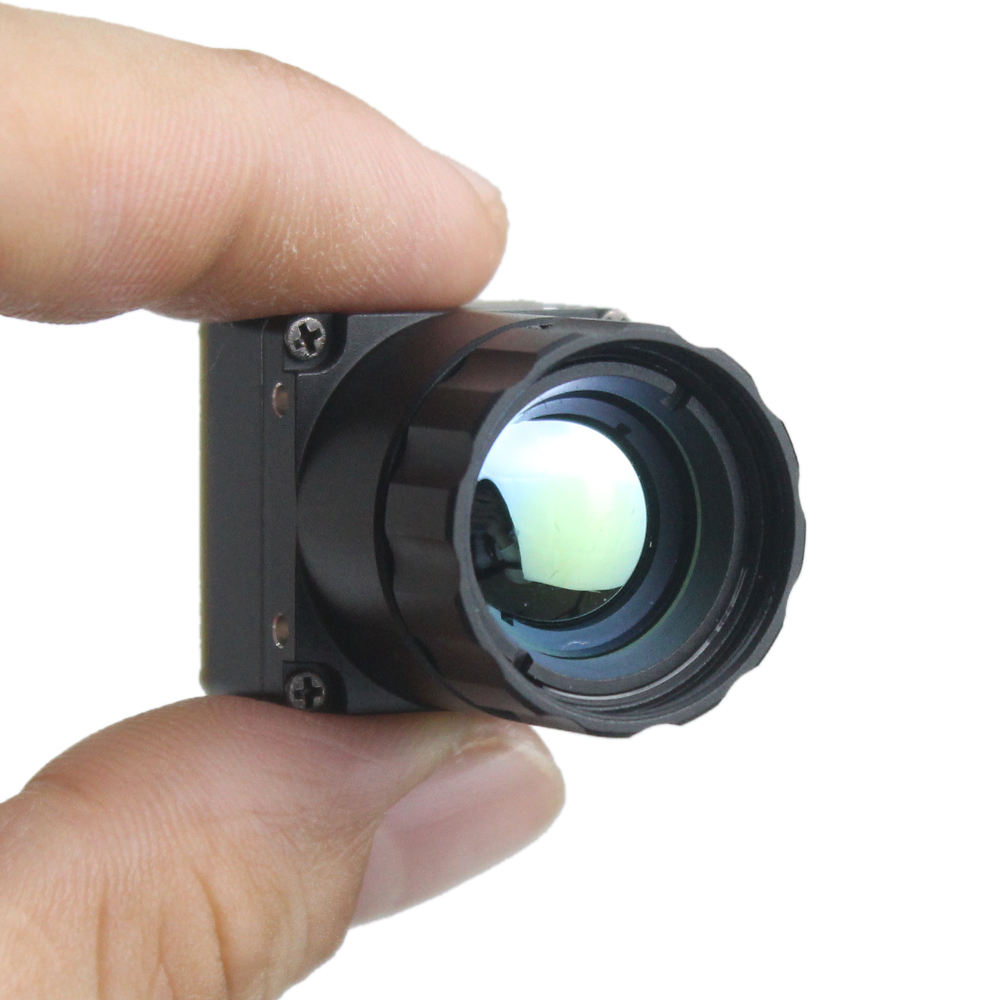
يتكون الهيكل المادي لمستشعر AMG8833 Grid-Eye من 64 عنصرًا حراريًا متميزًا مرتبة في تخطيط متماثل مكون من 8 صفوف في 8 أعمدة. تقوم عدسة سيليكون صغيرة مثبتة مباشرة على الحزمة بتركيز ضوء الأشعة تحت الحمراء الوارد على القالب، مما يمنح الحزمة مجال رؤية إجمالي يبلغ $60^\circ$ أفقيًا في $60^\circ$ عموديًا. نظرًا لأن مجال الرؤية البالغ $60^\circ$ مقسم على 8 عناصر فقط لكل محور، فإن كل بكسل فردي يرى زاوية فرعية بصرية تبلغ تقريبًا $7.5^\circ \times 7.5^\circ$. هذه بصمة بصرية ضخمة لبكسل واحد ليغطيها.
المعلمات الكهروضوئية الرئيسية
- 📌 مصفوفة البكسل وحجم المصفوفة: 64 بكسل كاشف نشط مرتبة في شبكة أصلية بحجم $8 \times 8$.
- 📌 مجال الرؤية البصري: $60^\circ \times 60^\circ$ إجمالاً، مما ينتج بصمة مكانية واسعة تبلغ $7.5^\circ$ لكل بكسل.
- 📌 فرق درجة الحرارة المكافئ للضوضاء (NETD): مقدرة بحوالي $\pm 0.05^\circ\text{C}$ ($0.09^\circ\text{F}$) عند معدل إطار بطيء يبلغ $1\text{ Hz}$، وتتدهور إلى حوالي $\pm 0.16^\circ\text{C}$ ($0.29^\circ\text{F}$) عند دفعها إلى أقصى معدل تحديث لها وهو $10\text{ Hz}$.
- 📌 دقة درجة الحرارة المطلقة: مقدرة بـ $\pm 2.5^\circ\text{C}$ ($\pm 4.5^\circ\text{F}$) في وضع الكسب العالي تحت ظروف درجة حرارة الغرفة المستقرة ($25^\circ\text{C}$).
- 📌 اتصال الناقل وبروتوكولات البيانات: يستخدم واجهة $I^2C$ أصلية في الوضع السريع ($400\text{ kHz}$) محولة إلى USB CDC (منفذ COM افتراضي) أو USB HID من خلال متحكمات مضيفة مثل STM32 أو ATmega32U4 أو RP2040.
في فيزياء الحرارة الأساسية غير التلامسية، كما هو مفصل في ويكيبيديا التصوير الحراري المصادر، تتبع الطاقة المشعة من جسم ما قانون ستيفان-بولتزمان:
E = ε · σ · T⁴
حيث E هي الانبعاثية الإشعاعية،, ε هي الانبعاثية السطحية،, σ هو ثابت ستيفان-بولتزمان ($5.670374 \times 10^{-8}\,\text{W/m}^2\text{K}^4$)، و T هي درجة الحرارة المطلقة بالكلفن. نظرًا لأن AMG8833 يوزع مجال رؤية $60^\circ$ عبر 8 بكسل أفقي فقط، فإن كل بكسل يجمع فوتونات الأشعة تحت الحمراء على منطقة هدف ضخمة. إذا وضعت الهدف على بعد متر واحد ($100\text{ cm}$)، فإن البكسل الواحد يغطي مساحة مربعة تبلغ حوالي $13.1\text{ cm} \times 13.1\text{ cm}$—أي مساحة $171.6\text{ cm}^2$.
في الورشة، إذا ارتفعت حرارة مكون دقيق على لوحة دائرة (مثل مقاوم SMD بحجم 0805) إلى $120^\circ\text{C}$ ($393.15\text{ K}$) لكنه يشغل فقط $0.04\text{ cm}^2$ داخل مجال البكسل البالغ $171.6\text{ cm}^2$، يقوم AMG8833 بحساب متوسط تلك الحرارة عبر المساحة المتبقية البالغة $171.56\text{ cm}^2$ من خلفية الغرفة الأبرد عند $25^\circ\text{C}$. النتيجة؟ قيمة البكسل بالكاد ترتفع بجزء من الدرجة. لا يرى نظامك أي خطأ، بينما يحترق المكون.
طاقة USB وديناميكيات الواجهة في القياس الإشعاعي بالأشعة تحت الحمراء
تشغيل وحدة AMG8833 عبر USB يجعل الحياة سهلة على طاولة العمل. تقوم بتوصيل كابل واحد بجهاز لابتوب أو كمبيوتر شخصي أو كمبيوتر لوحي أحادي، وتحصل على كل من مصدر الطاقة وخرج البيانات التسلسلية. ولكن إذا كنت تهتم بسلامة القياس الإشعاعي، فإن تشغيل مستشعر تناظري حساس مباشرة من طاقة USB القياسية 5 فولت يخلق صداعًا كهربائيًا وحراريًا حقيقيًا.
طاقة USB القياسية التي توفرها وحدات التحكم المضيفة والموزعات الرخيصة مشهورة بالضوضاء. منظمات التبديل، وتقلبات طاقة وحدة المعالجة المركزية، وحلقات الأرض القذرة تُدخل بشكل روتيني جهد تموج وضوضاء عالية التردد تتراوح من $20\text{ mV}$ إلى $150\text{ mV}_\text{p-p}$. يعمل قلب AMG8833 بمنطق $3.3\text{V}$، لذا تستخدم هذه الوحدات منظمات منخفضة الهبوط (LDO) لخفض جهد التغذية. إذا كانت هذه المنظمات منخفضة الهبوط تفتقر إلى نسبة رفض ضوضاء مصدر طاقة (PSRR) عالية عند الترددات الأعلى، فإن ضوضاء خط الطاقة تتسرب مباشرة إلى دوائر مرجع ADC الداخلي للمستشعر.
عند قياس إشارات بمستوى الميكروفولت من وصلات الثرموبيل، تعني الفولتية المرجعية غير المستقرة تشويش البت. بصريًا، يظهر هذا على شكل "تأثير رقعة الشطرنج" عبر مصفوفة 64 بكسل، وانجراف في درجة الحرارة الأساسية بين الإطارات المتتالية، و NETD نشط يبدو أسوأ بكثير مما تعد به ورقة البيانات.
التوصيل الحراري والتسخين الذاتي للمستشعر
إليك مشكلة أخرى غالبًا ما يغفل عنها المهندسون: التوصيل الحراري الموضعي على لوحة الدائرة المطبوعة للوحدة. شرائح جسر USB-to-UART (مثل CP2102، أو FT232RNL، أو CH340) ومنظمات LDO تسحب تيارًا مستمرًا، ملقيةً $50\text{ mW}$ إلى $200\text{ mW}$ من الحرارة الطفيلية مباشرة في نحاس لوحة الدائرة.
يعتمد AMG8833 على ثيرميستور داخلي للتعامل مع تعويض الوصلة الباردة. عندما تتسلل الحرارة الطفيلية من شريحة USB عبر مستوى الأرضي، فإنها تسخن غلاف المستشعر بشكل غير متساوٍ. إذا قرأ الثيرميستور الداخلي $33^\circ\text{C}$ بسبب حرارة اللوحة بينما هواء الغرفة عند $22^\circ\text{C}$، فإن حسابات التعويض الداخلي تطرح إزاحة حرارية كبيرة جدًا. تنخفض قراءات الهدف بشكل مصطنع، مما يفسد دقتك الإشعاعية منذ البداية.
الاستيفاء الرياضي مقابل دقة الميكروبولومتر البصري الحقيقي
لأن شبكات $8 \times 8$ الحرارية الخام تبدو متكتلة وصعبة القراءة، فإن جميع البرامج المضيفة المرفقة تقريبًا مع وحدة مصفوفة كاميرا تصوير حراري amg8833 مع طاقة usb لقياس درجة الحرارة بالأشعة تحت الحمراء تقوم بتشغيل حسابات استيفاء على البيانات الواردة. باستخدام خوارزميات Bilinear، أو Bicubic، أو Thin Plate Spline (TPS)، تقوم التطبيقات المضيفة بتكبير تلك المصفوفة الصغيرة $8 \times 8$ إلى خرائط حرارية ملونة ناعمة بحجم $320 \times 240$ أو $640 \times 480$.
تنعيم البيانات الخام ينتج عروضًا توضيحية جميلة المظهر، لكن دعنا نكن واضحين: الاستيفاء لا يضيف أي معلومات بصرية حقيقية. إنه لا يعزز الدقة المكانية. إنه ببساطة يحسب خطوات تدرج لوني اصطناعية بين نقاط البيانات الحقيقية المتناثرة.
رياضيات الضبابية الحرارية ونقص العينات المكانية
لنأخذ سيناريو واقعيًا حيث يوجد موسفيتا طاقة على بعد $10\text{ mm}$ من بعضهما على لوحة دائرة مطبوعة تخضع لاختبار الحمل:
- ⚠️ أداء مصفوفة AMG8833: على مسافة طاولة عمل قياسية تبلغ $30\text{ cm}$، يغطي البكسل الواحد من AMG8833 مربعًا يبلغ حوالي $3.93\text{ cm} \times 3.93\text{ cm}$. يقع كلا الموسفيتين - والفجوة بينهما - ضمن بصمة خلية بكسل واحدة. يقرأ المستشعر قيمة تدفق حراري مدمجة واحدة. ثم يقوم البرنامج باستيفاء هذه القيمة المدمجة، ناشرًا هالة حرارية ناعمة عبر البكسلات المجاورة. يعرض برنامج التشخيص بقعة ساخنة واحدة، عريضة، وضبابية. لا يستطيع المهندس تحديد أي مكون معطل أو ما إذا كان هناك أثر قصير تحته.
- ✅ أداء نواة VOx 640x512 غير المبردة: A professional LWIR camera module featuring a $12\mu\text{m}$ pixel pitch and a $9\text{mm}$ lens yields 327,680 real optical pixels. At that same $30\text{ cm}$ working distance, each pixel covers an area smaller than $0.4\text{ mm} \times 0.4\text{ mm}$. The camera easily resolves both $10\text{ mm}$ components separately, showing crisp edges, individual junction temperatures, and exact heat spreading across the board traces.
If you are designing custom setups for circuit board inspection, check out our deep-dive on high resolution USB thermal camera module custom OEM cores for PCBA.
المعيار الصناعي: المصفوفات الحرارية 8x8 مقابل نوى VOx LWIR الاحترافية
To help you compare component options for your build, the table below highlights the performance gaps between low-cost AMG8833 USB modules and industrial Vanadium Oxide (VOx) uncooled microbolometer camera cores.
| المعلمة التقنية | AMG8833 USB Module | Standard 256x192 VOx Core | Industrial 640x512 VOx Core |
|---|---|---|---|
| تقنية الكاشف | MEMS Thermopile Array | ميكروبولومتر VOx غير مبرد | ميكروبولومتر VOx غير مبرد |
| Native Pixel Array | 8 x 8 (64 pixels) | 256 x 192 (49,152 pixels) | 640 x 512 (327,680 pixels) |
| Spectral Response | $5 - 13\,\mu\text{m}$ | $8 - 14\,\mu\text{m}$ (LWIR) | $8 - 14\,\mu\text{m}$ (LWIR) |
| تباعد البكسل | Monolithic IC Silicon Element | $12\,\mu\text{m}$ | $12\,\mu\text{m}$ |
| الحساسية الحرارية (NETD) | $< 50\text{ mK}$ @ $1\text{Hz}$ / $160\text{ mK}$ @ $10\text{Hz}$ | $\le 40\text{ mK}$ ($0.04^\circ\text{C}$) | $\le 30\text{ mK} - 40\text{ mK}$ ($0.03^\circ\text{C}$) |
| Frame Rate | $1\text{ Hz} - 10\text{ Hz}$ | $25\text{ Hz} - 50\text{ Hz}$ | $25\text{ Hz} - 60\text{ Hz}$ |
| Effective Optical Range | $< 0.3\text{ meters}$ | $0.5 - 50\text{ meters}$ | $1 - 500+\text{ meters}$ |
| Hardware Data Output | $I^2C$ / USB Virtual COM (CDC) | USB 2.0 / MIPI CSI-2 / DVP / Network | MIPI CSI-2 / USB 2.0 / LVDS / Analog |
| Radiometric Accuracy | $\pm 2.5^\circ\text{C}$ (Close proximity) | $\pm 2^\circ\text{C}$ or $\pm 2\%$ | $\pm 2^\circ\text{C}$ or $\pm 2\%$ |
| Primary Application Scope | Binary presence, educational kits | Handheld thermal tools, Smart HVAC | UAV payloads, Edge AI, Industrial QA |
As the numbers show, thermopiles like the AMG8833 belong in simple detection setups. For serious manufacturing QA, fast automated lines, and airborne imaging, microbolometers deliver the optical density and speed required. If you are developing handheld systems, take a look at our breakdown on كاميرا الهاتف الذكي الحرارية تجلب تصور درجة الحرارة إلى الحياة اليومية. For component-level specs and microfabrication standards, engineers often cross-reference data sheets from component vendors like جي إم شيب.
مواصفات النوى الصناعية عالية الدقة ومعايير المنتجات
When you are building equipment for production lines, drone integration, or edge monitoring, high-performance VOx microbolometer cores offer reliable optical alternatives to simple 8x8 thermopile modules.
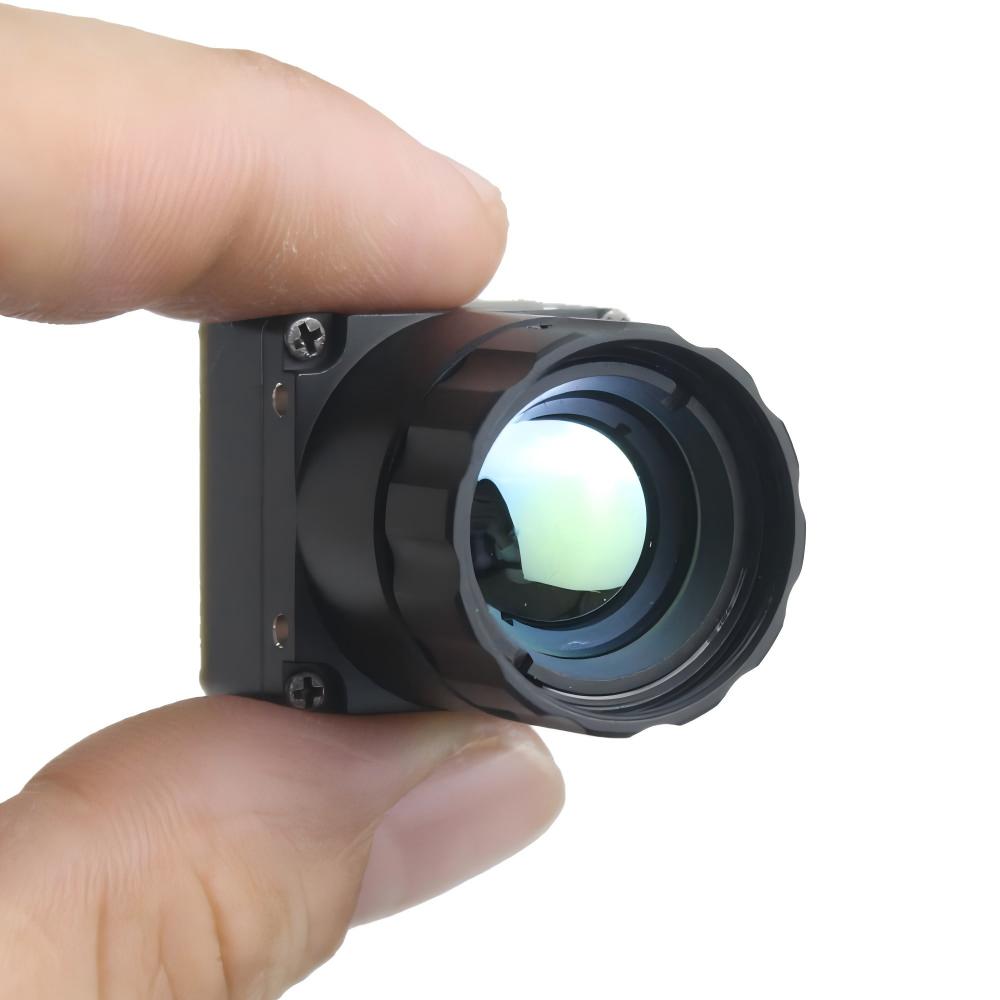
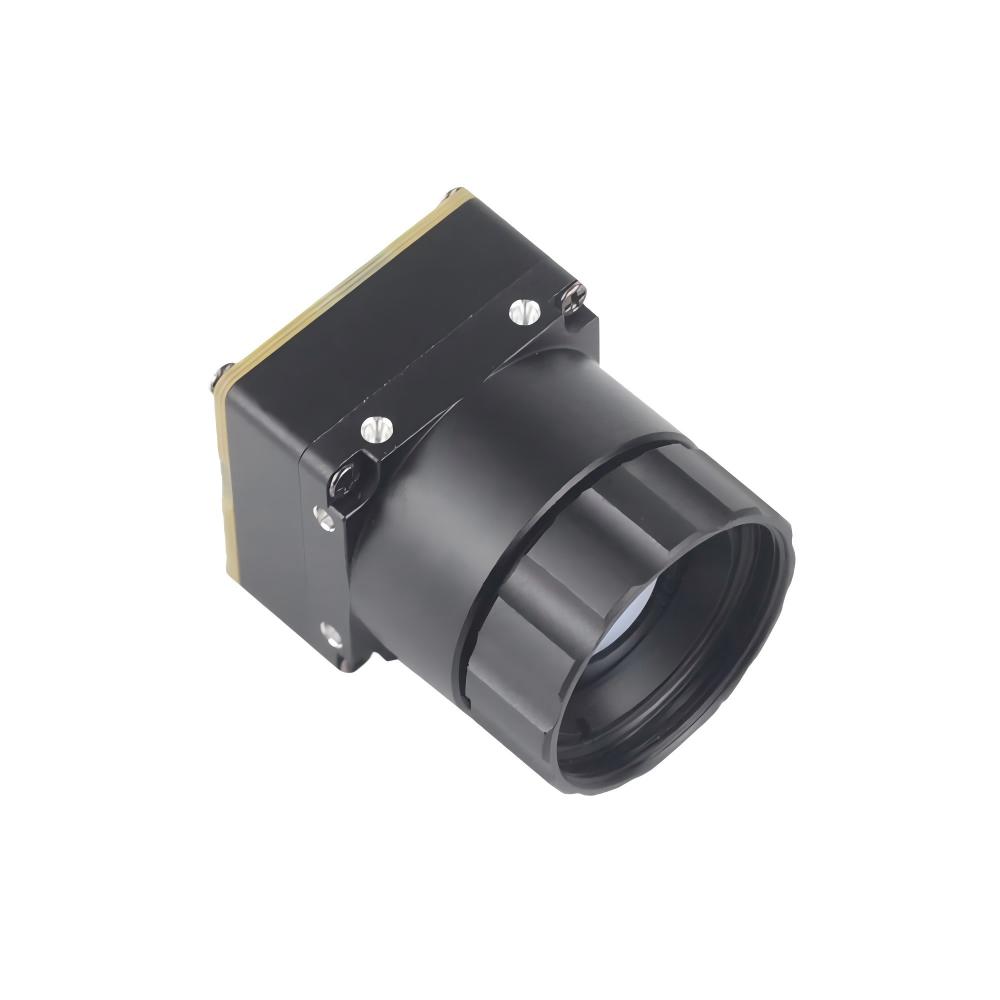
Uncooled Infrared MIPI 640/384/256 9mm Thermal Imaging Camera Module For Drones
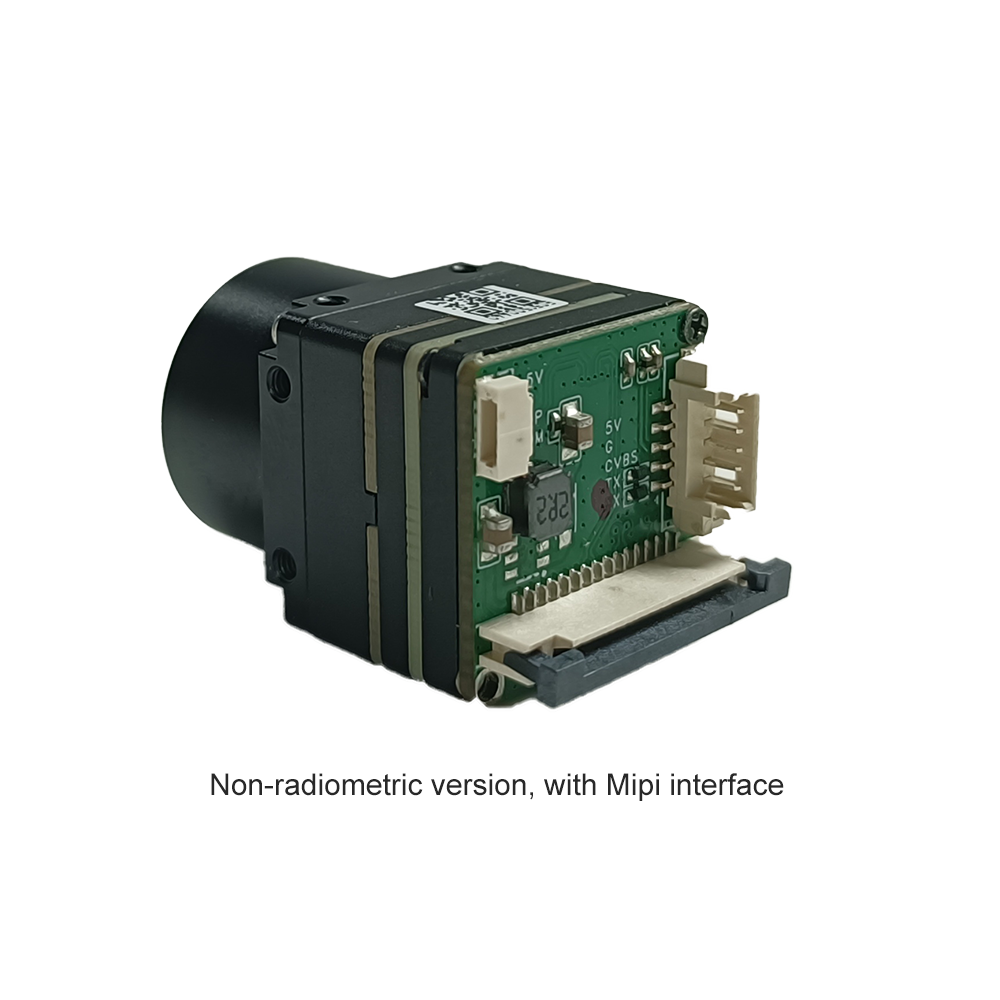
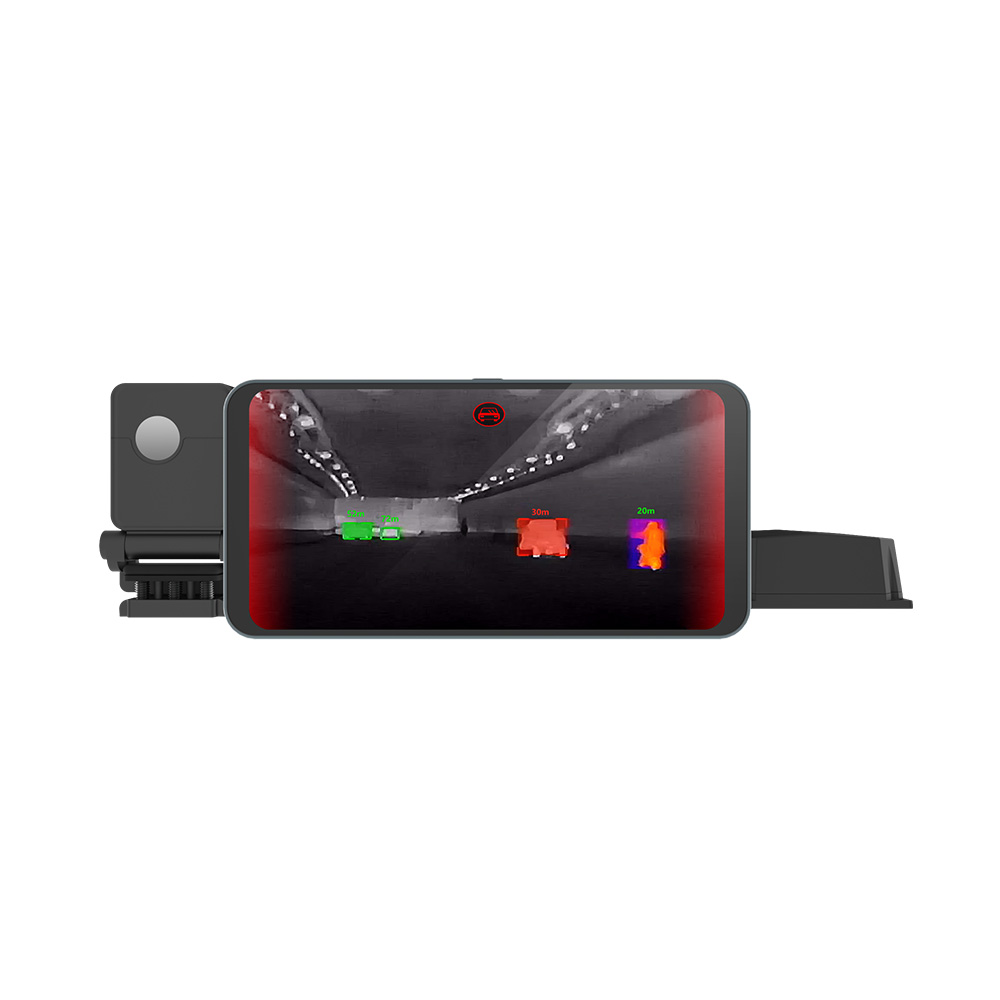
The Mini2 thermal module offers clear image detail, low power draw, and a tiny physical footprint. Designed specifically for drone gimbals, autonomous platforms, and embedded computer vision units, this camera core relies on uncooled VOx technology to pass raw radiometric video streams across native MIPI CSI-2 interfaces.
| نوع الكاشف: | ميكروبولومتر VOx غير مبرد |
| خيارات الدقة: | 640x512 / 384x288 / 256x192 Native Pixels |
| Pixel Pitch & Optics: | 12μm Pixel Pitch with 9mm Germanium Lens |
| Output Protocol: | Raw MIPI / DVP Video Stream Interface |
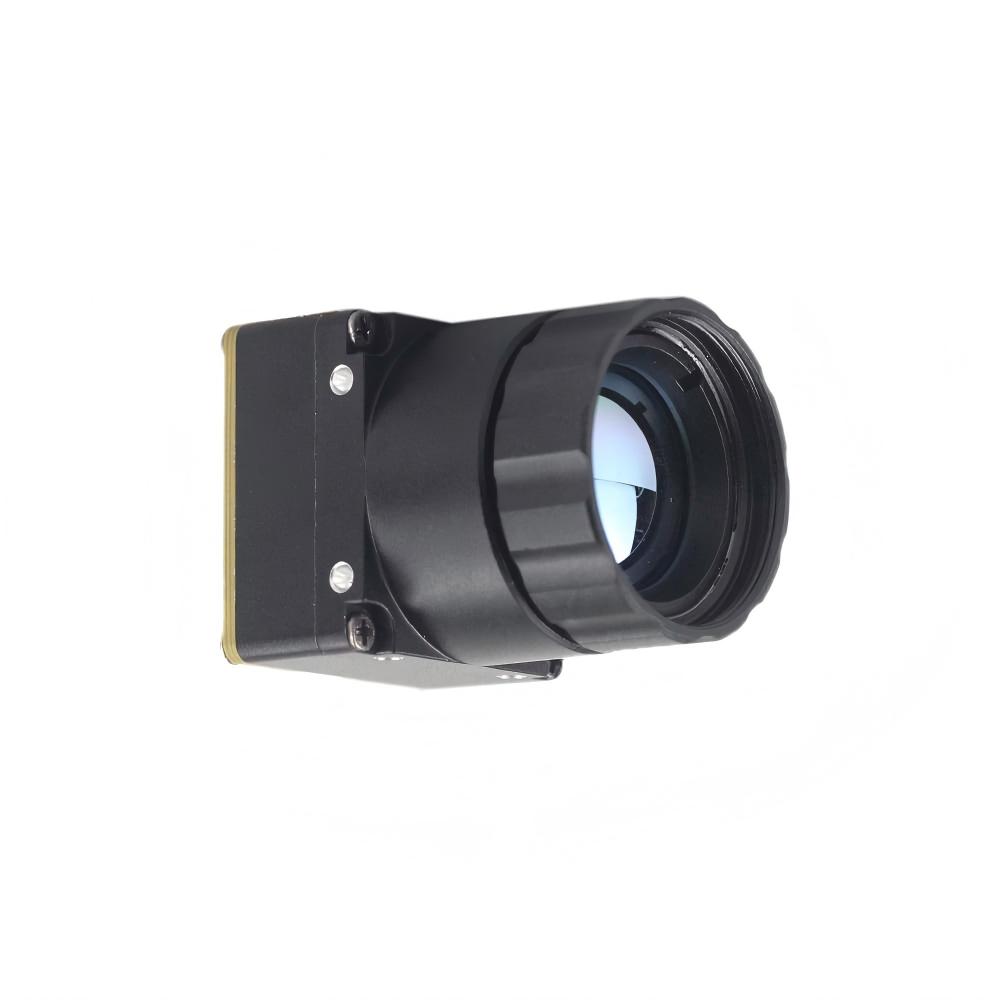
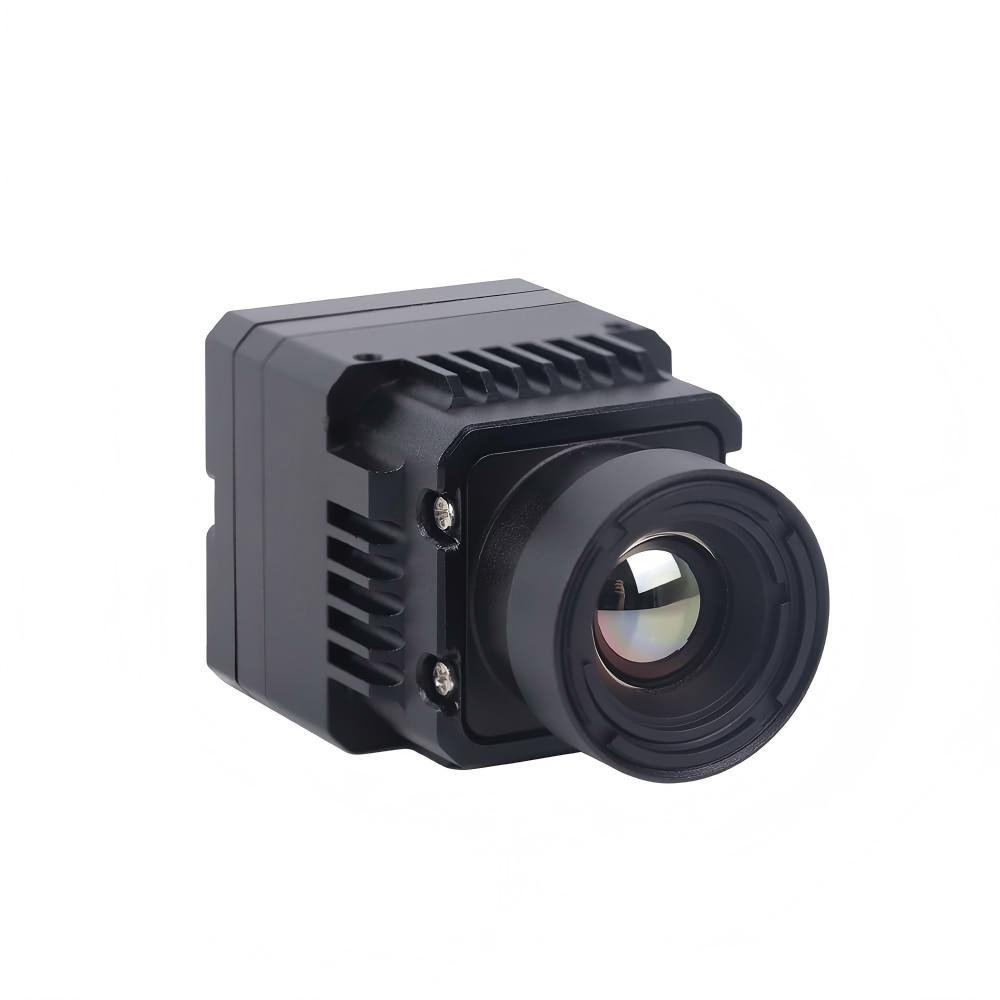
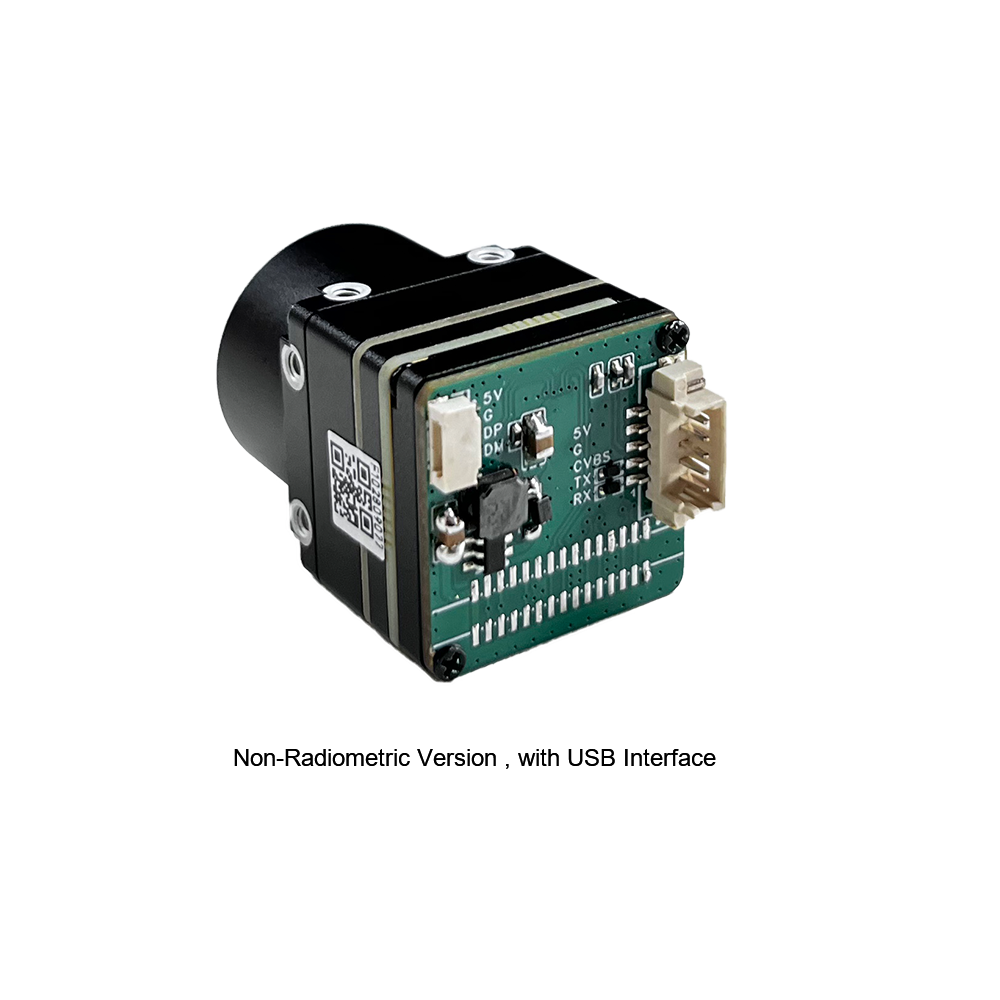
Uncooled LWIR USB Mini 640*512 Thermal Imaging Camera Core Module For Drones
Built into a compact 21mm x 21mm mechanical housing, this LWIR module Streams 640x512 thermal video directly over USB connections. Ideal for industrial IPCs, aerial mapping rigs, and automated station checks, it supports fixed-focus lenses from 5mm up to 150mm.
| Resolution Matrix: | 640x512 Native Uncooled Microbolometer Array |
| Dimensions: | Miniature 21mm × 21mm Housing Form Factor |
| Lens Options: | 5/9/13/18/35/50/75/100/150mm Fixed Focus Optics |
| Connectivity: | Standard USB UVC / Radiometric Temperature Data |
إرشادات تكامل الأنظمة: الطائرات بدون طيار، والذكاء الاصطناعي الطرفي، وأتمتة المصنّعين الأصليين
Choosing between low-cost thermopiles and full-resolution microbolometers comes down to math, physical constraints, and data pipeline requirements.
1. Distance-to-Spot Ratio ($D:S$) and Optical Field Calculations
To get a reliable radiometric temperature reading without energy bleeding over the edges, your target must cover a minimum matrix area of at least $3 \times 3$ physical pixels.
When calculated out:
- ⚠️ AMG8833 Limits: With a $7.5^\circ$ per-pixel field, covering a $3 \times 3$ pixel patch on a small $1\text{ cm}^2$ target means placing the sensor closer than $2.5\text{ cm}$ (1 inch). If you pull back to normal working distances ($30\text{ cm}$ to $1\text{ meter}$), the pixel spot size balloons, making spot measurement impossible.
- ✅ 640x512 Core Capabilities: With a $9\text{mm}$ lens ($12\mu\text{m}$ pitch, horizontal FOV $\approx 48^\circ$), each pixel spans just $0.075^\circ$. That same $1\text{ cm}^2$ component easily covers a $3 \times 3$ pixel cluster at inspection distances beyond $2.5\text{ meters}$, which works great on drone mounts or overhead plant installations.
2. Interface Selection: USB Video Class (UVC) vs. MIPI CSI-2
Matching interface options to your host platform saved development headaches down the road:
- 🖥️ USB UVC (USB Video Class): Best for industrial PCs, Windows setups, or Linux boards (Raspberry Pi, NVIDIA Jetson) where standard video drivers save time. Standard USB connections make benchtop setups and laboratory testing quick to build.
- ⚡ MIPI CSI-2 / DVP Interfaces: Essential for light, low-power embedded builds like drone gimbals and mobile robots. Bypassing USB hardware cuts circuit board mass, lowers heat generation, and drops frame latency down to single-digit milliseconds—a big deal for real-time target tracking and Edge AI.
3. Regulatory Compliance and Export Frameworks
When integrating thermal vision hardware running above $9\text{ Hz}$ into export products, keep trade regulations in mind, including ITAR and EAR frameworks. Check our policy details on our terms of use page.
الأسئلة الشائعة (FAQ)
Why does my AMG8833 thermal module only show clear thermal images within 30cm, and can I calibrate it for long-distance measurement?
The AMG8833 has a native $8 \times 8$ element matrix—giving you just 64 total pixels spread across a wide $60^\circ \times 60^\circ$ optical view. As distance to your target increases, each individual pixel's view grows larger, blending the target's thermal radiation with the surrounding background temperature within the same detector cell.
Beyond $30\text{ cm}$, a target smaller than a couple of inches only takes up a tiny fraction of a single pixel's field, forcing the sensor to report a blended average. While software offsets (tweaking emissivity or manual temperature adjustments) can fix room bias, they cannot bypass fundamental physics and optical sampling limits. Interpolation tricks smooth out visual steps, but they do not add real optical resolution. To measure small targets at a distance, you need an uncooled microbolometer camera core (like a $256 \times 192$ or $640 \times 512$ LWIR module).
Can an AMG8833 USB thermal module reliably handle human presence detection and PCB thermal path checks?
An AMG8833 USB module works fine for basic presence checks in tight, predictable spaces—like detecting if someone is sitting in an office chair or standing right in front of a kiosk within 1 to 2 meters. But it falls flat on PCB thermal path checks, micro-short detection, or precise room tracking.
Inspecting PCBs requires spotting heat anomalies across tiny surface-mount parts (like 0402 or 0603 chips), power management ICs, or trace cracks smaller than a millimeter. The AMG8833's 64 pixels simply lack the spatial resolution to isolate these tiny targets, blending hot spots into adjacent cold traces. For production QA and serious diagnostic work, engineering teams use higher-resolution MIPI or USB LWIR modules that can pinpoint component-level thermal signatures.
How does ambient temperature drift impact USB-powered thermopile modules compared to uncooled VOx cores?
USB-powered thermopile modules suffer from internal board heat. USB bridge chips and voltage regulators draw current and dump heat right into the module's copper traces, creating temperature imbalances across the sensor chip.
Because thermopile sensors compute object temperatures relative to their internal reference thermistor, this board heating messes up compensation math, causing temperature readings to drift over time. Professional uncooled VOx microbolometer cores avoid this by using shuttered or shutterless Non-Uniformity Correction (NUC) algorithms tied to factory calibration tables. These routines adjust individual pixel gains across wide operating ranges ($-40^\circ\text{C}$ to $+80^\circ\text{C}$), keeping measurement drift under control despite USB power noise or ambient temperature shifts.
Is an 8x8 thermopile matrix suitable for high-speed industrial process monitoring on conveyor lines?
No, an 8x8 thermopile matrix is not suitable for fast line monitoring. Aside from severe pixel limitations, the AMG8833 tops out between $1\text{ Hz}$ and $10\text{ Hz}$. Pushing it to $10\text{ Hz}$ degrades its noise performance (NETD) from $0.05^\circ\text{C}$ up to roughly $0.16^\circ\text{C}$, adding visible frame noise.
Industrial lines—like continuous heat sealing, bottling operations, plastic molding inspection, or packaging checks—need high frame rates ($25\text{ Hz}$ to $60\text{ Hz}$) to capture quick thermal events on moving targets. At $10\text{ Hz}$, a part moving down a belt travels inches between frames, creating motion blur and missed defects. High-resolution VOx thermal cores running at $30\text{ Hz} - 60\text{ Hz}$ deliver real-time radiometric streams, allowing automated vision setups to catch rapid heat changes instantly.
📚 المراجع والقراءات الإضافية
- Industry Standard Thermal Physics: ويكيبيديا التصوير الحراري
- Semiconductor Architecture & Fabrication: JM Chip Semiconductor Solutions
- Related Hardware Integration Guide: High Resolution USB Thermal Camera Module Custom OEM Cores for PCBA
- Mobile Thermal Imaging Applications: Smartphone Thermal Camera Bringing Temperature Visualization into Daily Life
- Regulatory Compliance & Terms: Thermal Image System Integration Terms of Use