

Digital Thermal Camera Cores vs Analog: Next-Gen OEM AI Solutions Guide
2026年8月18日
VOx (Vanadium Oxide) Thermal Camera Modules: The Ultimate OEM Guide for AI & Drone Vision
2026年8月20日
Vanadium Oxide Thermal Sensor Modules: High-Performance IR Imaging Cores for OEM Integration
Here's the deal with modern uncooled long-wave infrared (LWIR) imaging: system integrators are constantly backed into a corner trying to balance raw thermal sensitivity, high frame rates, and cut-throat size, weight, power, and cost (SWaP-C) constraints. When you are engineering an uncooled thermal core, your choice of thin-film detector material makes or breaks the entire platform. That is why Vanadium Oxide (VOx) has become the gold standard across defense, industrial automation, and robotic payloads. As a high-performance transition metal oxide semiconductor, VOx delivers a killer combination: an exceptionally high Temperature Coefficient of Resistance (TCR) paired with ultra-low electrical noise characteristics. If you're building autonomous unmanned aerial systems (UAS), perimeter sentry grids, industrial machine vision, or ADAS automotive night vision, you need a sensor core that pushes crisp radiometric data without bogging down your downstream host compute.
Look at the legacy hardware on the market: older silicon-based microbolometers frequently force engineers into messy compromises on dynamic range, thermal lag, and signal-to-noise ratio. Integrating a modern uncooled Vanadium Oxide thermal sensor module changes the game entirely. By suspending VOx thin-film microbridges over complementary metal-oxide-semiconductor (CMOS) Readout Integrated Circuits (ROIC), current generation sensor engines achieve Noise Equivalent Temperature Differences (NETD) well below 30 to 40 millikelvins (mK). This comprehensive engineering guide breaks down the underlying solid-state physics of VOx microbolometers, detailing hardware integration architectures, ROIC/ASIC processing pipelines, physical interfacing buses, and field deployment strategies for mission-critical embedded hardware.
Table of Contents
- 👉 1. Physics of Vanadium Oxide Microbolometer Technology
- 👉 2. Sensor Architecture, ROIC, and ASIC Image Pipelines
- 👉 3. OEM Protocol Integration: RTSP, CVBS, USB, and Ethernet
- 👉 4. Purpleriver OEM Thermal Sensor Core Specifications
- 👉 5. Environmental Hardening, Thermal Drift, and Edge AI Integration
- 👉 6. Deep-Dive Frequently Asked Questions
1. Physics of Vanadium Oxide Microbolometer Technology
Uncooled thermal imaging does not rely on photon-electron excitation across a narrow semiconductor bandgap like cryogenic InSb or MCT detectors. Instead, it operates on the bolometric principle: incoming long-wave infrared radiation in the 8 to 14 micrometer (μm) atmospheric window strikes an absorbing membrane, causing a minute temperature rise that alters the material's electrical resistance. The performance of any microbolometer hinges on its constituent material's Temperature Coefficient of Resistance (TCR). TCR quantifies the percentage change in electrical resistance per degree Kelvin of temperature shift. A higher absolute TCR means an infinitesimal flux in incident scene radiation translates directly into a large, easily measurable voltage or current swing across the readout circuitry.
In the shop, deposition quality is everything. The Vanadium Oxide films used in industrial-grade microbolometers are not single-crystal materials; they are carefully engineered multi-phase mixed compounds combining vanadium dioxide (VO2), vanadium pentoxide (V2O5), and vanadium trioxide (V2O3). When deposited via precision ion-beam or magnetron sputtering under tightly controlled oxygen partial pressures, these mixed-phase films achieve a high negative TCR typically sitting between -2.0% and -3.0% per Kelvin at room temperature (300 K). Compare that to titanium oxide or standard metal thin films, which hover around -0.5% to -1.0% per Kelvin, and you can see why VOx provides vastly superior electro-thermal conversion efficiency without requiring excessive pre-amplifier gain.
Structurally, each individual pixel in a modern 12 μm focal plane array (FPA) is a marvel of MEMS engineering. The pixel consists of a microbridge platform suspended above the underlying silicon CMOS substrate by two ultra-slender silicon nitride (Si3N4) support legs. This mechanical architecture provides near-total thermal isolation. The thermal conductance down those tiny support legs is minimized so that absorbed radiant heat does not bleed into the substrate before the readout circuit can sample the resistance change. Because the microbridge itself is fabricated to sub-nanogram thermal mass, its thermal time constant drops to an agile 8 to 10 milliseconds. This rapid thermal response is what allows true 50 Hz and 60 Hz full-frame video streaming without the annoying image ghosting or motion blur you see on sluggish sensors during fast pan-and-tilt maneuvers.
Now, let's talk about the noise floor, which is where VOx completely outclasses amorphous silicon (a-Si). Microbolometer noise consists of three primary elements: Johnson noise, thermal fluctuation noise, and low-frequency 1/f flicker noise. Amorphous silicon suffers from an inherently disordered atomic network filled with dangling bonds and localized trapping states. This atomic disarray introduces massive 1/f noise, forcing designers to run higher integration times or aggressive digital temporal filtering that smears motion. VOx, by contrast, exhibits exceptionally low 1/f flicker noise spectral density. This clean electrical baseline allows ROIC design teams to implement high-gain column integrators that capture clean, high-bandwidth signals. The end result? NETD values dropping below 35 mK, giving operators crisp, low-noise imagery even in zero-contrast conditions like thick sea fog, heavy rainstorms, or flat overcast fields.
2. Sensor Architecture, ROIC, and ASIC Image Pipelines
A professional thermal core is a tightly coupled electro-optical system. It marries the microbolometer Focal Plane Array directly to a mixed-signal CMOS Readout Integrated Circuit (ROIC), which in turn feeds a dedicated hardware Image Signal Processor (ISP) ASIC. The ROIC sits directly beneath the MEMS microbridge array, tied together via micro-scale indium bump bonds or monolithic post interconnects. During operation, column-parallel capacitive transimpedance amplifiers (CTIA) sample the subtle resistance changes across each row of pixels during the line integration cycle. On-chip 14-bit or 16-bit analog-to-digital converters (ADCs) then digitize the raw analog signals right at the column level, suppressing analog signal degradation before the data leaves the focal plane package.
Raw digital frames streaming off a microbolometer ROIC are messy. Every pixel has slight microscopic variances in film thickness, leg geometry, and transistor threshold voltages. Without real-time processing, the raw image looks like static noise. To turn this raw data stream into a crisp thermal image, the sensor's hardware ASIC pipeline runs dedicated hardware-accelerated algorithms at full line rates:
- ⚙️ Non-Uniformity Correction (NUC): Dedicated hardware blocks apply two-point (gain and offset) correction matrices to each individual pixel in real time. Periodic mechanical shutter closures—or intelligent shutterless background modeling—dynamically refresh the offset map to zero out thermal drift caused by internal housing temperature rise.
- ⚙️ Defective Pixel Concealment (DPC): Microbolometer manufacturing yields always leave a tiny fraction of dead, noisy, or saturated pixels. Factory calibration registers these locations into non-volatile EEPROM, and the real-time pipeline continuously patches them using adaptive spatial interpolation from healthy neighboring pixels.
- ⚙️ Digital Detail Enhancement (DDE): Thermal scenes routinely pack massive dynamic ranges—like a glowing 600°C engine manifold set against a -20°C winter sky. Linear 8-bit quantization would completely blow out highlights or crush shadow detail. DDE splits the 14-bit linear radiometric feed into low-frequency base layers (overall scene dynamic range) and high-frequency detail layers (fine thermal texture), compressing global dynamic range while boosting local contrast for immediate operator target recognition.
- ⚙️ 3D Dynamic Temporal & Spatial Noise Reduction (3D-DNR): Temporal recursive filtering strips out high-frequency thermal shot noise frame-over-frame, while spatial bilateral filtering cleans up flat visual planes without softening crisp thermal edge boundaries.
When you are packaging this high-frequency digital architecture into compact UAV gimbals or ruggedized mobile chassis, EMI and signal integrity become major hurdles. Top-tier builds isolate high-speed LVDS and MIPI-CSI-2 lines using custom micro-coaxial harness assemblies, such as those engineered by Micro Coaxial Cable Man, preventing motor noise from bleeding into the high-gain analog front-end. On the optical side, the sensor relies on precision-machined Germanium or chalcogenide glass elements, such as optics produced by Rising Optics, treated with broad-band anti-reflective oxide thin-film coatings to ensure maximum optical transmission across the 8 to 14 μm band.
3. OEM Protocol Integration: RTSP, CVBS, USB, and Ethernet
In the field, hardware flexibility is everything. An OEM thermal core must drop into edge compute boards, existing analog telemetry links, or enterprise IP security infrastructure without requiring a ground-up redesign of your communication stack. Purpleriver uncooled VOx modules natively support four distinct interfacing protocols to accommodate any system architecture:
1. Ethernet RTSP / IP Video Streaming (H.264 / H.265 / ONVIF): Sensor cores featuring integrated on-board network microprocessors compress the native 640×512 thermal stream into standard H.264 or H.265 elementary streams delivered via RTSP over standard RJ45 physical ports. This allows effortless integration into enterprise VMS suites, municipal traffic control grids, and fixed perimeter monitoring nodes. Dual-stream support allows you to pipe a high-bitrate stream into edge analytics engines while routing a low-bitrate sub-stream to mobile operations consoles.
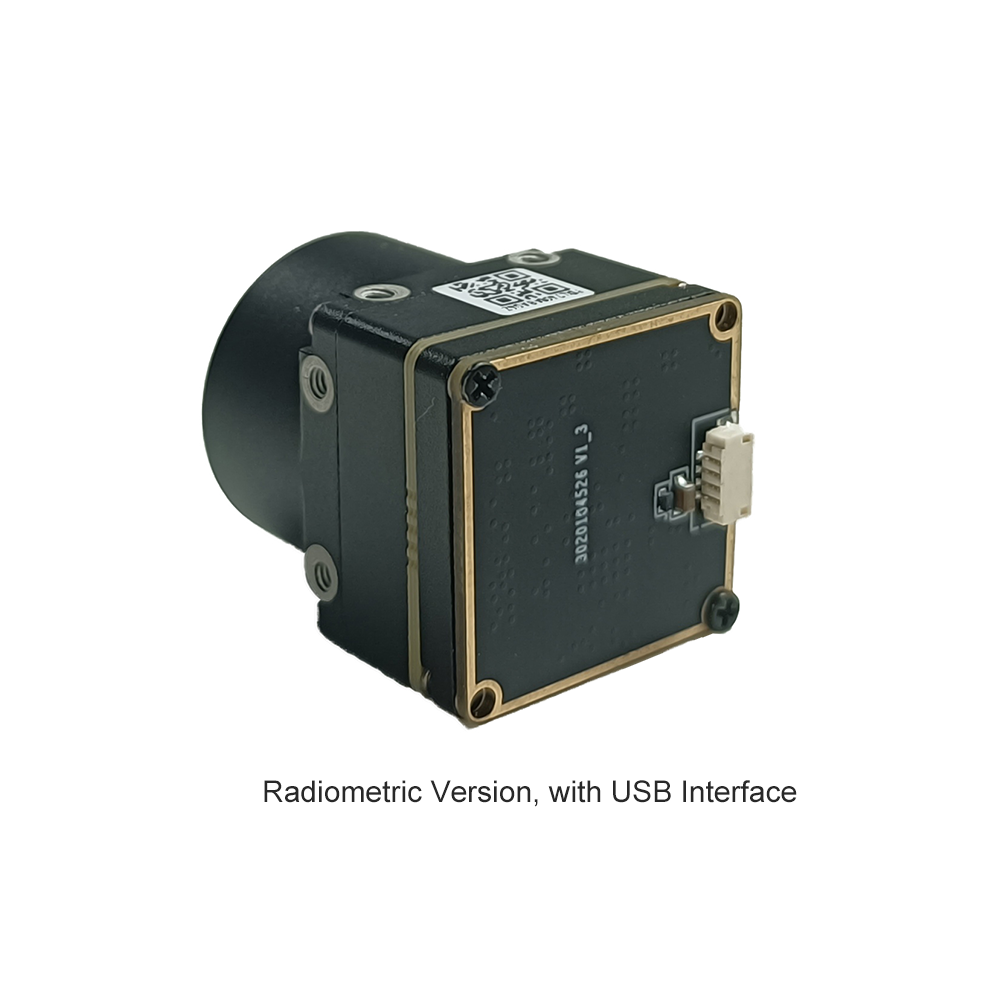
2. USB UVC and Radiometric Data Streaming: For systems running edge compute units like the NVIDIA Jetson Orin, Raspberry Pi CM4, or x86 industrial box PCs, direct USB 2.0 / 3.0 interfaces operating under standard USB Video Class (UVC) provide seamless driverless operation. The camera core can be polled for either 8-bit AGC-enhanced visual video or full 14-bit linear temperature data arrays directly into OpenCV, ROS (Robot Operating System) nodes, and custom C++/Python pipelines, unlocking pixel-by-pixel temperature telemetry on the fly.
3. Analog CVBS Composite Video: When sub-10-millisecond glass-to-glass latency is non-negotiable—such as high-speed First-Person View (FPV) drone piloting, airborne target tracking gimbals, and defense vehicle driver vision enhancement (DVE)—analog CVBS output is the tool of choice. It bypasses all digital encoding and packet buffering delays for instantaneous situational awareness.
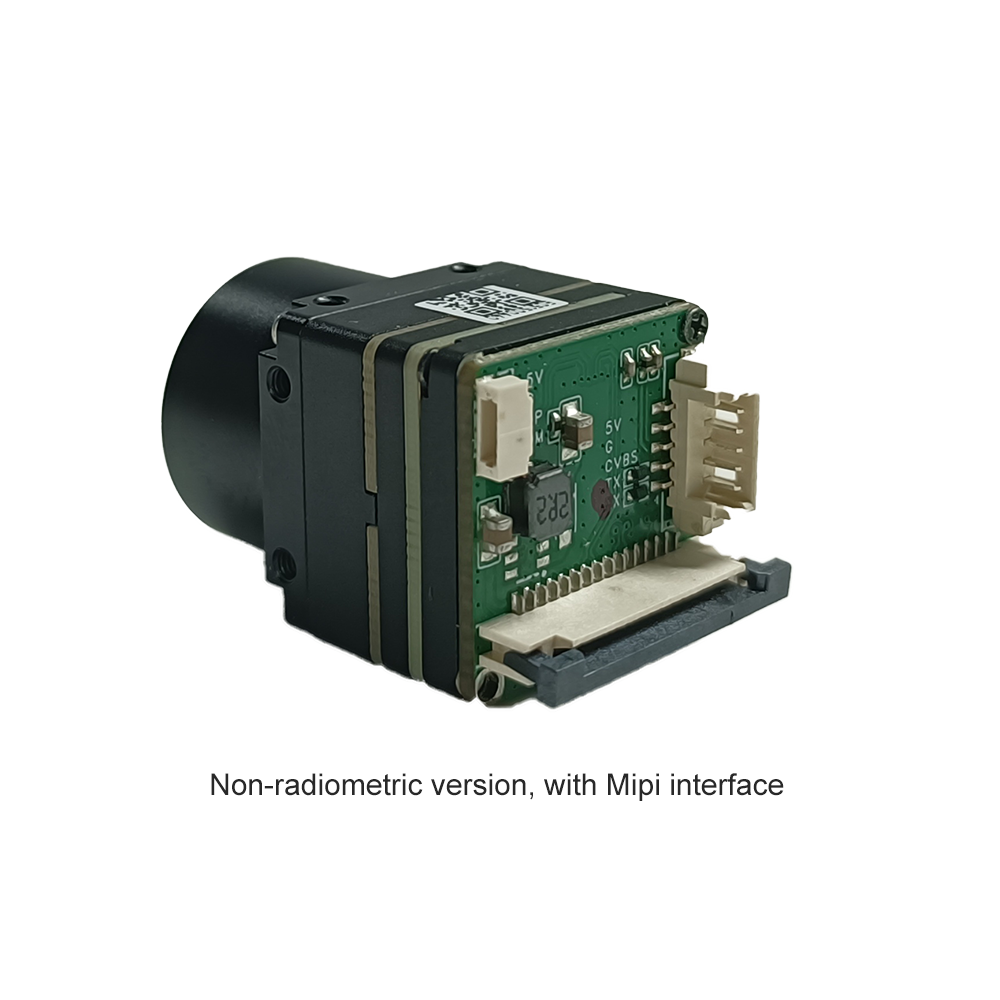
4. Digital Raw CMOS / MIPI-CSI-2: For deep embedded applications where size, mass, and milliwatts are scrutinized, raw CMOS or MIPI-CSI-2 interfaces route 14-bit digital pixel clocks straight into your carrier board's ISP or FPGA, bypassing all secondary protocol overhead.
These robust interfaces make deployment straightforward across a huge range of field applications. We see them deployed in automotive night vision upgrades detailed in our guide on thermal imaging car camera setups, broad-spectrum defense systems covered in our инфракрасная технология technical series, and critical perimeter security projects deployed with the نظام مراقبة أمني بكاميرا تصوير حراري platform.
4. Purpleriver OEM Thermal Sensor Core Specifications
Purpleriver builds high-rel uncooled Vanadium Oxide microbolometer thermal sensor modules designed specifically for drop-in OEM integration, harsh environmental endurance, and high optical performance. Below are the verified technical parameters for our flagship production cores.
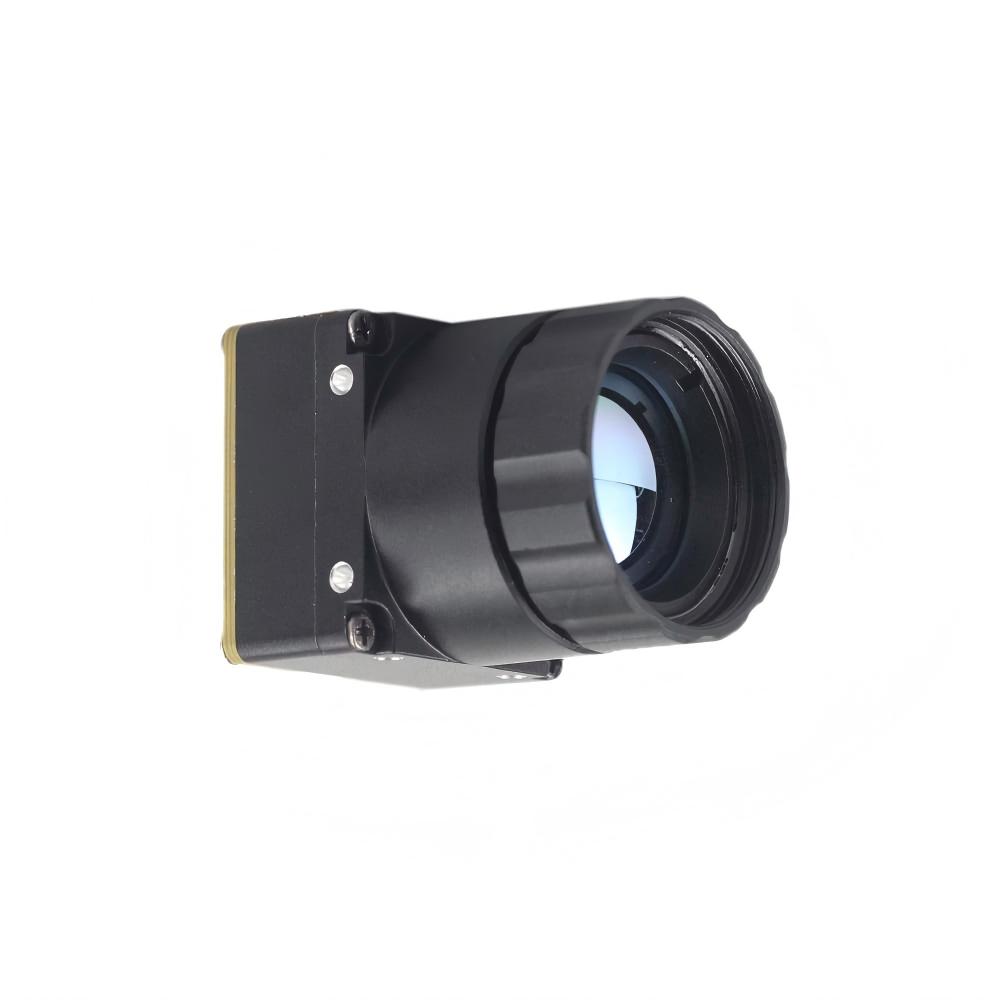
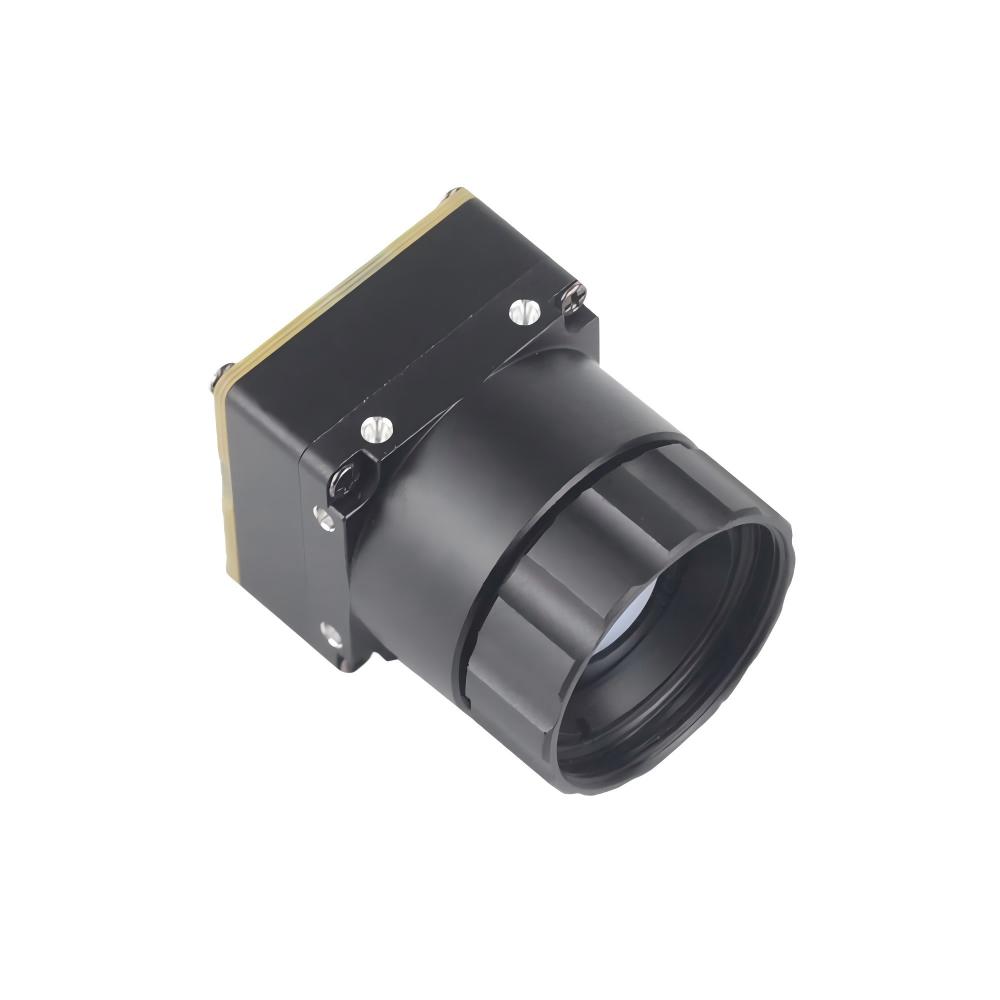
Product Showcase 1: Uncooled Infrared RJ45 CVBS RTSP IP 640*512 Thermal Sensor Camera Module
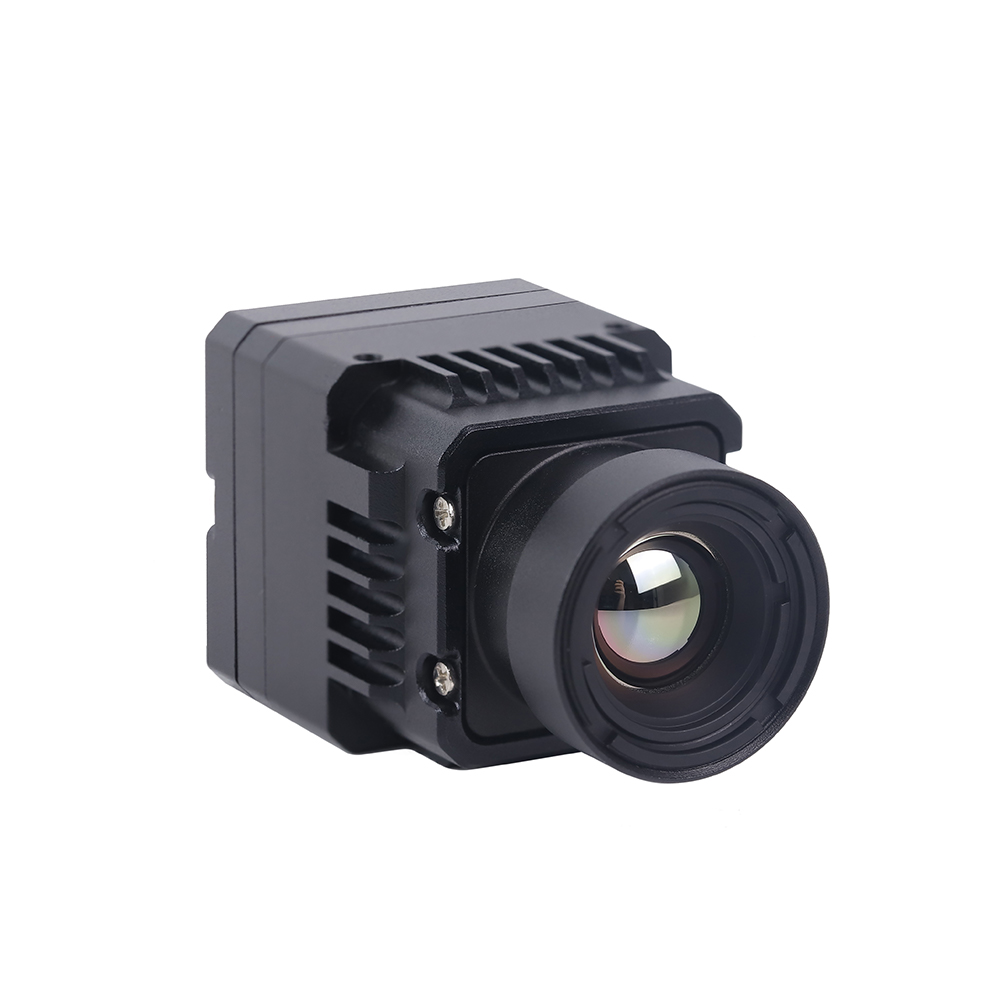
The Purpleriver Uncooled Infrared Mini 640*512 ASIC Thermal Imaging Camera Module is an ultra-miniaturized optoelectronic core built for drone gimbals, remote monitoring stations, and industrial surveillance. Driven by an advanced dedicated ASIC processor, it natively encodes long-wave infrared video into RJ45 IP network streams (RTSP with H.264/H.265) and simultaneous CVBS analog feeds. This allows developers to integrate military-grade thermal vision directly into existing IP video management software or low-latency analog telemetry links.
| Parameter | Specification Value |
|---|---|
| Detector Technology | Uncooled Vanadium Oxide (VOx) Microbolometer FPA |
| Array Resolution | 640 × 512 Pixels |
| Pixel Pitch | 12 µm |
| Spectral Band | 8 to 14 µm (LWIR) |
| Thermal Sensitivity (NETD) | ≤ 40 mK (@ f/1.0, 300 K) |
| Video Outputs | RJ45 (RTSP / IP Video H.264/H.265) & Analog CVBS |
| Processing Engine | Dedicated ASIC ISP with hardware NUC, DDE, and 3D-DNR |
| Target Systems | Airborne UAV Gimbals, Remote Perimeter Sentries, Industrial Inspection |
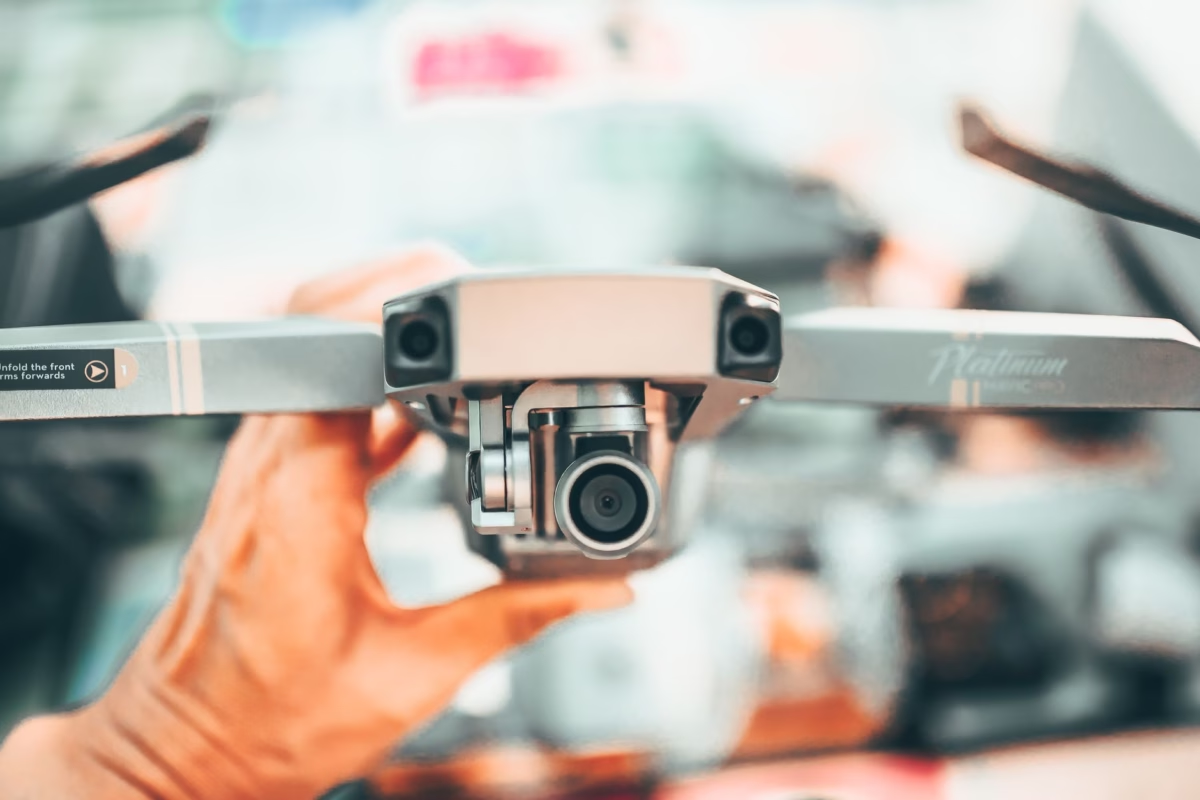
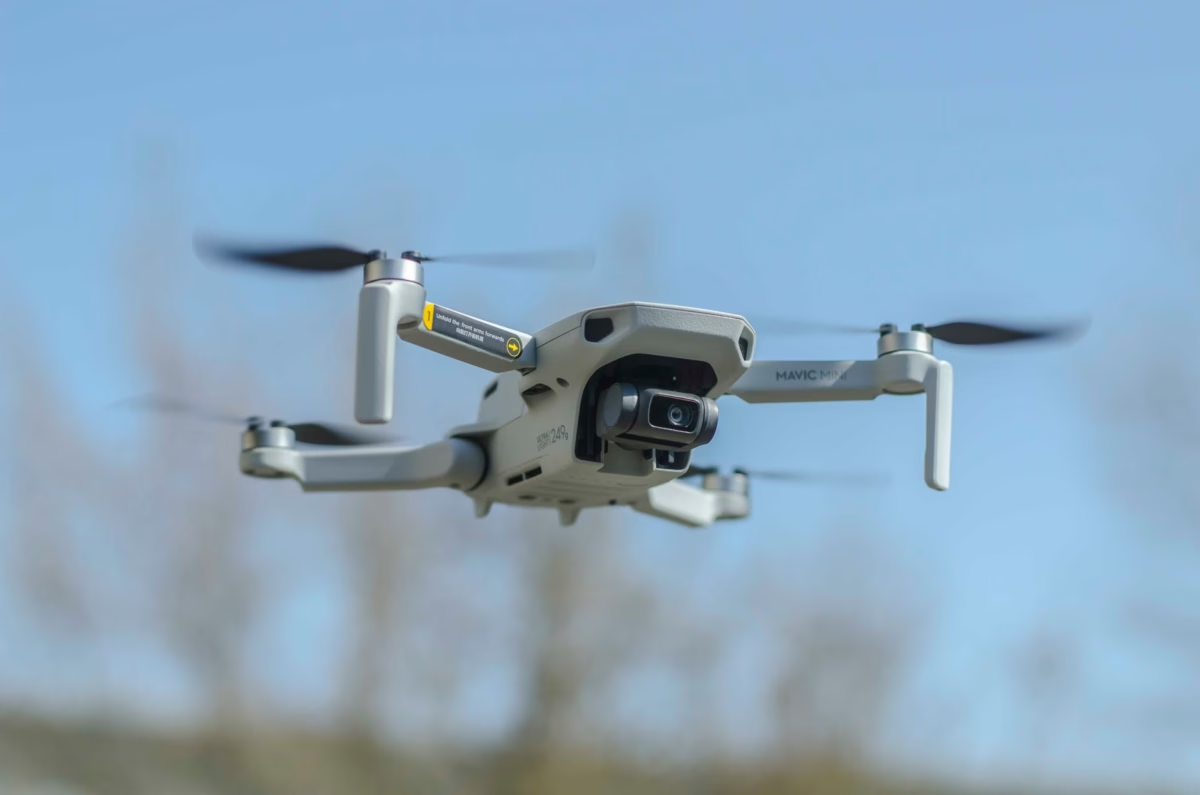
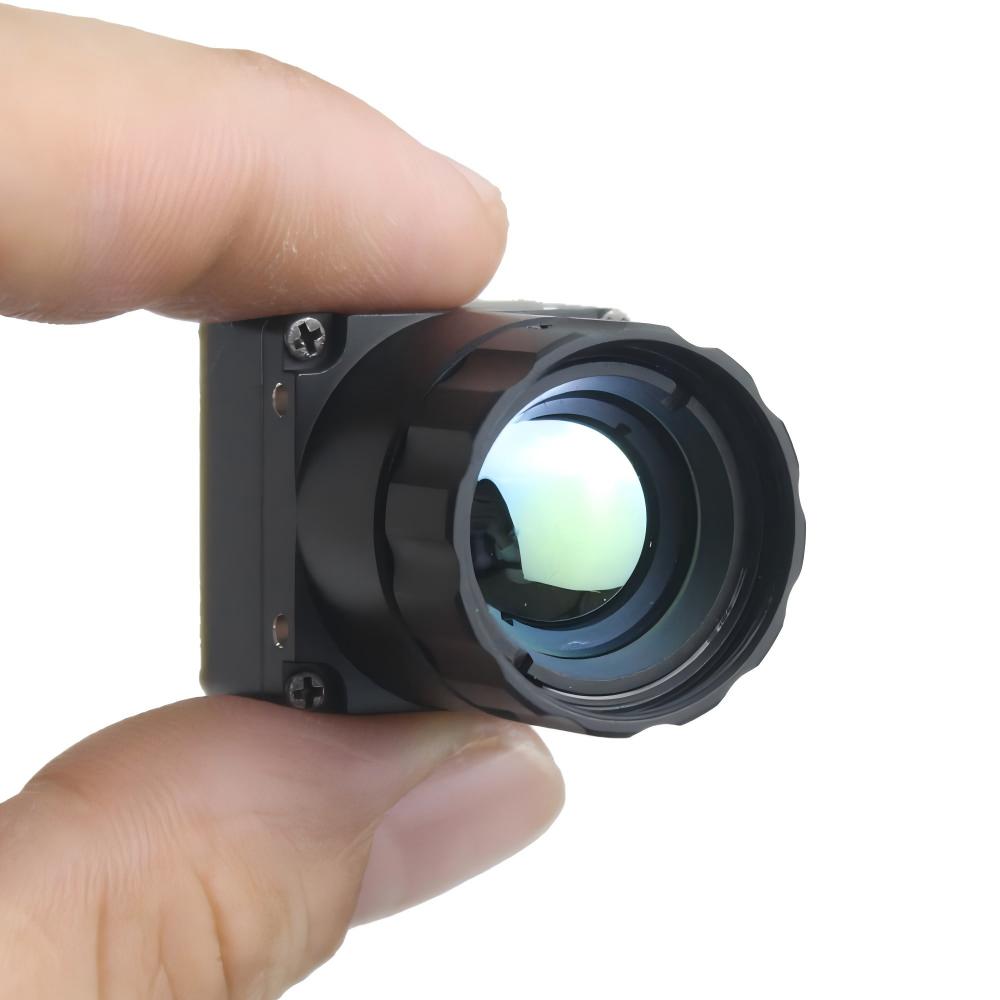
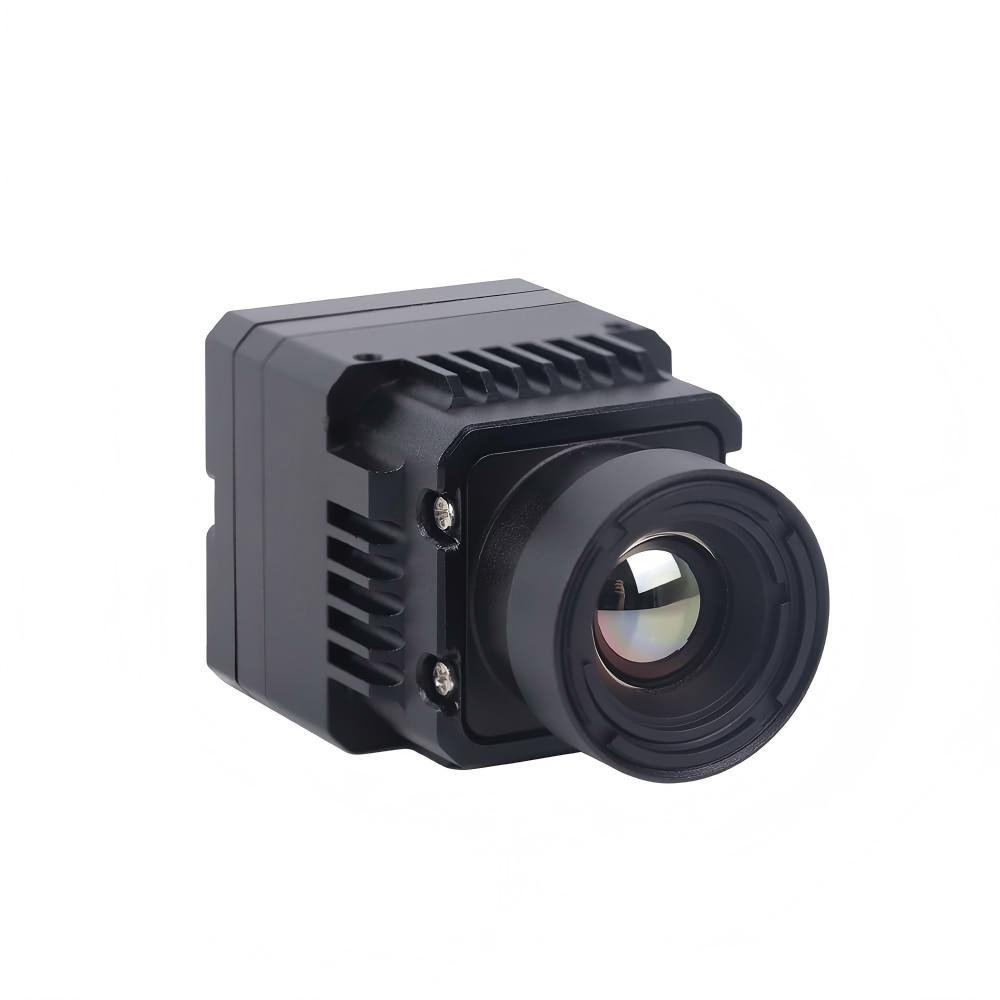
Product Showcase 2: Uncooled LWIR USB Mini 640*512 Thermal Imaging Camera Core Module For Drones Similar To DJI
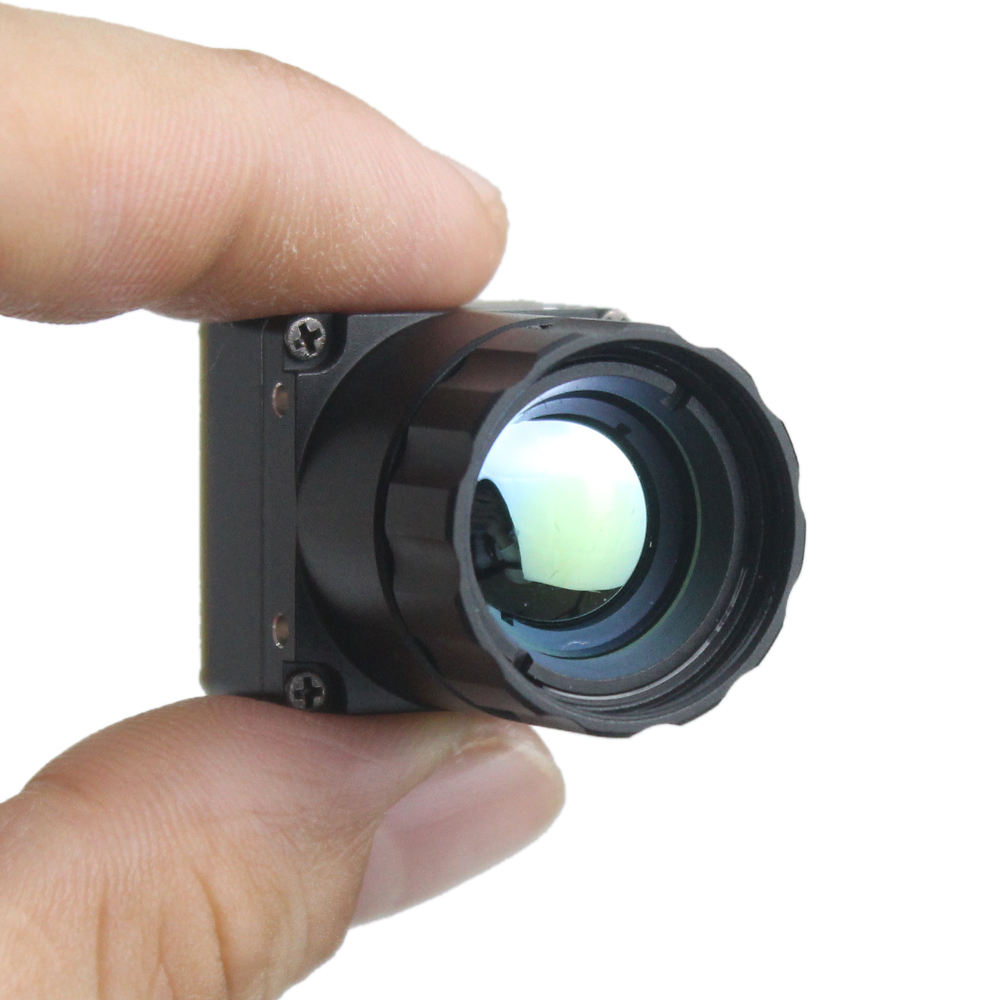
The Mini 640 uncooled infrared thermal imaging module delivers sharp, crisp thermal image presentation within an ultra-miniature 21 mm × 21 mm envelope. Engineered for high SWaP-C efficiency, this lightweight core is designed specifically for small unmanned aerial systems, handheld monoculars, and compact robotic integration similar to DJI-class enterprise payloads. It offers versatile optical options ranging from 5 mm wide-angle lenses up to 150 mm long-range telephoto optics, backed by stable performance and strong environmental adaptability.
| Parameter | Specification Value |
|---|---|
| Form Factor / Envelope | Ultra-compact mini-size of 21 mm × 21 mm |
| Detector Material | Vanadium Oxide (VOx) Microbolometer |
| Sensor Resolutions Available | 640 × 512 (Standard) / 640 × 480 (Optional) |
| Lens Focal Length Options | 5 mm / 9 mm / 13 mm / 18 mm / 35 mm / 50 mm / 75 mm / 100 mm / 150 mm |
| Sensitivity (NETD) | ≤ 35-40 mK |
| Interface & Power | Direct USB (UVC compliance) with micro-power consumption |
| Image Characteristics | Sharp, crisp image presentation, low latency, strong thermal stability |
| Primary Applications | UAV Drone Gimbals (DJI-class alternatives), Handheld Scopes, Wearable Vision |
5. Environmental Hardening, Thermal Drift, and Edge AI Integration
When you take a thermal sensor out of the lab and put it into real-world service—whether that is an unmanned aircraft flying at 10,000 feet or a mining robot in an open pit—it has to survive severe operating environments. We are talking thermal swings from -40°C up to +85°C, high g-force mechanical shocks, and non-stop structural vibration. Because VOx microbolometer thin films are acutely responsive to ambient temperature shifts, the internal heating of the camera chassis itself can easily induce severe baseline drift if your thermal control loops aren't rock solid.
In the field, nothing frustrates an operator more than a camera shutter clicking shut every thirty seconds during a critical tracking operation. To solve this, Purpleriver uses a hybrid thermal compensation architecture. Multiple high-precision thermistors are embedded right onto the CMOS ROIC substrate and along the internal housing walls. Multi-dimensional Look-Up Tables (LUTs) in the firmware calculate real-time temperature gradients and dynamically trim column amplifier reference voltages. This continuous algorithmic adjustment maintains radiometric accuracy across the full thermal envelope, slashing the need for frequent mechanical shutter recalibrations.
At the mechanical level, our sensor engines are housed in CNC-machined aerospace-grade aluminum and magnesium alloys with precision micro-gasket sealing. The microbolometer FPA itself is encapsulated inside a permanent Wafer-Level Vacuum Package (WLP). This vacuum seal isolates the suspended microbridge structures, preventing atmospheric gas molecules from conducting heat away from the pixel membranes or introducing moisture that could oxidize the active thin films over decades of operation.
For modern edge computing setups, pairing a 640×512 50/60 Hz VOx stream with an edge AI accelerator like an NVIDIA Jetson Orin or Google Coral gives you a formidable perception engine. The uncompressed 14-bit data stream feeds deep learning models (such as YOLOv8 and custom CNNs) to execute complex automation tasks:
- ✅ Automated Target Recognition (ATR): High-confidence detection, classification, and continuous tracking of personnel, vehicles, and maritime vessels through total darkness, dense tree cover, and battlefield smoke.
- ✅ Radiometric Industrial Telemetry: Autonomous pixel-by-pixel temperature inspection to flag hot-spot electrical substation faults, bearing friction anomalies, or chemical vessel integrity failures before catastrophic breakdowns occur.
- ✅ All-Weather Autonomous Navigation: Providing high-contrast LWIR perception for autonomous mobile robots (AMRs) operating in completely unlit, dusty, or GPS-denied subterranean tunnels and industrial logistics yards.
6. Deep-Dive Frequently Asked Questions
Why is Vanadium Oxide (VOx) preferred over alternative metal oxide and amorphous silicon materials in uncooled thermal sensors?
How do Purpleriver VOx thermal modules handle wide operating temperature ranges and thermal drift in industrial environments?
Can Purpleriver OEM thermal sensor camera cores be customized for proprietary embedded drone gimbals and robotic hardware?
📚 References & Further Reading
- Industry Standard: Precision optical elements and multi-spectral Germanium lenses manufactured by Rising Optics.
- Industry Standard: High-bandwidth flexible interconnect wiring engineered by Micro Coaxial Cable Man.
- Related Guide: Explore practical automotive applications in our Thermal Imaging Car Camera Integration Guide.
- Related Guide: Comprehensive overview of infrared technology at Технология Инфракрасного Тепловизора.
- Related Guide: Advanced remote perimeter monitoring with the نظام مراقبة أمني بكاميرا تصوير حراري.