
Vanadium Oxide Thermal Sensor Modules: High-Performance IR Imaging Cores for OEM Integration
2026年8月18日
VOx Uncooled Thermal Imaging Module Buying Guide: Edge AI & OEM Integration
2026年8月20日
VOx (Vanadium Oxide) Thermal Camera Modules: The Ultimate OEM Guide for AI & Drone Vision
When you're building autonomous systems, tactical UAVs, or edge AI inspection rigs, you run headfirst into brutal size, weight, power, and cost (SWaP-C) limitations. VOx (Vanadium Oxide) uncooled long-wave infrared (LWIR) microbolometers are the undisputed workhorse of modern thermal imaging. Unlike legacy materials, VOx delivers a rock-solid Temperature Coefficient of Resistance (TCR) alongside remarkably low 1/f flicker noise. That means your sensor pulls usable, high-contrast thermal detail out of flat, low-delta scenes where older materials turn into a muddy mess. In the embedded vision world, picking the right microbolometer core dictates whether your neural network tracks a target cleanly through heavy smoke or drops bounding boxes entirely.
Dropping a VOx thermal engine into production hardware—from sub-250g commercial inspection quads to robotic sentry units—requires hands-on mastery of bus protocols (MIPI CSI-2, USB, DVP), non-uniformity correction (NUC) pipelines, optical MTF, and radiometric calibration loops. This guide breaks down everything field engineers, embedded architects, and OEM product leads need to spec, bench-test, and deploy industrial-grade VOx thermal cores into rugged vision payloads.
Table of Contents
- 👉 1. Fundamentals of Vanadium Oxide (VOx) Microbolometers
- 👉 2. Engineering SWaP-C Constraints in UAV & Drone Payloads
- 👉 3. Edge AI Vision & Interface Pipelines: MIPI CSI-2, USB, & DVP
- 👉 4. Industrial OEM Solutions: Technical Specifications & Comparative Analysis
- 👉 5. LWIR Optics Selection Guide: Apertures, Focal Lengths, and Range (DRI)
- 👉 6. Advanced Signal Processing: Shutterless Algorithms, NUC, and DDE
- 👉 7. Deep-Dive Engineering FAQ
- 👉 8. OEM Integration Roadmap & Next Steps
1. Fundamentals of Vanadium Oxide (VOx) Microbolometers
Material Physics: Temperature Coefficient of Resistance (TCR) & 1/f Noise
Here's the deal with uncooled thermal imaging: you're working with an array of tiny microbolometers suspended on micro-bridges right at the focal plane. When long-wave infrared radiation across the 8µm to 14µm band hits that thermally isolated pixel membrane, the membrane warms up ever so slightly. That tiny fraction of a degree causes a predictable shift in electrical resistance. The Readout Integrated Circuit (ROIC) bonded right underneath measures that resistance shift and turns it into a raw digital count.
The key metric that defines how responsive that microbolometer material will be is its Temperature Coefficient of Resistance (TCR), defined mathematically as:
Vanadium Oxide is a mixed-valence transition metal material tuned specifically to run in a stable, semiconductive state at typical ambient temperatures. In well-controlled thin-film deposition, VOx routinely achieves a negative TCR between -2%/K and -3%/K. That level of responsiveness ensures even a tiny millikelvin temperature delta across the scene registers as a clear, quantifiable voltage swing at the ROIC.
Out in the field, raw sensitivity means nothing if your signal gets swallowed by sensor noise. Thermal detectors are constantly battling Johnson noise and low-frequency 1/f flicker noise. Because high-end VOx thin films are sputtered under high vacuum, they form an exceptionally uniform nanocrystalline matrix with minimal lattice defects. That tight micro-structure keeps 1/f flicker noise exceptionally low across the readout bandwidth, which is why modern VOx cores routinely post Noise Equivalent Temperature Difference (NETD) numbers below 35mK to 40mK at f/1.0.
VOx vs. a-Si (Amorphous Silicon): The Decisive Architectural Comparison
In the shop, engineers frequently weigh Vanadium Oxide against Amorphous Silicon (a-Si). While a-Si has deep roots in standard CMOS foundries, its material physics introduce serious trade-offs once you shrink the pixel pitch or demand tight radiometric accuracy in hot environments.
| Engineering Metric | Vanadium Oxide (VOx) | Amorphous Silicon (a-Si) | Impact on Autonomous Payloads |
|---|---|---|---|
| Typical TCR | -2.0% to -3.0%/K | -2.5% to -4.0%/K | VOx maintains superior operational linearity and thermal stability |
| 1/f Noise Floor | Extremely Low | Moderate to High | VOx provides crisper edge contrast and superior AI inference features |
| Core NETD (Sensitivity) | <35mK to 40mK | >50mK to 60mK | VOx resolves minute scene details in low-thermal-gradient conditions |
| Thermal Time Constant | 8ms to 12ms | 10ms to 15ms | VOx minimizes motion blur and rolling distortion during fast drone flight |
| Pixel Pitch Scaling | Scales readily to 12µm and 8µm | Degrades significantly below 17µm | VOx supports compact optics and reduced overall payload dimensions |
Look at what happens when you shrink pixel pitch down to 12µm or 8µm: amorphous silicon's disordered atomic structure causes 1/f noise to spike aggressively, severely degrading image contrast. VOx holds its signal-to-noise ratio steady at small pixel pitches, allowing optical designers to pair smaller sensors with lighter, shorter focal-length optics. For a deeper breakdown of focal plane array physics, check out our thermal engineering technical knowledge base.
2. Engineering SWaP-C Constraints in UAV & Drone Payloads
Size, Weight, Power, and Cost (SWaP-C) Optimization
When you're hanging an optical payload on a multi-rotor drone or a fixed-wing UAV, every single gram and milliwatt comes directly out of your flight endurance. Integrating a thermal engine changes the entire mechanical dynamic of your gimbal stabilization loops and thermal management system.
Look at mass distribution: a compact VOx module with a 21mm × 21mm footprint makes it straightforward to design multi-sensor EO/IR gimbals that stay well under 150 grams total. Keeping the core mass close to the center of rotation slashes the moment of inertia on both pitch and yaw axes. That means smaller brushless motors, lower current draw, and responsive mechanical stabilization loops operating above 400 Hz without motor jitter.
Power management is just as critical. High-efficiency VOx microbolometer cores draw only 1.0W to 1.2W under full streaming workloads. Keeping thermal dissipation low protects your main flight pack and stops waste heat from getting trapped inside sealed IP67 enclosures. Trapped heat causes non-uniform thermal drift across the FPA frame, forcing constant offset recalibrations.
Radiometric Accuracy vs. Non-Radiometric Spatial Vision
Before you spec a thermal sensor core for an autonomous airframe, decide whether your mission requires quantitative radiometric telemetry or raw spatial dynamic range:
- ✅ Calibrated Radiometric Engines: Convert digitized thermal flux into true temperature values per pixel (°C/°K) in real time. The core's onboard processor continuously runs compensation curves using internal thermistors on the ROIC, lens housing, and shutter. Radiometry is mandatory for predictive utility audits, solar farm hotspot mapping, and industrial pipe inspection.
- ✅ Non-Radiometric Spatial Pipelines: Prioritize visual scene contrast, local edge sharpness, and high dynamic range over absolute temperature values. By bypassing floating-point radiometric lookups, non-radiometric cores minimize pipeline latency and deliver clean, high-contrast imagery optimized for real-time edge AI object tracking and collision avoidance.
3. Edge AI Vision & Interface Pipelines: MIPI CSI-2, USB, & DVP
Direct MIPI Interfacing for Low-Latency Neural Networks
When running object detection models like YOLOv8 or custom TensorRT architectures on edge SoCs (NVIDIA Jetson Orin, Rockchip RK3588, NXP i.MX8), interface latency makes or breaks high-speed flight tracking. If your video frame arrives 40ms late, an autonomous quadrotor traveling at 15 m/s has already covered more than half a meter before inference even starts.
The MIPI CSI-2 bus provides a direct, high-speed pipe between the VOx core and the host SoC's hardware Video Input (VI) subsystem. By transferring raw 14-bit or 16-bit linear microbolometer frames across differential lanes using zero-copy Direct Memory Access (DMA), MIPI CSI-2 completely avoids the USB packetization and driver stack. This pulls capture latency down to under 10 milliseconds, ensuring your neural network receives fresh sensor data every frame cycle.
USB Core Integration for Embedded SBCs and Fast Prototyping
While MIPI is the standard for custom carrier boards, standard USB remains the most practical choice for rapid prototyping, benchtop test fixtures, and modular ground robots:
- ✅ UVC (USB Video Class) Standard Compatibility: Streams standard 8-bit YUV/grayscale or raw 14-bit radiometric telemetry over virtual COM channels. Runs out of the box on Linux (V4L2), Windows, and ROS/ROS2 without custom kernel modifications.
- ✅ Rapid Prototyping Across Single Board Computers: Speeds up integration when building robotic prototypes using ecosystem hardware from developers like DFRobot.
If you're retrofitting visual camera mounts for thermal payloads, check our practical guide on converting standard optical cameras into thermal imaging systems to review optomechanical footprint requirements.
4. Industrial OEM Solutions: Technical Specifications & Comparative Analysis
To help system architects evaluate hardware options, here is a breakdown of two battle-tested uncooled VOx LWIR modules engineered for airborne gimbals and edge vision platforms.
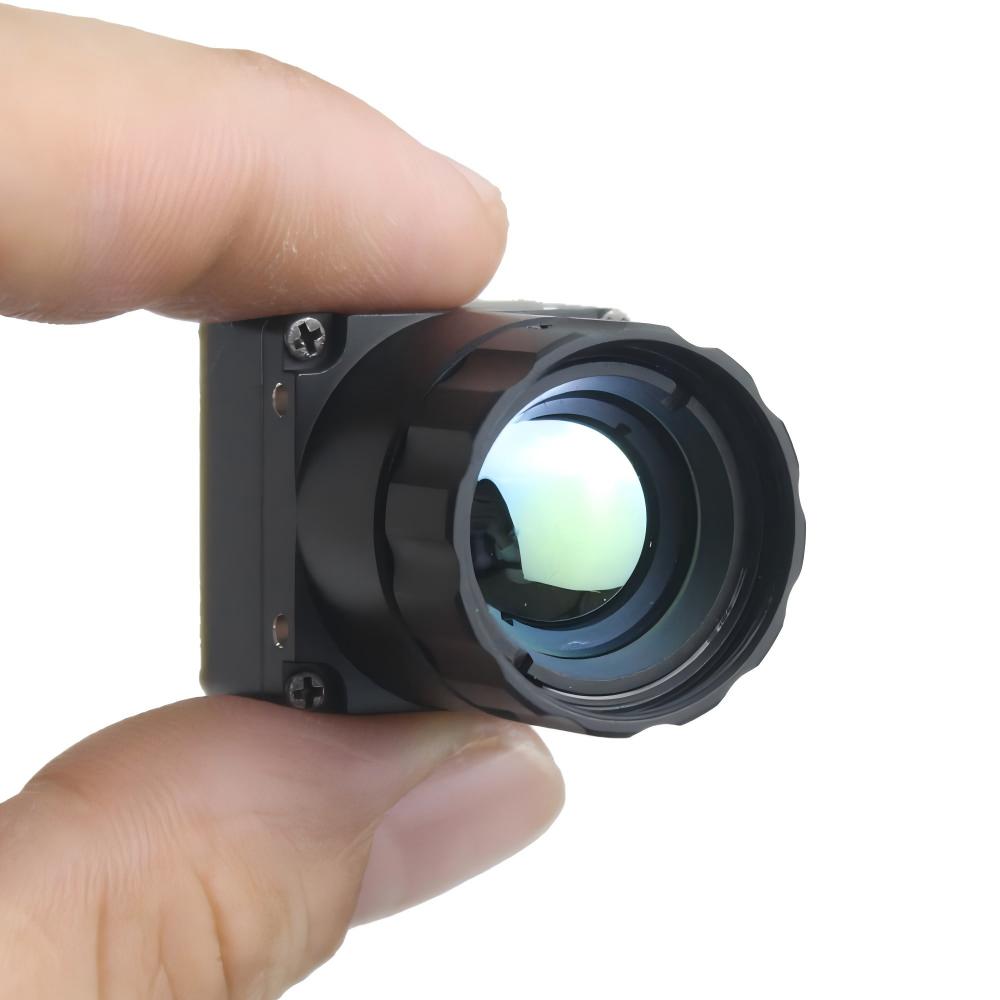
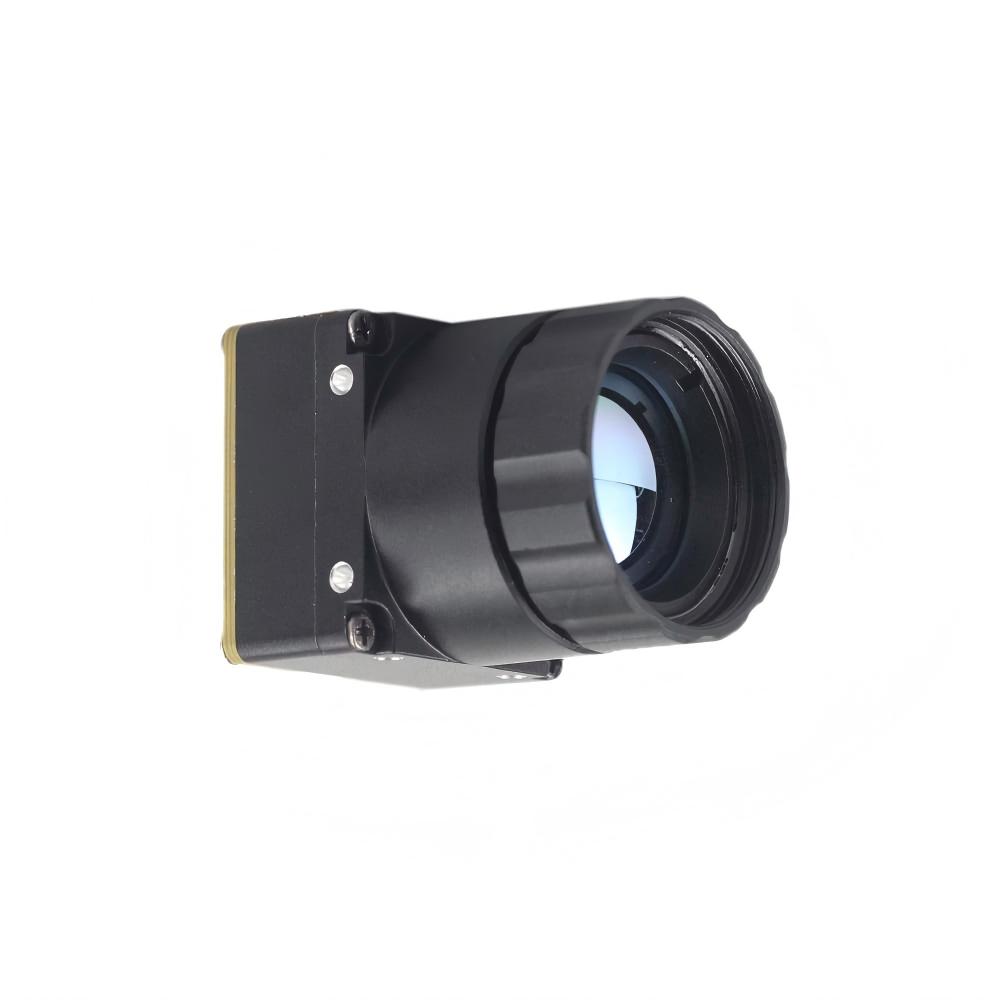
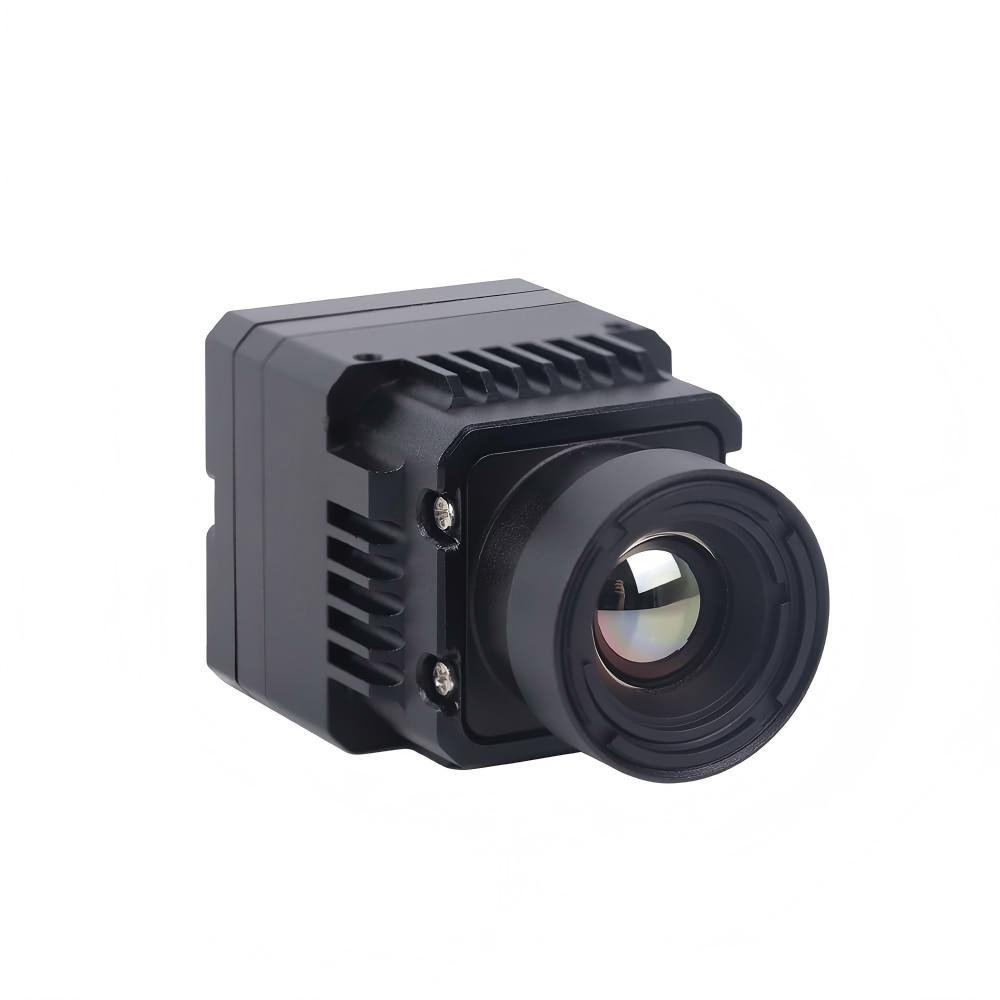
Product Showcase 1: Uncooled LWIR USB Mini 640*512 Thermal Imaging Camera Core Module For Drones Similar To DJI
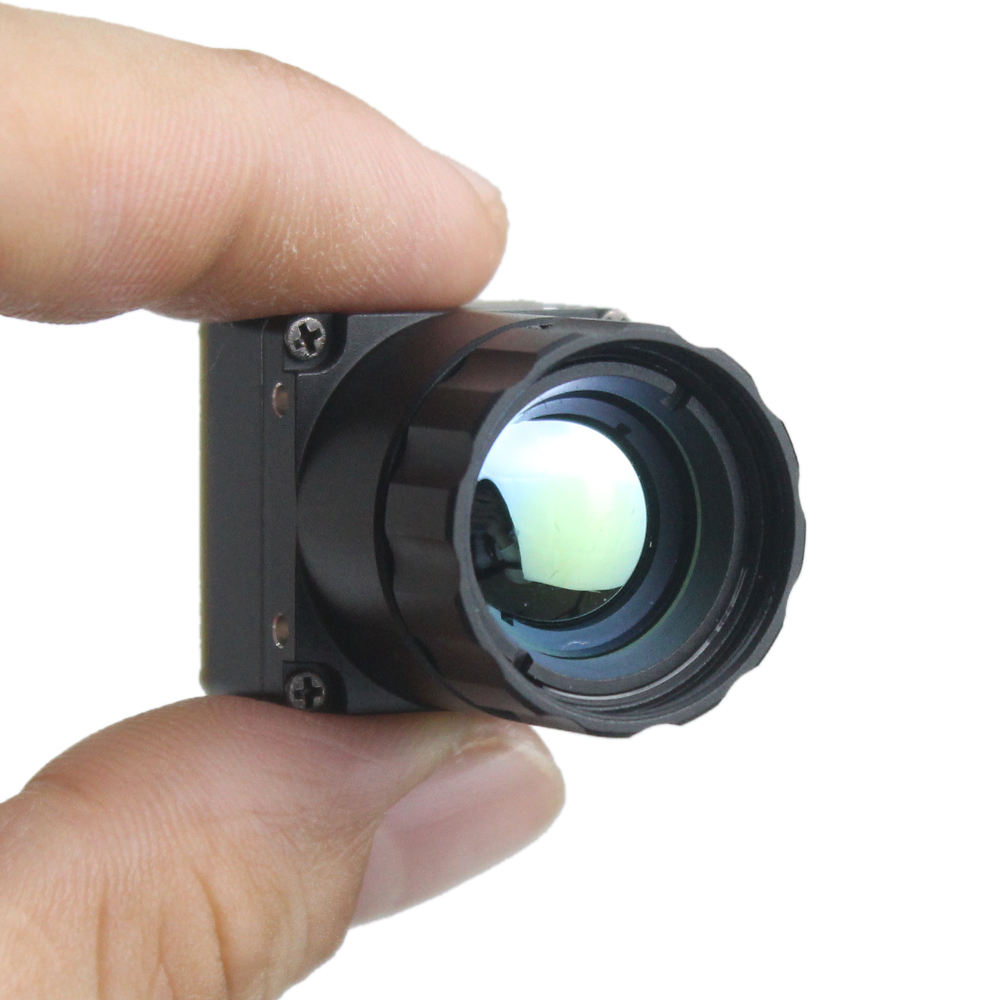
The Uncooled LWIR USB Mini 640*512 Thermal Imaging Camera Core Module is an ultra-compact thermal engine designed for drone gimbals, industrial machine vision rigs, and handheld inspection tools. Featuring sharp, high-contrast image presentation, an ultra-small 21mm × 21mm footprint, and low unit power draw, this core fits comfortably into tight payload envelopes.
This module provides wide optical versatility, offering lens configurations from wide-angle 5mm up to 150mm telephoto optics, and supports both 640×512 and 640×480 output options. Its robust optomechanical build ensures stable imaging and environmental adaptability across industrial temperature ranges.
| Product Model | Mini 640 Uncooled LWIR Thermal Camera Module |
| Dimensions | Mini-Size 21mm * 21mm |
| Array Resolution | 640×512 (640×480 optional) |
| Focal Length Options | 5mm, 9mm, 13mm, 18mm, 35mm, 50mm, 75mm, 100mm, 150mm |
| Interface Support | USB Digital Video / Control Protocol |
| Application Profile | Drone Gimbals (DJI class), Industrial USB Vision, Autonomous Inspection Payloads |
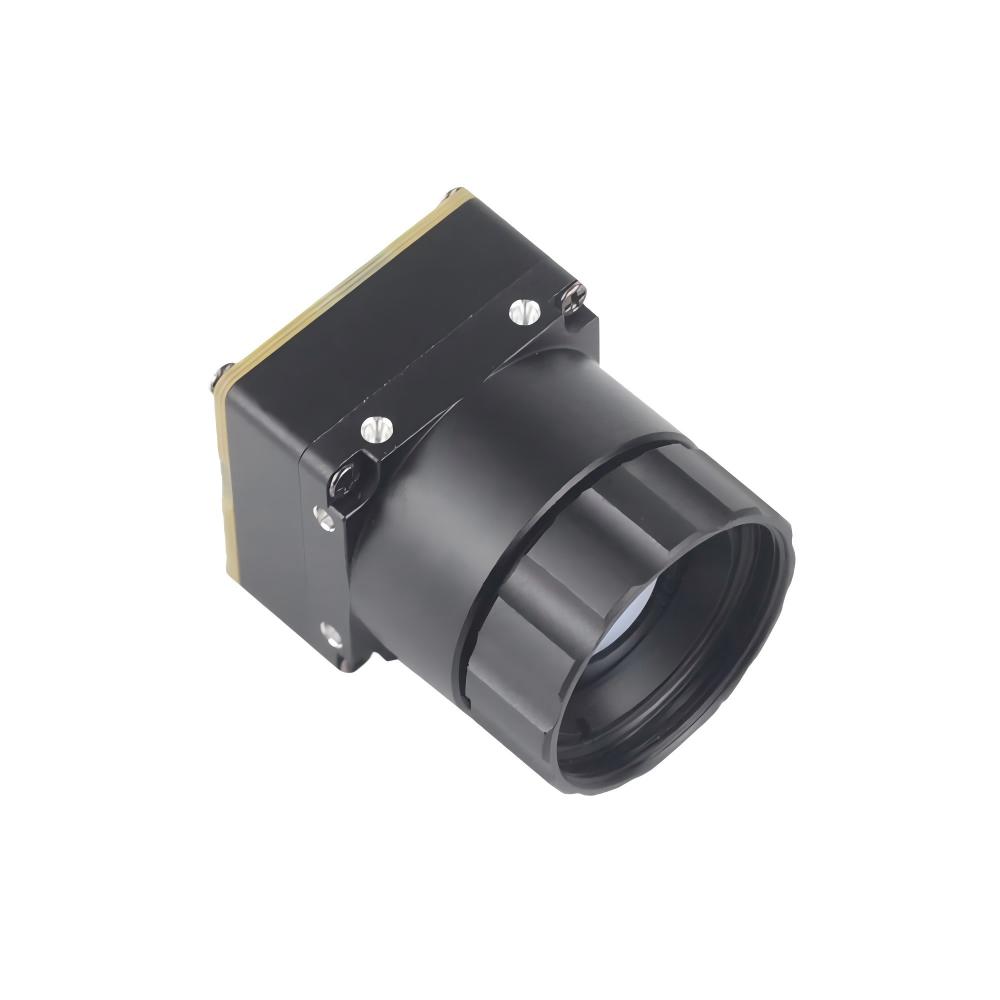
Product Showcase 2: Uncooled Infrared Mipi 640 384 256 9mm Thermal Imaging Camera Module For Drones
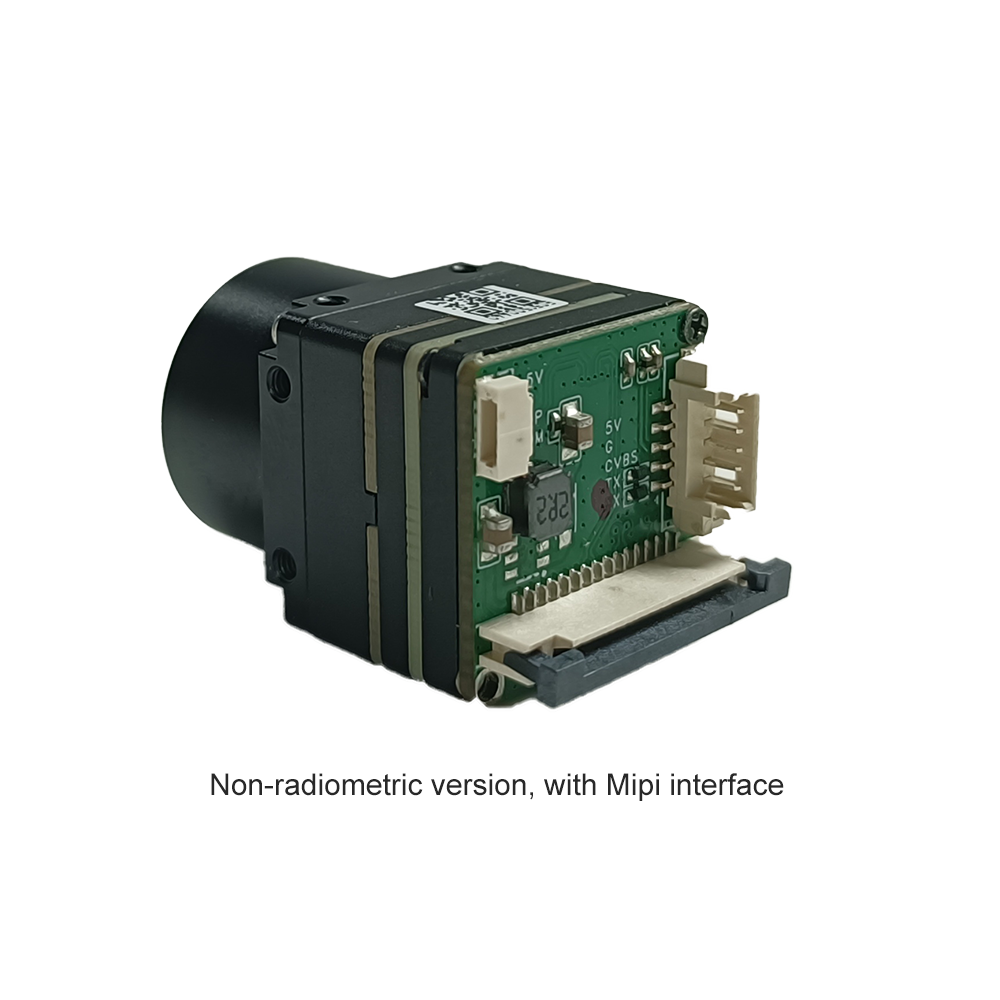
The Uncooled Infrared Mini2 640x512 9mm Thermal Imaging Camera Module For Drones is designed specifically for direct embedded system integration. Built for platforms where every millisecond of processing latency and every gram of weight matters, the Mini2 pairs a high-sensitivity VOx detector with a native MIPI output interface.
The Mini2 module features an integrated 9mm athermalized lens assembly, providing a well-balanced field of view for drone navigation, AI object detection, and infrastructure inspection. Available in 640×512, 384×288, and 256×192 array configurations, it allows developers to balance bill-of-materials cost against computing requirements across different product tiers.
| Product Model | Mini2 MIPI Uncooled Thermal Module |
| Resolution Configurations | 640×512 / 384×288 / 256×192 |
| Optical Configuration | 9mm Athermalized Optical Assembly |
| Interface Protocol | MIPI CSI-2 Direct Bus Output |
| Primary Target Architecture | Embedded AI Systems, Autonomous Drones, Micro Gimbal Payloads |
| Key Features | Ultra-low latency streaming, crisp image presentation, compact footprint, low power consumption |
5. LWIR Optics Selection Guide: Apertures, Focal Lengths, and Range (DRI)
Matching Lens Focal Lengths (5mm to 150mm) to Tactical Missions (DRI Analysis)
In thermal systems engineering, selecting optics is always a direct trade-off between Field of View (FOV) and target pixels across Johnson's Criteria (Detection, Recognition, Identification):
- ⚙️ Wide-Angle Lenses (5mm to 9mm): Deliver a wide horizontal field of view (HFOV > 45°). These are your go-to optics for indoor robotic navigation, close-quarters situational awareness, SLAM obstacle mapping, and automated landing pads.
- ⚙️ Mid-Range Lenses (13mm to 35mm): Provide a balanced field of view (between 30° and 12° HFOV). This is the sweet spot for search-and-rescue (SAR) drones, utility line auditing, and solar inspection from standard 30m to 60m operating altitudes.
- ⚙️ Telephoto Optics (50mm, 75mm, 100mm, 150mm): Narrow the FOV down below 6°, putting maximum pixels on distant targets. Used for long-range perimeter defense, border surveillance, and maritime patrol. For extreme standoff distance requirements, system integrators often step up to 1280x1024 12µm high-resolution thermal imaging systems.
Germanium vs. Chalcogenide Optical Elements & Athermalization
Standard glass blocks LWIR light entirely. You must use infrared-transparent materials with specific optomechanical properties:
- ⚙️ Single-Crystal Germanium (Ge): Boasts a very high refractive index (~4.0), making it easy to design fast f/1.0 and f/1.1 lenses with minimal spherical aberration. However, Germanium is dense, pricey, and has a high thermal index shift (dn/dT), which will blur your image if temperature shifts and the lens isn't compensated.
- ⚙️ Chalcogenide Glass: Can be precision-molded into aspheric elements at higher production volumes, cutting lens unit costs. It has a significantly lower dn/dT than Germanium, making optical athermalization much simpler to achieve.
- ⚙️ Passive Mechanical Athermalization: When a drone climbs from sea-level heat into freezing high altitudes (-20°C), lens focus will drift. Passively athermalized barrels combine aluminum, Delrin, or Invar sleeves that expand and contract at calculated rates to keep the optical focal point locked onto the FPA without noisy focus motors.
6. Advanced Signal Processing: Shutterless Algorithms, NUC, and DDE
Non-Uniformity Correction (NUC) and Shutterless Operation
Due to micro-scale manufacturing tolerances, no two microbolometer pixels have identical gain or baseline offset. Left uncalibrated, you get Fixed Pattern Noise (FPN)—a heavy static grain overlaying your image. NUC corrects this by applying a two-point linear transformation per pixel:
Where G(i,j) is your gain calibration matrix and O(i,j) is your offset matrix.
Mechanical shutters drop an internal flag in front of the sensor to recalculate the offset matrix, freezing video output for 300ms to 600ms. On a high-speed drone, that brief freeze can cause your visual tracking or flight controller to lose lock. Advanced VOx modules implement Scene-Based Non-Uniformity Correction (SBNUC). SBNUC continuously tracks spatial non-uniformities from natural scene motion over time, eliminating the mechanical shutter entirely, eliminating moving-part failures, and guaranteeing a smooth, uninterrupted frame stream.
Digital Detail Enhancement (DDE) and Contrast Optimization for Machine Vision
VOx cores output raw scenes with 14 bits of linear thermal dynamic range, but deep learning neural networks (like YOLO or SSD) and standard displays consume 8-bit data (0–255 grayscale). Simple linear down-sampling crushes low-contrast details, making subtle thermal signatures vanish into background clutter.
Digital Detail Enhancement (DDE) solves this by splitting the 14-bit image into two streams: a low-frequency base layer (overall background temperature gradients) and a high-frequency detail layer (fine edges, wire structures, target silhouettes). Adaptive bilateral filters boost the high-frequency detail layer without blowing out high-temperature regions, then compress the composite image into an 8-bit dynamic range. That gives your AI models razor-sharp edge boundaries to run object detection without false positives.
7. Deep-Dive Engineering FAQ
Why is VOx (Vanadium Oxide) preferred over Amorphous Silicon (a-Si) for thermal camera cores?
How do VOx thermal camera modules maintain stability under extreme environmental conditions?
Can VOx thermal cores be easily integrated into Edge AI systems via MIPI or USB interfaces?
8. OEM Integration Roadmap & Next Steps
Here is the battle-tested engineering blueprint for getting a VOx thermal engine integrated into your autonomous hardware platform:
- ⚙️ Stage 1: Optics & Range Budgeting: Calculate your Detection, Recognition, and Identification (DRI) targets using Johnson's Criteria. Pick the right focal length (from wide-angle 5mm for navigation up to 150mm for narrow ISR tracking) and lock down your interface requirements (MIPI CSI-2 for ultra-low latency or USB for modular prototyping).
- ⚙️ Stage 2: Power and Optomechanical Packaging: Route clean, isolated power rails drawing under 1.2W to keep electrical noise away from the ROIC. Match impedance on MIPI differential lines, clamp the core inside an athermalized, IP67 housing, and ensure structural heatsinking moves heat away from the focal plane.
- ⚙️ Stage 3: Firmware & Video Pipeline Tuning: Ingest the raw 14-bit linear stream into DMA buffers via V4L2. Configure SBNUC algorithms and tune Digital Detail Enhancement (DDE) bilateral filters to provide clean 8-bit dynamic contrast for your neural network models (YOLOv8, SSD, or custom classifiers).
- ⚙️ Stage 4: Chamber Stressing & Flight Validation: Run thermal soak cycles from -40°C to +80°C in an environmental chamber to verify athermal lens stability and radiometric lookup accuracy. Perform high-G vibration and gimbal resonance testing to ensure stabilization loops hold up under turbulent real-world flight conditions.
By pairing compact, industrial-grade VOx (Vanadium Oxide) microbolometer cores with flexible MIPI and USB interfaces, OEM engineering teams can deploy lightweight, high-performance thermal vision systems built to withstand the toughest operating environments.
📚 References & Further Reading
- Industry Standard: DFRobot Open Robotics & Embedded Vision Hardware Ecosystem
- Related Guide: Thermal Imaging Engineering & Sensor Technical Knowledge Base
- Related Guide: Converting Standard Visual Cameras to Thermal Systems: Engineering Principles
- Related Guide: 1280x1024 12µm Long-Range High-Resolution Thermal Optical Systems