
OEM Thermal Camera Module Selection & Integration Guide: Custom IR Cores for Drones & Machine Vision
2026年9月2日
Thermal Camera Module Manufacturer: High-Res Uncooled LWIR Cores for OEM & Embedded Vision
2026年9月3日
Best Thermal Camera Module Supplier: OEM High-Res Cores for Drones & Edge AI
When you're engineering unmanned aerial vehicles (UAVs), autonomous mobile robots (AMRs), or ruggedized handheld thermography tools, you run headfirst into the iron triangle of SWaP-C: Size, Weight, Power, and Cost. But cutting corners on thermal sensitivity or raw resolution to save a few grams is a trap. Selecting a reliable thermal camera module supplier isn't just a procurement line item—it's a foundational system architecture decision. That single choice dictates your end-to-end pipeline latency, Noise Equivalent Temperature Difference (NETD), signal-to-noise ratio, optical transmission efficiency, and edge inference throughput.
Here's the deal: when long-wave infrared (LWIR) microbolometer cores operate in the field, they take a beating. They face high aerial vibration, rapid ambient temperature swings, and razor-thin payload power budgets—often capped strictly under 1.5 Watts. Off-the-shelf consumer sensors choke in these conditions. They drift out of calibration, drown in fixed-pattern noise (FPN), and introduce crippling driver-level latency that wrecks closed-loop flight controllers and target trackers.
Tier-1 OEM thermal camera manufacturers build uncooled Vanadium Oxide (VOx) focal plane arrays (FPAs) using wafer-level packaging (WLP) paired with bare-metal video interfaces. We are talking native MIPI-CSI2, direct analog CVBS, and low-overhead parallel Digital Video Ports (DVP). These low-level buses let embedded engineers bypass the non-deterministic scheduling jitter and kernel stack overhead of generic USB UVC drivers. Whether your project demands calibrated, pixel-by-pixel radiometry for utility inspection, high-frame-rate analog feeds for tactical drone gimbals, or direct radiometric tensor streaming into embedded AI accelerators, choosing an established OEM partner guarantees precise optical alignment, factory-baked Non-Uniformity Correction (NUC), stable 5-to-7-year production lifecycles, and direct board support package (BSP) integration.
Table of Contents
- 👉 1. Uncooled LWIR Microbolometer Physics & VOx Sensor Architectures
- 👉 2. High-Speed Embedded Video Interfacing: MIPI-CSI2 vs. CVBS vs. USB3
- 👉 3. SWaP-C Engineering: Integrating Thermal Cores into UAV & Robotic Gimbals
- 👉 4. OEM Mini-Series Product Matrix & Technical Benchmarks
- 👉 5. Tier-1 Sourcing: Calibration, NUC, and Long-Term Supply Chain Reliability
- 👉 6. Deep-Dive Engineering FAQs
1. Uncooled LWIR Microbolometer Physics & VOx Sensor Architectures
Long-Wave Infrared (LWIR) sensing operates across the 8 µm to 14 µm atmospheric transmission window. It relies on detecting radiated electromagnetic energy emitted by any object above absolute zero, based on Planck's Radiation Law and the Stefan-Boltzmann Law. Cryogenic cooled sensors (like InSb or MCT detectors) yield insane sensitivity, but they require bulky, power-hungry Stirling cycle coolers. That completely rules them out for lightweight drones and edge systems. Instead, modern OEM thermal modules rely on uncooled microbolometer focal plane arrays.
Inside an uncooled microbolometer, every individual pixel consists of a microscopic, infrared-absorbing membrane suspended over a silicon Readout Integrated Circuit (ROIC). This membrane is held aloft by tiny, thermally isolated micro-bridge legs inside a high-vacuum, wafer-level packaged cavity. When incoming LWIR photon flux hits the membrane, the material heats up. That tiny thermal shift changes the electrical resistance of the thermistor thin film. The underlying ROIC measures this resistance delta by injecting a stable bias pulse, integrating the resulting charge across an internal capacitor, and converting that analog voltage into raw 14-bit or 16-bit digital counts via on-chip ADCs.
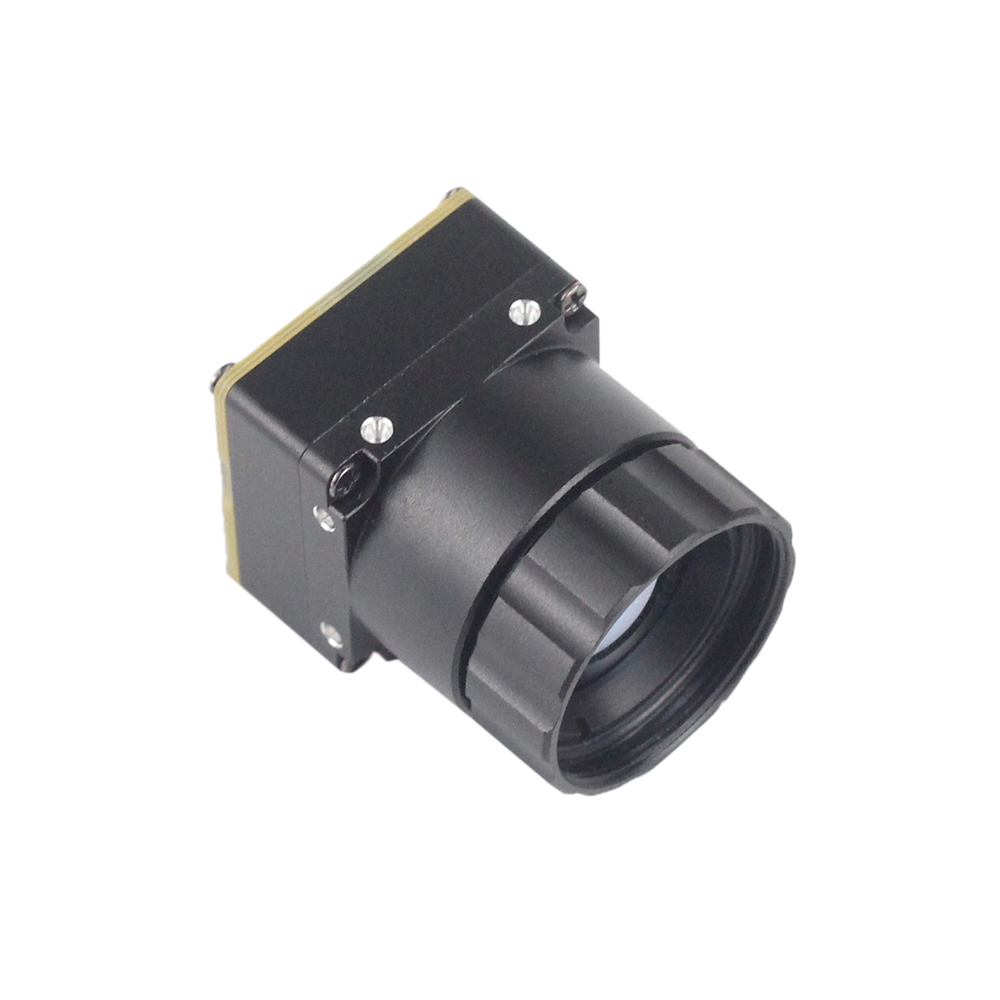
Vanadium Oxide (VOx) vs. Amorphous Silicon (a-Si) Thin-Film Performance
The chemical makeup of that thermistor thin film is one of the biggest differentiators between standard thermal cores and high-performance OEM modules. You will run into two main sensor chemistries across the industry: Vanadium Oxide (VOx) and Amorphous Silicon (a-Si).
- ⚙️ Temperature Coefficient of Resistance (TCR): TCR defines how much electrical resistance changes per degree Kelvin of temperature shift. High-grade VOx thin films deliver a TCR between -2.0%/K and -3.0%/K at room temperature. Standard a-Si sits much lower, around -1.5%/K to -2.2%/K. That higher responsiveness in VOx produces larger raw voltage swings per millikelvin of scene delta, easily pushing thermal sensitivity down to NETD ≤ 35 mK to 40 mK.
- ⚙️ 1/f Low-Frequency Flicker Noise: VOx features a stable crystalline structure that generates far less low-frequency 1/f flicker noise than amorphous silicon. Because 1/f noise steadily degrades baseline readout stability, a-Si arrays suffer from fast signal drift, forcing systems to trigger mechanical shutter clicks constantly. VOx arrays stay clean and stable over substantially longer operational windows.
- ⚙️ Thermal Time Constant (τ): This metric governs how fast the micro-bridge dissipates heat to its substrate and resets to thermal equilibrium. Modern VOx microbolometers hit fast thermal time constants between 8 ms and 12 ms. That speed allows native 30 Hz to 60 Hz frame rates without the annoying ghosting, smearing, or motion blur you often see during high-speed aerial yaw maneuvers.
For a complete breakdown of blackbody radiation curves and microbolometer detection mechanics, check out our in-depth reference on the thermal imaging principle and radiometric FPA physics.
Pixel Pitch Scaling: Moving from 17 µm to 12 µm Architectures
The microbolometer sector has largely transitioned from legacy 17 µm pixels down to 12 µm and sub-10 µm geometries. For an optical and mechanical engineer, this shrink is a massive win for SWaP-C. Spatial target resolution is governed by the Instantaneous Field of View (IFOV):
$$\text{IFOV} = \frac{p}{f}$$
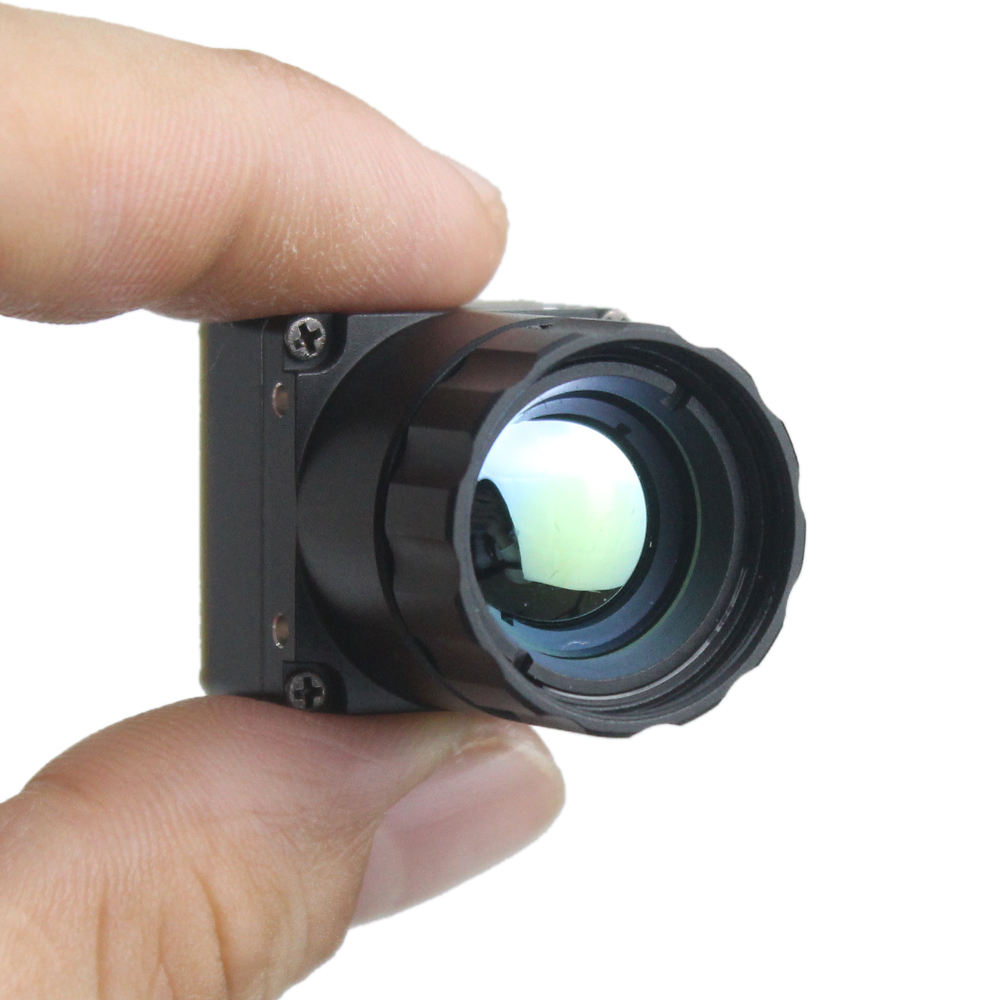
Where p is the physical pixel pitch and f is the focal length of your objective lens. Dropping pixel pitch from 17 µm down to 12 µm means you can achieve the exact same spatial target resolution on a distant object using an optical focal length that is 29.4% shorter. Shorter focal lengths mean smaller clear optical apertures (entrance pupils) while maintaining the identical optical speed (f/1.0 or f/1.1). That dramatically cuts the physical volume and weight of expensive, single-crystal optical Germanium (Ge). It allows an OEM thermal camera module supplier to fit a high-res 640×512 core into a package weighing under 20 grams—the sweet spot for sub-250g commercial inspection drones.
2. High-Speed Embedded Video Interfacing: MIPI-CSI2 vs. CVBS vs. USB3
Hooking an uncooled LWIR core up to an embedded processor isn't the same as wiring up a standard visible CMOS sensor. Thermal cores handle high-dynamic-range radiometric data (14-bit raw energy counts per pixel) right alongside tone-mapped, gain-controlled 8-bit visual streams (YUV or RGB with palette mapping). Picking the wrong hardware bus will instantly choke your memory bus, spike CPU utilization, and drop frames.
MIPI-CSI2: Zero-Copy Direct-to-Memory DMA Streaming
The Mobile Industry Processor Interface Camera Serial Interface 2 (MIPI-CSI2) is the undisputed king for embedded compute hardware like the NVIDIA Jetson series (Orin, Xavier), NXP i.MX8/i.MX9, and carrier platforms like the Raspberry Pi Compute Module 4/5. MIPI-CSI2 uses point-to-point differential clock and data lanes (D-PHY physical layer), delivering multi-gigabit throughput with rock-solid EMI immunity.
The real power of MIPI-CSI2 in thermal design is its hardware Direct Memory Access (DMA). Raw 14-bit radiometric frames (`RAW14` or unpacked `Y16`) dump straight into host RAM via the processor's hardware Image Signal Processor (ISP) or Video4Linux2 (`v4l2`) ring buffers. There are no intermediate USB driver stacks or OS scheduling hiccups. This zero-copy architecture keeps host CPU usage under 2% and cuts sensor-to-memory latency down below 5 milliseconds. If you're running closed-loop flight avoidance or feeding real-time tensors into TensorRT or ONNX Runtime models, this is the interface you want.
CVBS: Deterministic, Ultra-Low-Latency Analog Video
Composite Video Baseband Signal (CVBS) outputs raw analog baseband video (NTSC at 525 lines / 60 Hz or PAL at 625 lines / 50 Hz). CVBS doesn't stream 14-bit radiometric temperature arrays, but it remains the industry standard for tactical drone pilots, FPV spotters, and low-latency micro-gimbals. Because CVBS skips OS packetization, frame buffering, and driver handshakes entirely, latency from the microbolometer ROIC to the analog output is virtually instantaneous (≤ 1 ms). Hook that direct to a 5.8 GHz analog transmitter (VTX), and the pilot gets uninterrupted, real-time visual feedback without the catastrophic lockups that can occur with digital stream stalls.
USB 2.0 / 3.0 (UVC + CDC Radiometric Interfacing)
USB setups rely on standard USB Video Class (UVC) for the 8-bit visual stream, paired with a Communications Device Class (CDC) or custom vendor bulk endpoint to pump 14-bit raw temperature frames and serial control commands. USB is great for benchtop evaluation, rapid prototyping, and PC-based medical diagnostic rigs. But make no mistake: host OS USB scheduler queues, interrupt handling, and driver translation layers routinely introduce 30 ms to 100 ms of latency jitter. That makes pure USB a risky choice for high-bandwidth, multi-axis gimbal stabilization loops.
| Interface Protocol | Data Stream Capability | Latency (Core to Host RAM) | Host CPU Utilization | Primary Engineering Application |
|---|---|---|---|---|
| MIPI-CSI2 | 14-bit Raw Radiometric + YUV/RGB | ≤ 5 ms (Deterministic DMA) | Ultra-Low (< 2% on ARM64) | Embedded Edge AI, sUAS Autopilots, AMR Navigation |
| CVBS (Analog) | 8-bit Processed AGC Video (NTSC/PAL) | ≤ 1 ms (Direct Hardware) | Zero (No Host CPU Load) | FPV Tactical Drones, Direct RF Video Links |
| USB 2.0 / 3.0 (UVC) | UVC Video + 14-bit Bulk Radiometry | 35 ms – 100 ms (Jitter Prone) | Moderate to High (Driver Dependent) | Handheld Thermography, Benchtop Evaluation, PC Vision |
| DVP (Parallel CMOS) | 14-bit Raw / 8-bit ITU-R BT.656 | ≤ 8 ms | Low (FPGA / DSP Parallel FIFO) | Custom FPGA Pipelines, Industrial DSP Platforms |
3. SWaP-C Engineering: Integrating Thermal Cores into UAV & Robotic Gimbals
Packing an uncooled LWIR core into a high-bandwidth 2-axis or 3-axis brushless camera gimbal is a tough packaging challenge. Every gram you add directly eats into flight time, and every milliwatt of wasted heat turns into internal thermal noise right inside your sensor housing.
Minimizing Rotational Inertia and Motor Torque Demands
Brushless camera gimbals run fast Field-Oriented Control (FOC) loops—typically ticking between 400 Hz and 1000 Hz—to iron out flight turbulence, high-speed yawing, and high-frequency frame vibrations. The mechanical torque ($\tau$) needed from your direct-drive pitch and roll motors scales directly with the payload's mass moment of inertia ($J$):
$$\tau = J \cdot \alpha = (m \cdot r^2) \cdot \alpha$$
Where m is the combined mass of the thermal core and its lens, r is the distance from the center of mass to the rotational axis, and $\alpha$ is angular acceleration. Our ultra-compact OEM thermal modules weigh less than 20 grams bare, and under 35 grams with a 9mm athermalized lens assembly. That lets mechanical designers place the center of mass right on the intersection of the pitch and yaw axes. That drops inertia ($J$) to a minimum, enabling smaller motors (like 1806 or 2204 stators), lowering continuous battery draw, and preventing motor driver thermal shutdown in hot operating environments.
Optical Engineering: Germanium, Chalcogenide, and Anti-Reflective Coatings
Standard optical glass (like fused silica or BK7) is completely opaque to LWIR light across the 8 µm to 14 µm band. You have to cut thermal optics from exotic materials: single-crystal Germanium (Ge), Silicon (Si), Zinc Selenide (ZnSe), or specialized Chalcogenide glass. Germanium is great because it has a high refractive index ($n \approx 4.0$ at 10 µm), enabling compact optical designs with minimal spherical aberration. However, bare Germanium reflects roughly 36% of incident infrared energy at every air-to-glass interface due to Fresnel losses.
To fix this, high-tier OEM optics rely on Diamond-Like Carbon (DLC) or High-Efficiency Anti-Reflective (HEAR) multi-layer optical coatings. Specialized optical manufacturing suppliers like Rising Optics produce custom athermalized Germanium and Chalcogenide optical elements that push total optical transmission above 92% to 95% across the full 8–14 µm window. Athermalization is essential: by pairing optical materials with matching positive and negative thermal expansion and refractive index coefficients ($\mathrm{d}n/\mathrm{d}T$), the lens holds tack-sharp focus across harsh operating temperatures from -40°C to +80°C without mechanical refocusing.
Thermal Management & Thermodynamic Isolation
Microbolometers are fundamentally sensitive to ambient heat conducted or radiated from inside the gimbal pod. If motor drivers, onboard FPGAs, or video transmitters dump heat unevenly into the camera chassis, the FPA experiences thermal gradients that ruin the image with severe fixed-pattern noise. Industrial OEM cores solve this at the hardware level:
- ✅ Low Core Power Dissipation: Running at ≤ 0.8W to 1.2W continuous draw to eliminate internal self-heating issues.
- ✅ Integrated Substrate Thermistors: Monitoring ROIC silicon temperatures in real time via onboard precision sensor networks.
- ✅ Polynomial Lookup Tables (LUTs): Dynamically correcting pixel gain and offset drift on the fly as airframe temperatures fluctuate during rapid climbs and descents.
4. OEM Mini-Series Product Matrix & Technical Benchmarks
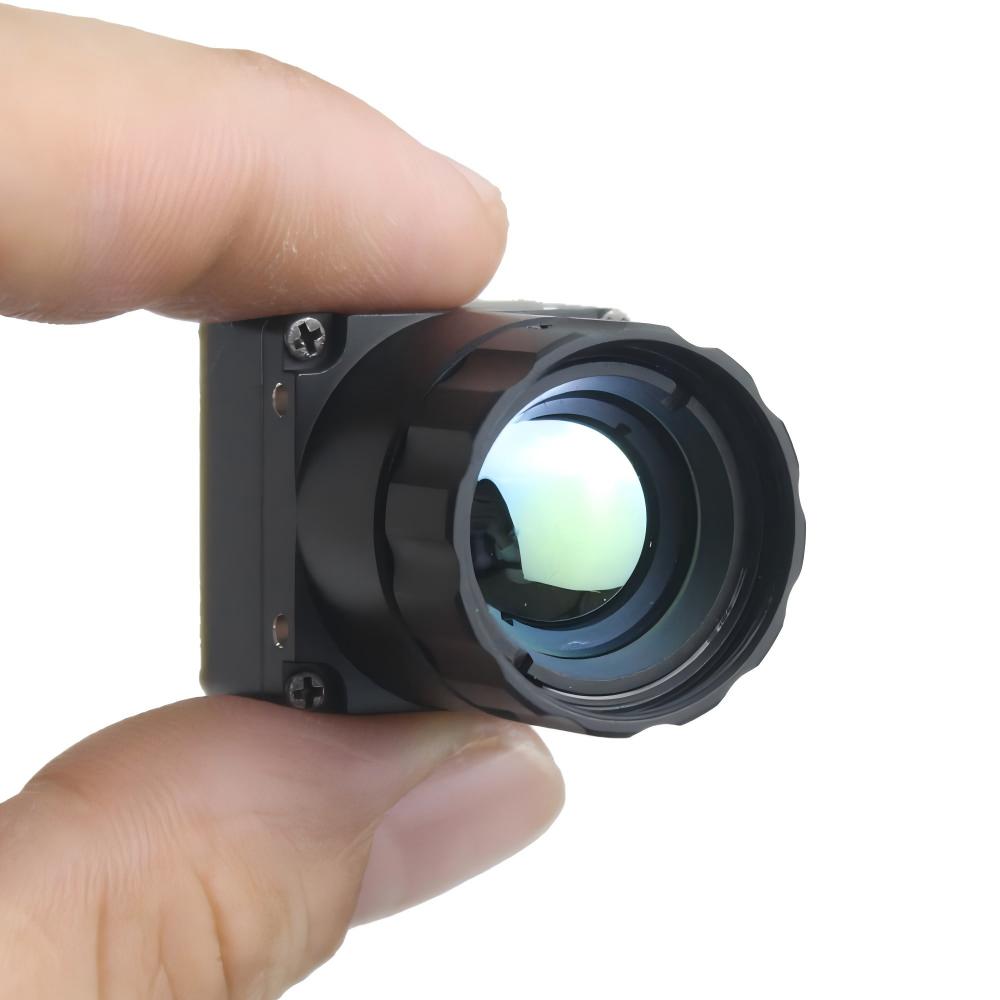
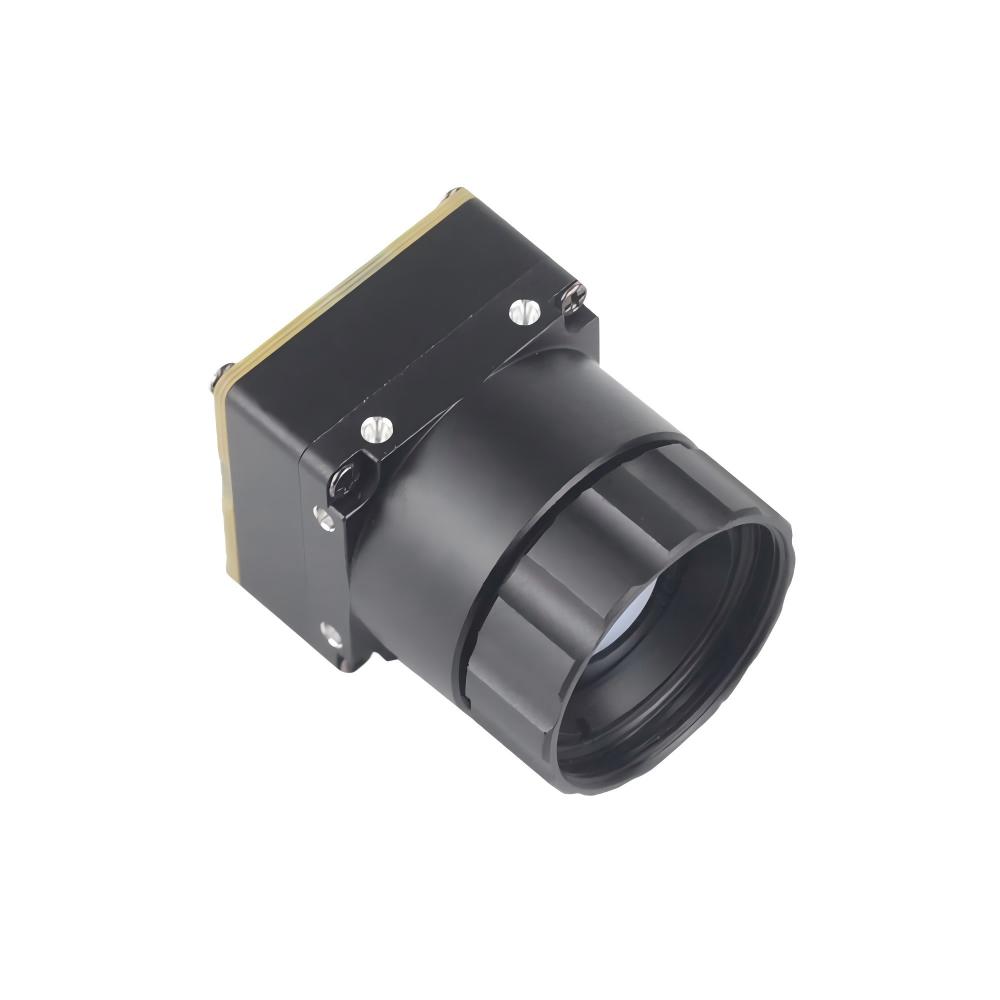
Purpleriver manufactures production-grade, ultra-compact uncooled LWIR microbolometer modules built for aerial platforms, robotic navigation, perimeter security, and continuous automated machine inspection. Here are the detailed hardware specifications for our flagship mini-series thermal cores.
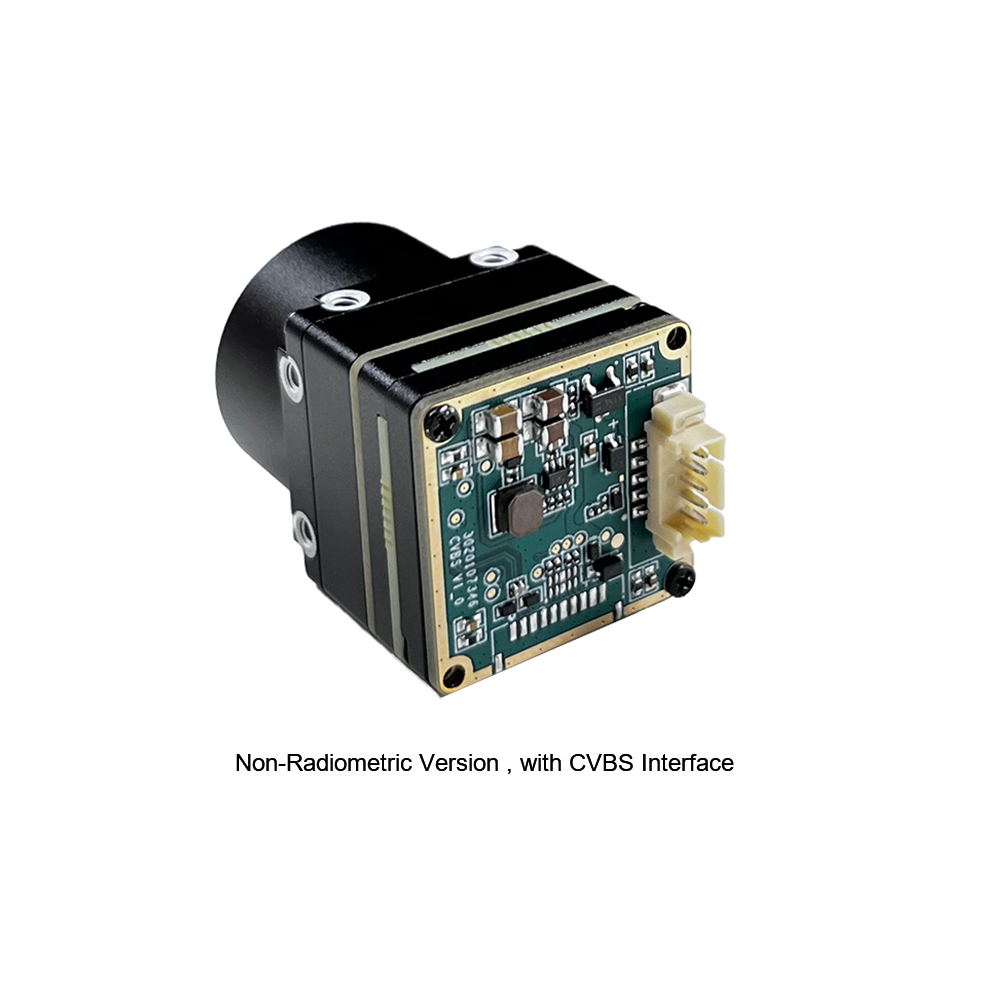
Uncooled Mini 384×288 Thermal Camera Module For Drones
The MINI series infrared thermal imaging temperature measurement module is a high-precision, small-sized, universal online radiometric core. Engineered with high-stability uncooled microbolometer detectors, it delivers reliable high-resolution thermal rendering, low power consumption, and versatile multi-interface connectivity. It represents the industry standard for machine vision, electrical safety inspection, intelligent factory manufacturing, predictive equipment maintenance, and airborne robotic drone systems.
| Detector Resolution | 384 × 288 Pixels |
| Spectral Band / Detector | 8 – 14 µm / Uncooled VOx Microbolometer |
| Thermal Sensitivity (NETD) | ≤ 40 mK @ 25°C, f/1.0 |
| Video Interfaces | Analog CVBS (PAL/NTSC), USB, UART Serial Control |
| Operating Mode | Online Full-Frame Radiometric Temperature Measurement |
| Target Deployment | FPV Drones, Robotic Airborne Platforms, Industrial Maintenance |
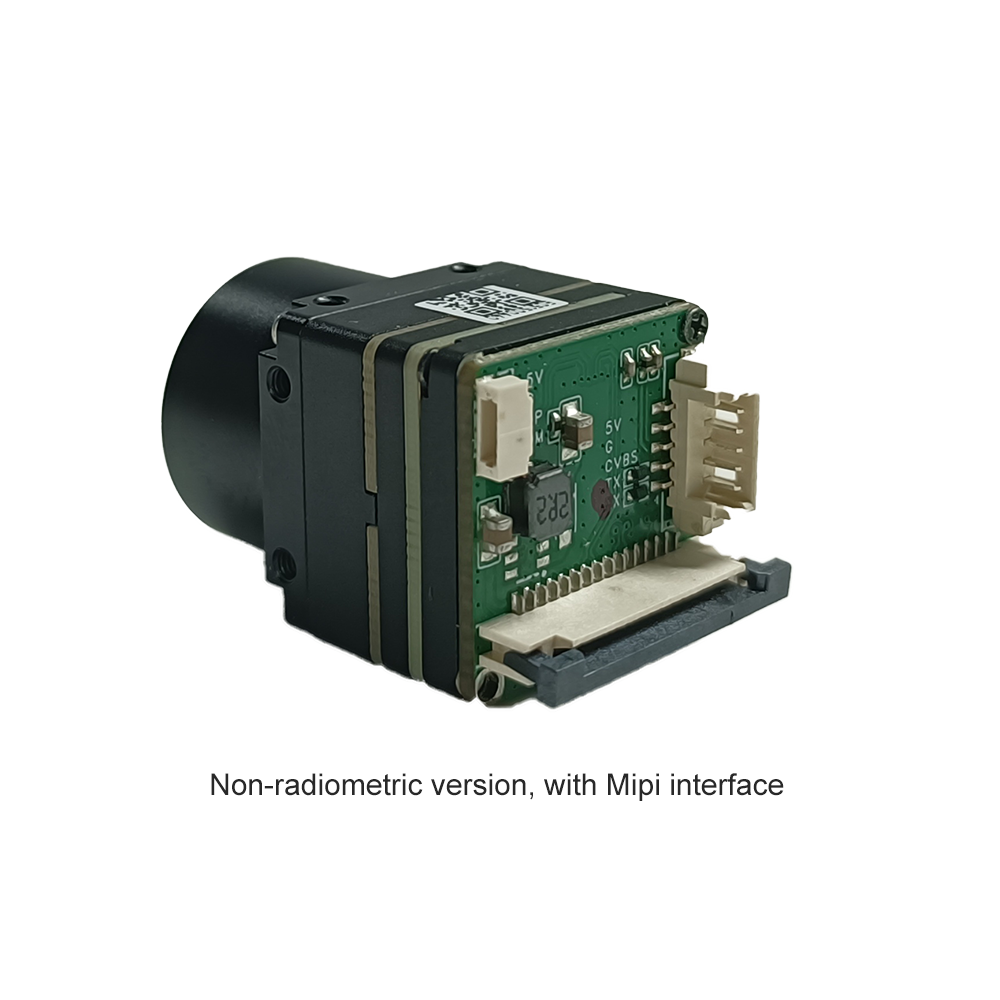
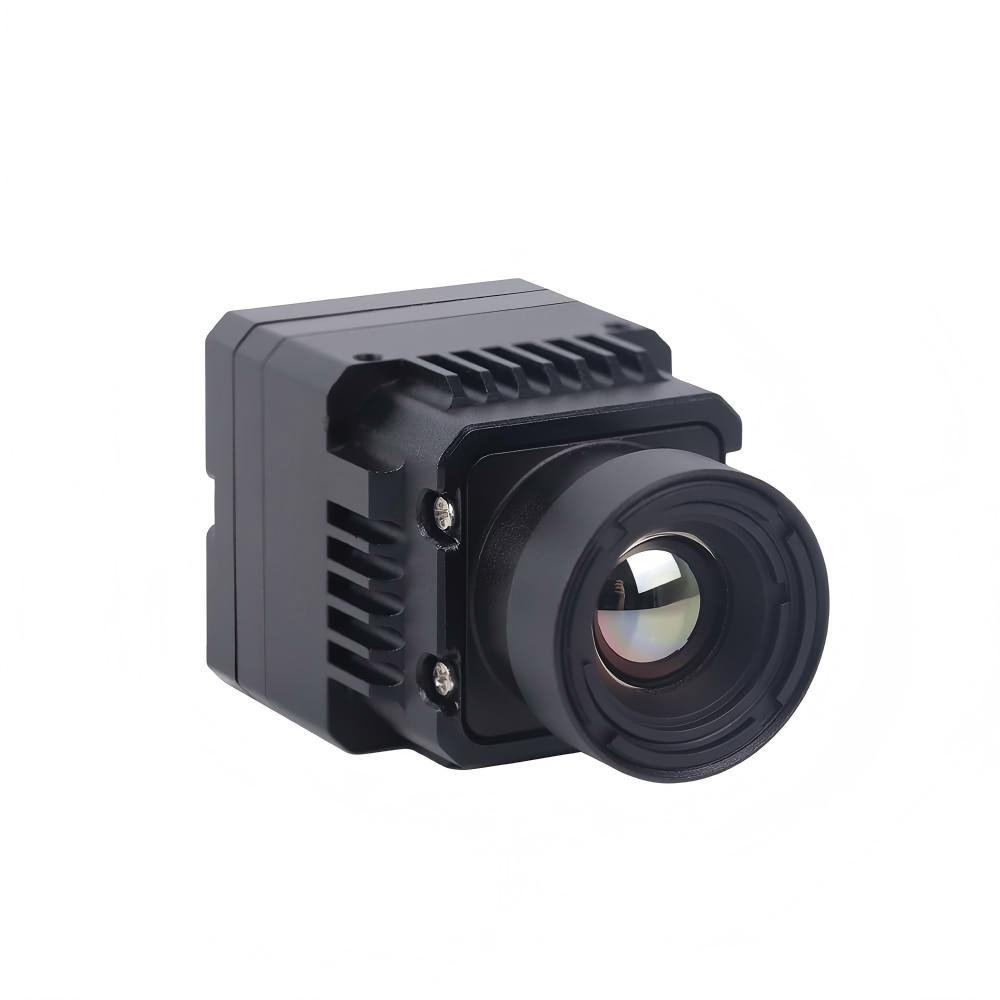
Uncooled Infrared MIPI 640 / 384 / 256 9mm Thermal Imaging Camera Module
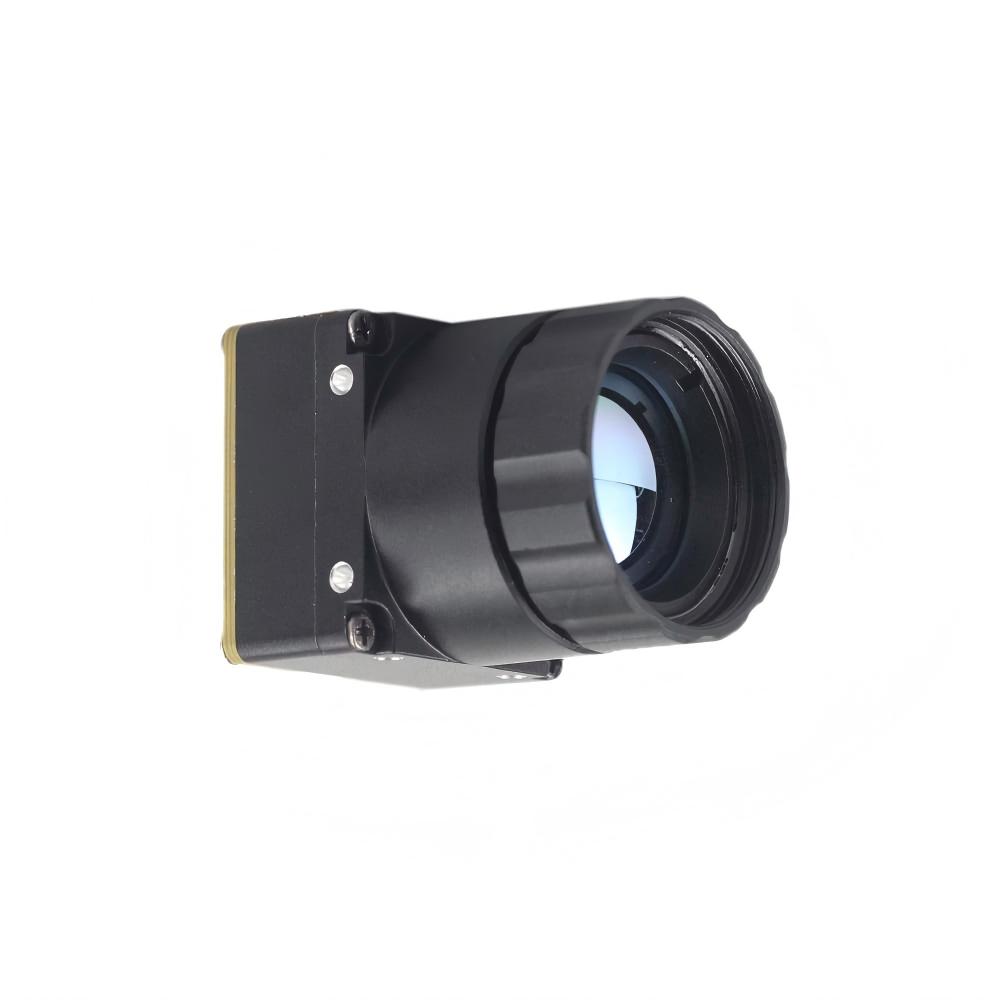
The Mini2 uncooled infrared thermal imaging camera module is engineered for SWaP-constrained aerial platforms and high-speed embedded processors. Featuring sharp, crisp image presentation, an ultra-compact volumetric footprint, and low unit production costs, the Mini2 series provides flexible multi-resolution sensor options (up to 640×512) paired with a high-transmission 9mm athermalized optical assembly. Its direct MIPI-CSI2 raw output makes it the premier choice for edge AI neural inference and autonomous drone navigation.
| Array Resolution Options | 640 × 512, 384 × 288, 256 × 192 (12 µm VOx) |
| Optical Configuration | 9mm High-Transmission Athermalized Lens |
| Primary Digital Interface | Native MIPI-CSI2 (Direct Host DMA) / DVP / Parallel |
| Analog Video Support | CVBS Composite Video Output Supported |
| Image Processing Pipeline | Hardware Non-Uniformity Correction (NUC), Digital Detail Enhancement (DDE) |
| Target Deployment | sUAS 3-Axis Gimbals, Autonomous AI Tracking, Edge Radiometry |
5. Tier-1 Sourcing: Calibration, NUC, and Long-Term Supply Chain Reliability
When you're sourcing an industrial thermal camera module supplier for mass production, datasheet specs are only half the battle. You have to audit the supplier's production testing infrastructure, calibration rigs, and supply chain lifecycle commitments.
Multi-Point Blackbody Factory Calibration
Out of the fab, raw microbolometer FPAs cannot measure accurate temperatures. Due to normal semiconductor doping variations, every single microbolometer pixel has its own unique baseline resistance, thermal slope, and dark-current characteristics. Tier-1 OEM cores go through comprehensive multi-point automated factory calibration across wide thermal chambers (-20°C to +60°C ambient testing across targets spanning -20°C to +550°C).
During this calibration cycle, the module is exposed to high-emissivity blackbody sources. The system calculates precise correction coefficients and burns them directly into onboard non-volatile flash:
- ⚙️ Two-Point Offset and Gain Calibration: Maps linear response curves for every individual pixel across multiple scene temperature spans.
- ⚙️ Dead Pixel / Bad Pixel Replacement (BPR): Maps non-responsive or unstable pixels and replaces them in real time using 3x3 or 5x5 neighborhood spatial interpolation in the FPGA/ASIC pipeline.
- ⚙️ Ambient Temperature Drift Compensation: Calibrates internal sensor thermistors against scene data to prevent measurement drift as air temperatures change at different flight altitudes.
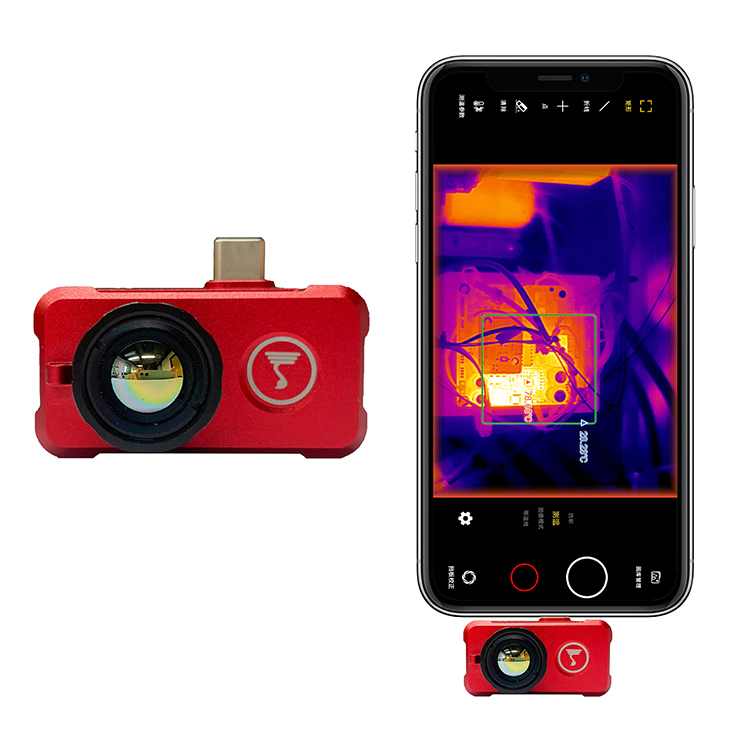
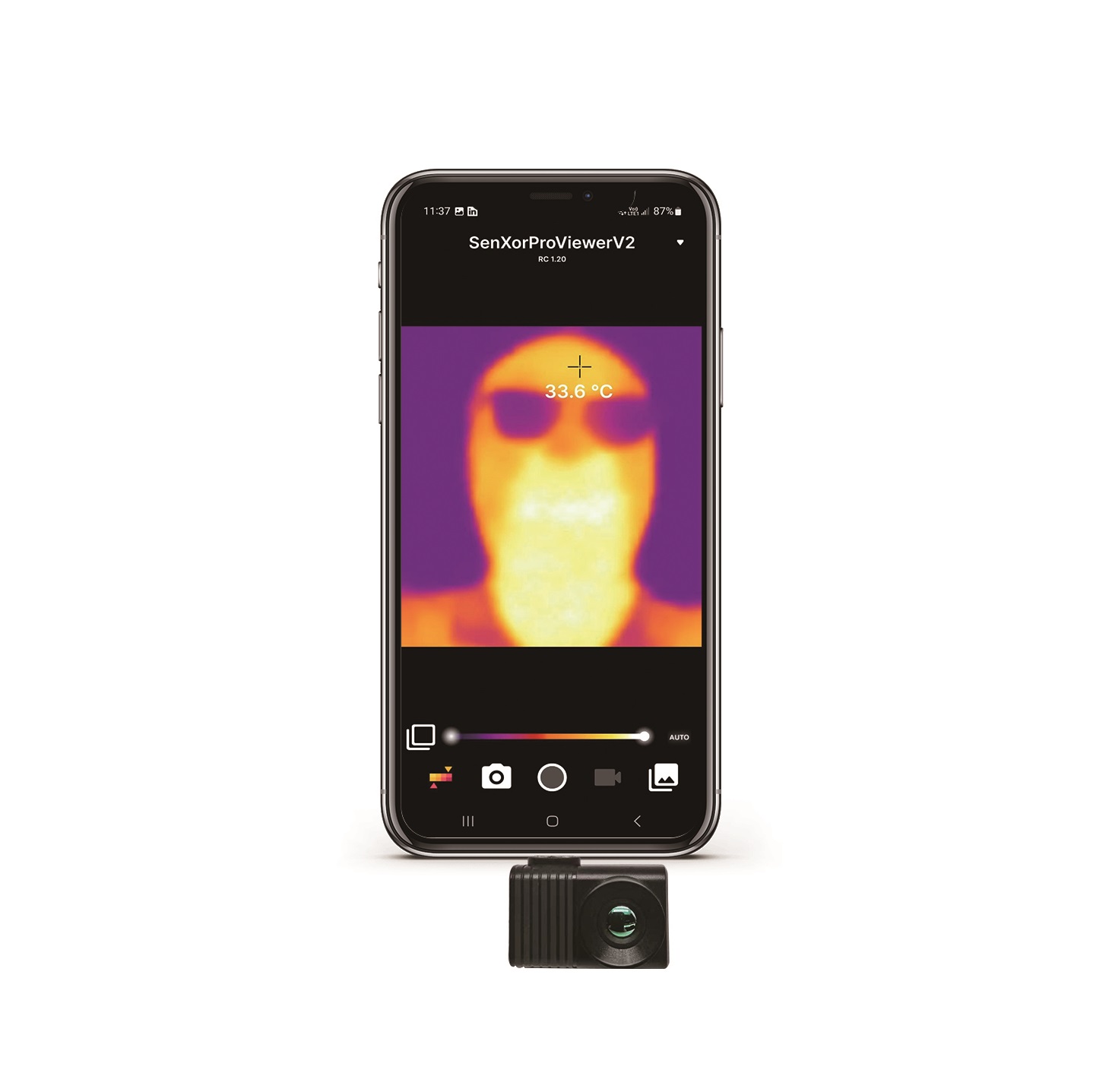
If your hardware targets handheld inspection tools or smartphone accessories, take a look at our practical guide on how to choose smartphone thermal imaging camera modules. For international teams looking for Russian-language technical documentation on compact cores, see our engineering guide on mini thermal imaging module cores.
Shutter-Based vs. Shutterless Non-Uniformity Correction (NUC)
As microbolometers run, internal self-heating and changing ambient air cause spatial drift, showing up as a cloudy pattern of fixed-pattern noise over the video. Standard modules drop an electromechanical shutter flag in front of the FPA for 200 ms to 500 ms to capture a uniform thermal reference frame. But in fast drone tracking, missile guidance, or automated perimeter defense, losing video for half a second can cause a lost lock or a crash.
Purpleriver integrates shutterless NUC algorithms directly on module hardware. By modeling the microbolometer's thermal transfer curve against internal sensor thermistors using polynomial regression, our shutterless modules clean up spatial drift continuously in software. You get uninterrupted 50/60 Hz video with zero screen freeze.
Long-Term Supply Chain Longevity (5–7+ Years)
Consumer parts get discontinued every 18 to 24 months. Aerospace, robotics, and industrial automation programs need hardware stability that lasts 5 to 10 years. Working directly with an established OEM manufacturer guarantees long-term wafer packaging continuity, pinout stability, ongoing Linux LTS kernel driver updates, and clear End-of-Life (EOL) roadmaps.
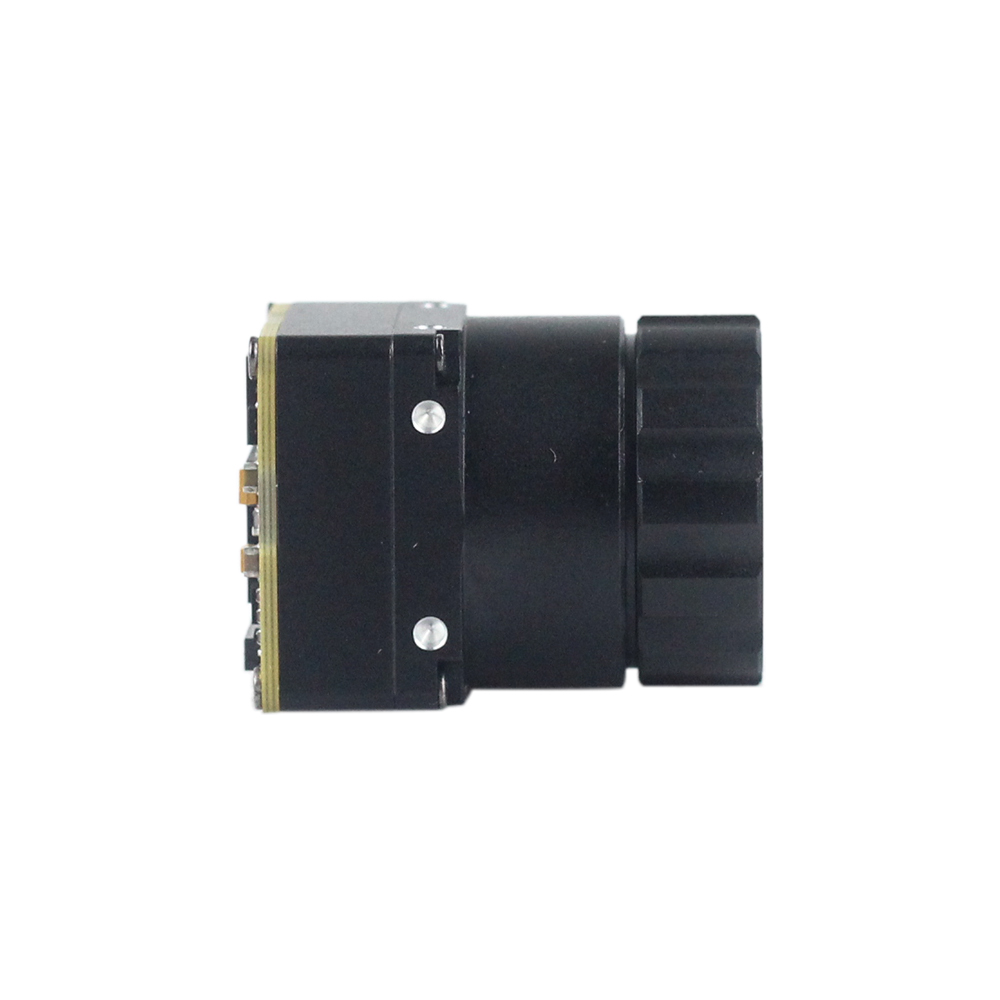
6. Deep-Dive Engineering FAQs
How do I select the right interface (MIPI, USB, or CVBS) for streaming thermal video to SBCs like Raspberry Pi or drone flight controllers?
If you're building a dedicated aerial FPV gimbal feeding an analog 5.8 GHz RF transmitter, CVBS (Composite Video Baseband Signal) gives you an uncompressed analog signal with sub-millisecond transmission latency—no OS drivers, no frame buffering, no lockups. USB 2.0 / 3.0 (UVC) is best left for benchtop testing, lab evaluation, and standard PC applications where driver plug-and-play matters more than strict real-time deterministic timing.
Why should industrial developers choose an OEM thermal module supplier over generic DIY sensor boards from online marketplaces?
An established industrial OEM thermal supplier provides high-sensitivity Vanadium Oxide (VOx) arrays (NETD ≤ 35 mK to 40 mK), true 12 µm pixel pitch architectures, factory-burned Non-Uniformity Correction tables, and shutterless drift compensation algorithms. OEM suppliers back their hardware with production Board Support Packages (BSPs), direct Linux kernel drivers (V4L2, ROS2, C/C++ SDKs), guaranteed 5-to-7-year hardware availability, and direct engineering support for optical and PCB integration.
Can Purpleriver thermal camera modules perform onboard Edge AI temperature tracking and object detection?
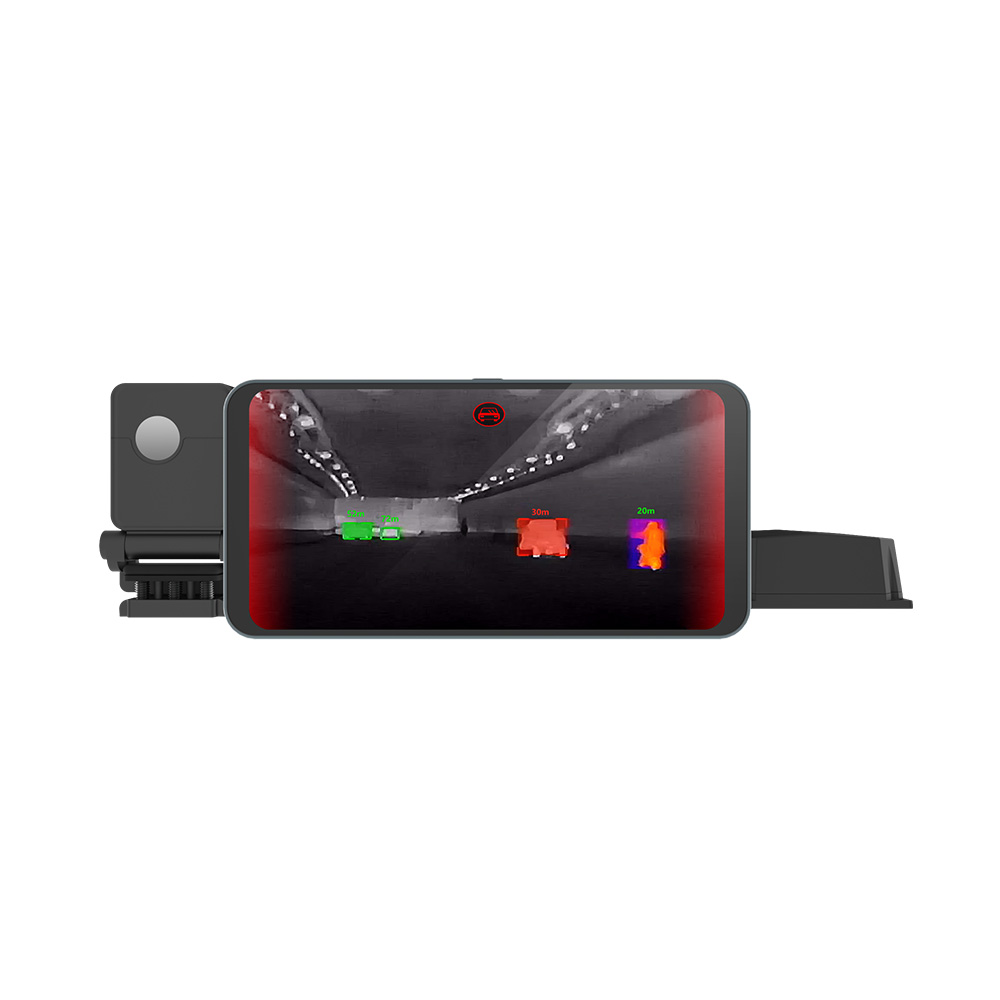
This multi-modal input powers advanced edge tasks: detecting hotspot anomalies across solar farms, finding people or vehicles through thick smoke or zero-light brush, spotting overheating industrial bearings, and detecting pipeline gas leaks. The core's onboard image processing engine handles spatial noise filtering, dead-pixel replacement, and dynamic range compression in hardware, leaving host CPUs fully available for real-time deep learning inference at 30 to 60 FPS.
What is the practical optical difference between a 12 µm and 17 µm thermal camera module when designing a drone gimbal payload?
In the shop, that means the magnification and field of view that used to require a heavy, expensive 13mm Germanium lens on an older 17 µm core can now be achieved with a compact 9mm lens on a 12 µm sensor. Because Germanium lens mass scales cubically with aperture diameter, switching to a 12 µm module like the Purpleriver Mini2 cuts overall optical payload mass by up to 40% to 50%. That massive drop in weight reduces gimbal motor torque requirements, cuts aerodynamic drag, and extends drone flight battery life.
📚 References & Further Reading
- Industry Standard: Raspberry Pi — Embedded Compute Platforms & MIPI-CSI2 Host Integration
- Industry Standard: Rising Optics — Precision Infrared Germanium & Chalcogenide Optical Assemblies
- Related Guide: Thermal Imaging Principle & Radiometric Microbolometer Physics
- Related Guide: How to Choose the Best Smartphone Thermal Imaging Camera Module
- Related Guide: Mini Thermal Imaging Module Cores & Architectural Selection Guide