

Low Power Consumption Thermal Camera Modules: Maximizing Efficiency for Drones & Edge AI
2026年8月27日
Best ≤50mK NETD Thermal Module Guide: OEM Cores for High-Sensitivity Imaging
2026年8月28日
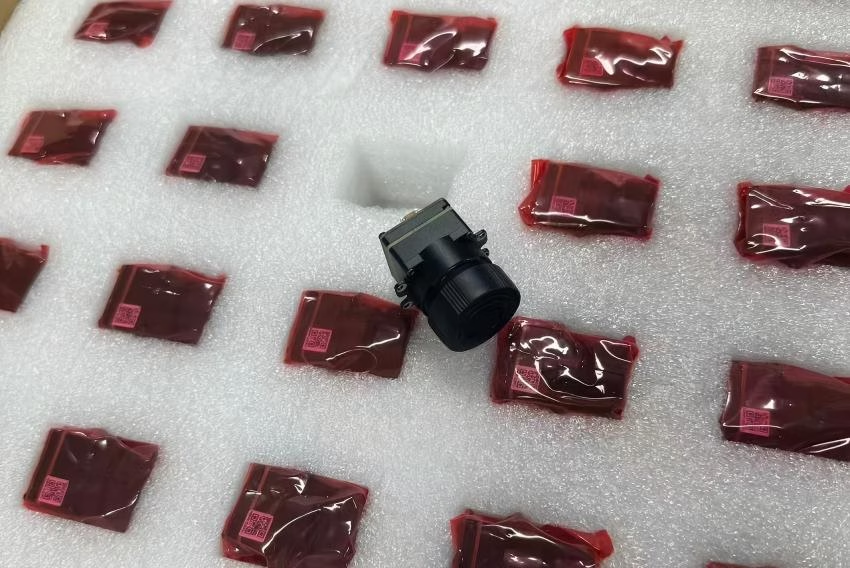
Ultra-Low Power <0.5W Thermal Module for Drones & IoT | Compact OEM Cores
If you've spent any real time designing tactical micro-gimbals, micro-UAVs, or distributed Industrial IoT (IIoT) sensor nodes, you already know the brutal reality of thermal imaging: power and heat are your worst enemies. For years, legacy long-wave infrared (LWIR) camera cores have been notorious power hogs, pulling anywhere from 1.5W to well over 4.5W of continuous juice. Pack that kind of heat into a sealed, miniature pod with zero airflow, and you get an immediate thermal disaster. That excess wattage turns the inside of your housing into a miniature oven, triggering sensor calibration drift, horrific fixed-pattern noise (FPN), destroyed Noise Equivalent Temperature Difference (NETD), and batteries that drain before the mission even gets off the ground. The breakthrough of the true <0.5w thermal module completely flips the script on electro-optical design, giving engineers full-motion radiometric surveillance, automated machine vision, and crisp night vision inside a razor-thin sub-500mW power budget.
Here's how we got here: we stopped relying on bulky, power-hungry FPGA image processors and moved straight to dedicated ultra-low-power Application-Specific Integrated Circuits (ASICs) matched with cutting-edge 12μm uncooled Vanadium Oxide (VOx) microbolometers. The result? Modern OEM thermal cores that deliver clean, crisp thermal video without turning your payload into a hot plate. Whether you're building sub-250g micro-drones (sUAS), remote solar-backed perimeter sentries, night-vision helmet rigs, or rugged diagnostic tools, ditching multi-watt cores eliminates the dead weight of copper heat pipes, thick aluminum heatsinks, and complex multi-stage power rails. In this engineering guide, we'll tear down the microbolometer physics, ASIC pipeline breakthroughs, SWaP-C advantages, digital interconnects, and dynamic calibration routines needed to run sub-half-watt thermal imagers in mission-critical hardware.
Table of Contents
- 👉 1. The Physics and Microbolometer Architecture Behind <0.5W Thermal Modules
- 👉 2. ASIC vs. FPGA Signal Processing: Breaking the Sub-500mW Barrier
- 👉 3. SWaP-C Optimization in Drones, Micro-Gimbals, and Edge IoT Nodes
- 👉 4. Hardware Integration, Embedded Interfaces & Transmission Protocols
- 👉 5. OEM Product Specifications & Comprehensive Hardware Showcase
- 👉 6. Thermal Mass Calibration, Drift Compensation, and Noise Mitigation
- 👉 7. Deep-Dive Technical FAQ
1. The Physics and Microbolometer Architecture Behind <0.5W Thermal Modules
To understand how we get high-resolution thermal imaging running on less power than an indicator LED rail, look at the base physics. Uncooled long-wave infrared (LWIR) sensing captures raw photon radiation across the 8μm to 14μm spectrum, adhering directly to Planck's blackbody distribution as explored in classic thermography. At the heart of the core is the Focal Plane Array (FPA). In an uncooled engine, every single detector pixel is a microscopic MEMS bridge suspended over a silicon Read-Out Integrated Circuit (ROIC) by tiny micro-cantilever legs engineered for extreme thermal isolation.
When incoming thermal energy hits the thin-film layer—usually Vanadium Oxide (VOx)—that absorbed photon energy heats the bridge, changing its bulk electrical resistance. In high-grade VOx films, we see a Temperature Coefficient of Resistance (TCR) running between -2%/K and -3%/K. To maintain a crisp 50Hz frame rate without image lag or ghost trails across the display, that suspended micro-bridge has to maintain ultra-low thermal mass with a thermal time constant (τ) under 10 milliseconds.
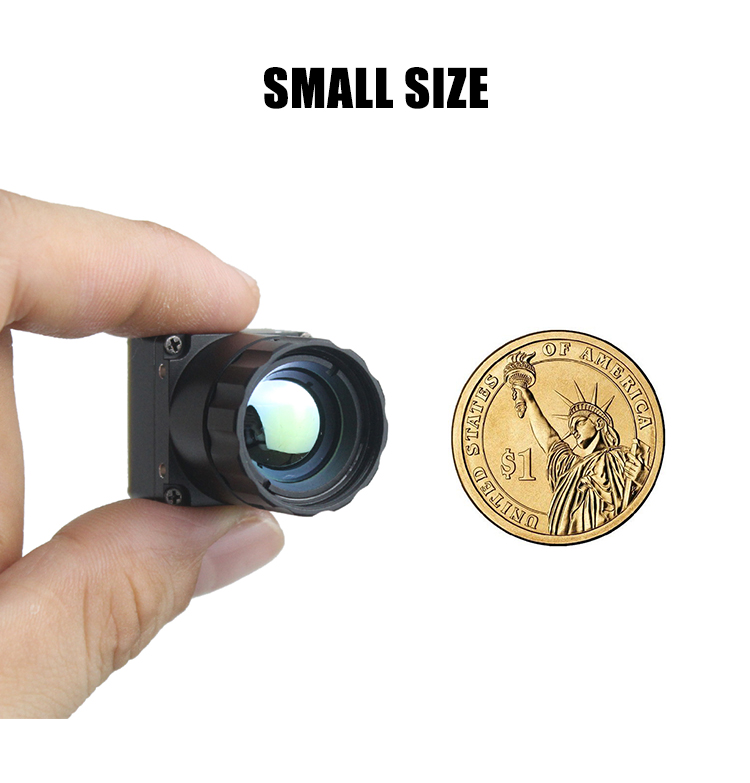
12μm Pixel Pitch and Thermal Capacitance Scaling
Back in the day, uncooled bolometers were built around 25μm and 17μm pixel nodes. While those fat pixels sucked down plenty of photons, they forced ROICs to use huge integration capacitor wells and massive bias currents. Shrinking down to a 12μm pixel pitch is what made sub-0.5W continuous operation an actual engineering reality:
- ⚙️ Drastically Smaller Die Footprint: A 640×512 array on a 12μm pitch occupies roughly 48% of the silicon area needed by an older 17μm array. That massive drop in physical area significantly cuts parasitic capacitance across internal clock buses and interconnect matrices.
- ⚙️ Lower Excitation Energy Thresholds: Because the physical volume of a 12μm VOx bridge is minute, its thermal capacitance drops through the floor. The sensor requires much lower pulsed bias voltages and shorter integration currents during the ROIC sample phase to produce a stellar Signal-to-Noise Ratio (SNR).
- ⚙️ Sub-Threshold ROIC Biasing: Modern low-power ROICs drive on-chip preamplifiers and analog-to-digital converters (ADCs) in near-threshold or sub-threshold regimes. This keeps raw detector die power dissipation pegged between a lean 35mW and 75mW during active 50Hz streaming.
Optical Transmission, Aperture Matching, and NETD Sensitivity
There is an old myth in the optics lab that smaller pixels and lower power automatically destroy thermal sensitivity. That is completely outdated. Modern <0.5w thermal cores consistently achieve a Noise Equivalent Temperature Difference (NETD) of ≤ 40mK (at f/1.0, 300K, 50Hz). This level of clarity comes from precision anti-reflective coated Germanium (Ge) optics and high-refractive-index Chalcogenide glass elements matched directly to the array.
Because the core produces virtually zero self-heating, you don't get thermal gradients between the lens barrel and the FPA. This eliminates unwanted housing radiation bleed, allowing optical designers to integrate lightweight $f/1.0$ to $f/1.2$ prime lenses without running into corner vignetting or severe radiometric temperature offsets.
2. ASIC vs. FPGA Signal Processing: Breaking the Sub-500mW Barrier
Look under the hood of a thermal camera and you'll find that digital signal processing (DSP) is where power budgets are usually blown. The raw analog feed coming off a microbolometer ROIC is unusable out of the box. It is packed with high DC offsets, fixed spatial noise, temperature drift, and bad pixels. Turning that raw 14-bit data stream into an actionable, high-contrast 8-bit image takes serious real-time math.
The Power Penalty of Legacy FPGA Architectures
Traditional thermal imagers have long leaned on Field-Programmable Gate Arrays (FPGAs) like Xilinx Artix/Spartan or Intel Cyclone chips. FPGAs are great for bench prototyping, but their generic silicon architecture—millions of reconfigurable Look-Up Tables (LUTs), sprawling interconnect matrices, and continuous clock distribution trees—suffers from massive static leakage and high dynamic switching losses. Throw in the required external DDR3/DDR4 SDRAM chips to buffer intermediate frames for temporal filtering, and an FPGA DSP block easily burns 1.8W to 3.5W just crunching raw pixels. Sub-watt operation on an FPGA board is dead on arrival.
Monolithic Low-Power ASIC Pipeline Architecture
A true <0.5w thermal module solves this by swapping the power-hungry FPGA for a dedicated, single-die Application-Specific Integrated Circuit (ASIC) fabricated on modern 28nm or 22nm FinFET nodes. The entire infrared image processing chain is hardwired directly into dedicated silicon logic gates, backed by on-chip SRAM caches that completely eliminate power-hungry external RAM transactions.
Here is what the hardwired ASIC pipeline executes at full pixel-clock speed with minimum current draw:
- ⚙️ Hardware Non-Uniformity Correction (NUC): High-speed multiplier-accumulator (MAC) blocks execute real-time two-point offset and gain correction directly as digital samples exit the ADC.
- ⚙️ Defective Pixel Concealment (DPC): Dynamic spatial interpolation hardware pinpoints dead or saturated micro-bridges on the fly, substituting clean adjacent pixel data with zero frame latency.
- ⚙️ Digital Detail Enhancement (DDE): Hardware-driven spatial convolution filters pull out high-frequency structural edges—like building perimeters, thin power lines, and vehicle contours—and blend them seamlessly over wide-dynamic-range backgrounds.
- ⚙️ Radiometric Temperature Processing: Dedicated mathematical logic converts 14-bit digital counts into calibrated temperature values in Kelvin or Celsius using factory blackbody lookup tables, outputting real-time spot, line, and regional telemetry.
- ⚙️ Dynamic Range Compression (DRC) & Color Palettes: Adaptive histogram engines squeeze wide-range 14-bit data into crisp 8-bit video streams (YUV, RGB, or monochrome) with user-selectable palettes like White Hot, Black Hot, Ironbow, and Rainbow.
Because this ASIC runs directly on hardwired logic gates instead of burning clock cycles executing software instructions on microcontrollers or generic FPGA fabric, the whole DSP engine draws only 250mW to 350mW. Add in the ultra-low-bias ROIC and high-efficiency switching regulators, and the entire thermal core cruises under continuous loads at just 400mW to 480mW.
3. SWaP-C Optimization in Drones, Micro-Gimbals, and Edge IoT Nodes
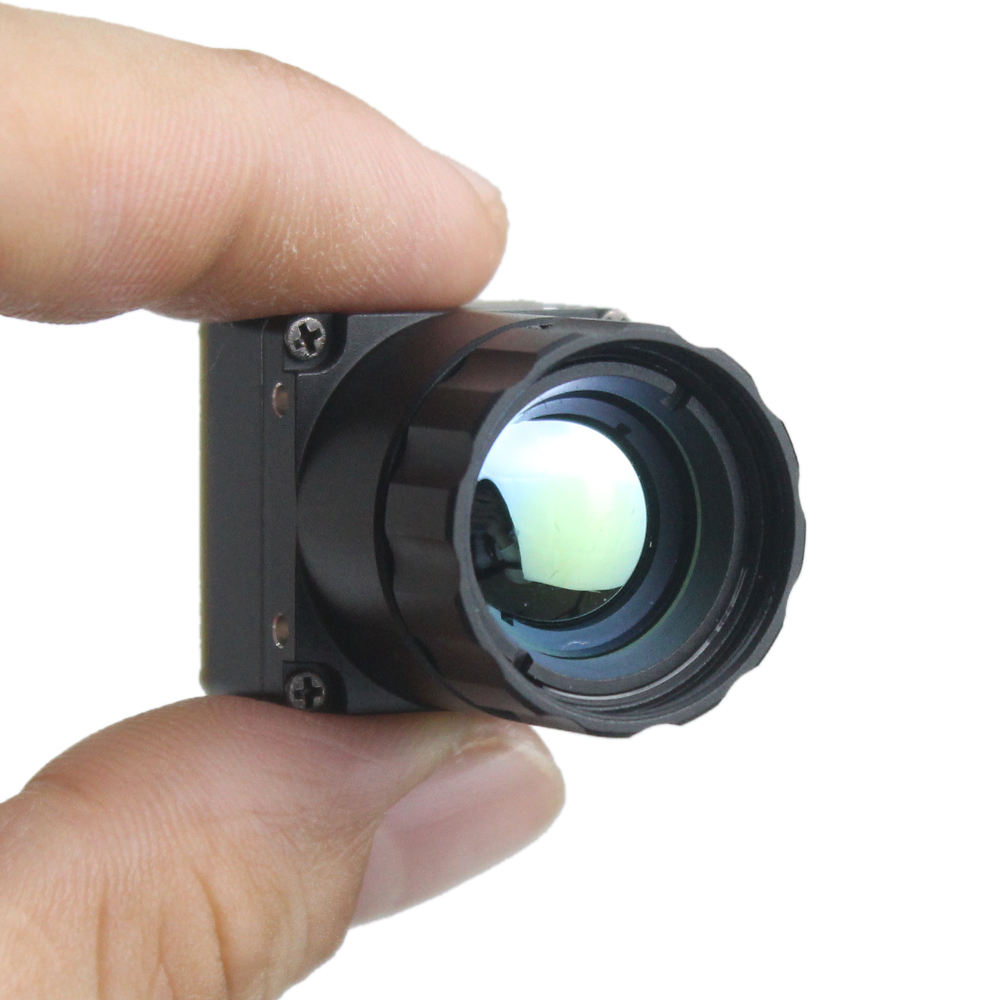
In aerospace and industrial robotics, every design review comes down to SWaP-C: Size, Weight, Power, and Cost. Chopping your camera core down to sub-500mW creates a massive positive ripple effect across your entire mechanical and electrical design.
Micro-UAV Payload Mechanics in the Field
On tactical reconnaissance drones and commercial inspection quadcopters, every single gram translates directly into lost flight time. In a stabilized gimbal ball, dropping the core weight from 90g down to under 20g reduces the rotational moment of inertia ($I = m \cdot r^2$) by orders of magnitude. This means you can drop down to tiny, ultra-low-torque brushless motors, slashing your gimbal stabilization power while dramatically increasing tracking bandwidth and horizon stability during high-speed wind buffeting.
Remote Industrial IoT and Solar-Harvesting Sensing Nodes
In distributed condition monitoring—like substation transformer tracking, perimeter security, and flare-stack monitoring—running AC trenching or high-voltage lines is a non-starter. A <0.5w thermal module runs easily on small, low-profile solar harvesters backed by compact lithium iron phosphate ($\text{LiFePO}_4$) cells. The tiny current draw keeps systems running continuously through deep winter conditions with minimal daylight.
When dropped into portable tactical gear, such as an ergonomic handheld thermal imaging monocular scope, this micro-power consumption boosts field runtimes from an annoying 3-hour limit to over 10 hours of continuous operation on a single standard 18650 cell.
4. Hardware Integration, Embedded Interfaces & Transmission Protocols
A cutting-edge core is useless if it's a nightmare to integrate. Sub-0.5W modules are built to talk seamlessly with host controllers, flight computers, and edge AI compute platforms using industry-standard digital and analog physical layers.
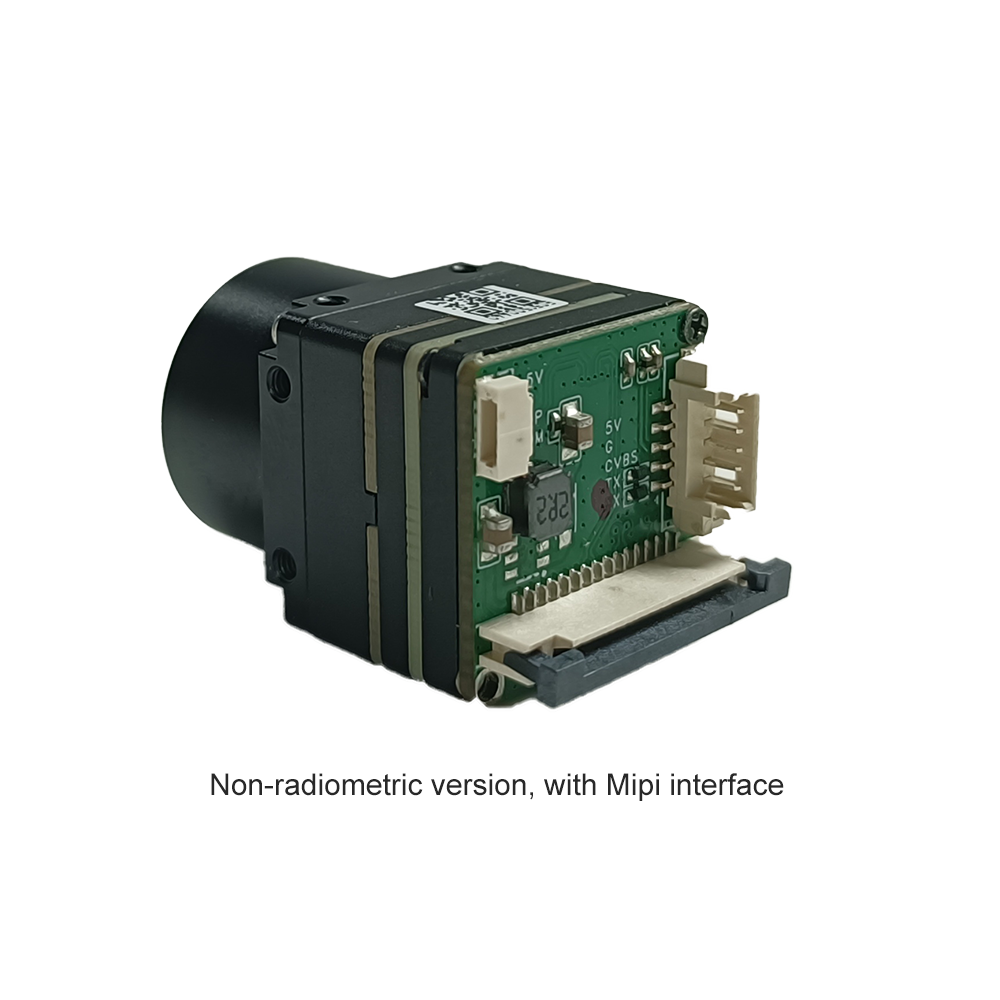
Analog Video Interface (CVBS)
For zero-latency analog first-person view (FPV) pilotage, tactical head-mounted displays, and direct legacy monitor feeds, the ASIC includes an on-chip Digital-to-Analog Converter (DAC) outputting standard Composite Video Baseband Signal (CVBS) in NTSC or PAL formats. Because analog encoding is handled within the ASIC with negligible overhead, latency from photon capture to analog output stays below 20 milliseconds, providing smooth, instantaneous visual telemetry.
Digital Embedded Video (MIPI CSI-2 & CMOS / DVP)
For edge AI applications running onboard neural networks—such as real-time target tracking, person detection, and optical inspection—the core outputs raw digital video over high-speed MIPI CSI-2 or parallel CMOS/DVP interfaces. These pipes stream 14-bit raw radiometric data or 8-bit YUV422/RGB888 video directly into host ISP hardware on boards like the NVIDIA Jetson Orin, Raspberry Pi CM4, Rockchip RK3588, or NXP i.MX8 platforms.
When routing these high-speed differential pairs through rotating gimbal slip rings, maintaining signal integrity without introducing mechanical stiffness is critical. In the shop, we route through ultra-flexible, shielded micro-coaxial cable assemblies from specialized manufacturers like Micro Coaxial Cable Man. These micro-coax bundles eliminate RF interference while enduring millions of continuous pan-tilt cycles without cracking.
Network Streaming (RTSP / IP) & Serial Control
Paired with compact network carrier boards, sub-0.5W modules can encode and stream H.264/H.265 video directly over standard RJ45 Ethernet lines. Real-Time Streaming Protocol (RTSP) and ONVIF profile compliance make it easy to drop streams straight into existing Video Management Software (VMS) or local Network Video Recorders (NVRs).
Telemetry, core configuration, and operational parameters are managed over simple serial interfaces (3.3V TTL UART, RS-232, or I2C). Your host processor can dynamically adjust core settings on the fly using standard command packets:
- ⚙️ Target Emissivity Adjustments ($\varepsilon$): Set emissivity from 0.01 to 1.00 to match specific surface material characteristics.
- ⚙️ Atmospheric Distance & Reflected Temperature: Inject real-time distance and ambient reflection matrices for high-precision radiometry.
- ⚙️ Non-Uniformity Correction Commands: Trigger manual recalibration or set dynamic autonomous NUC intervals.
- ⚙️ Digital Zoom Scaling: Execute smooth $1.0\times$ to $8.0\times$ digital zooming using bicubic edge interpolation.
5. OEM Product Specifications & Comprehensive Hardware Showcase
To help system architects choose the right optical and mechanical setup for their payloads, here is a detailed breakdown of two production-ready OEM cores engineered specifically for extreme SWaP-C constraints.
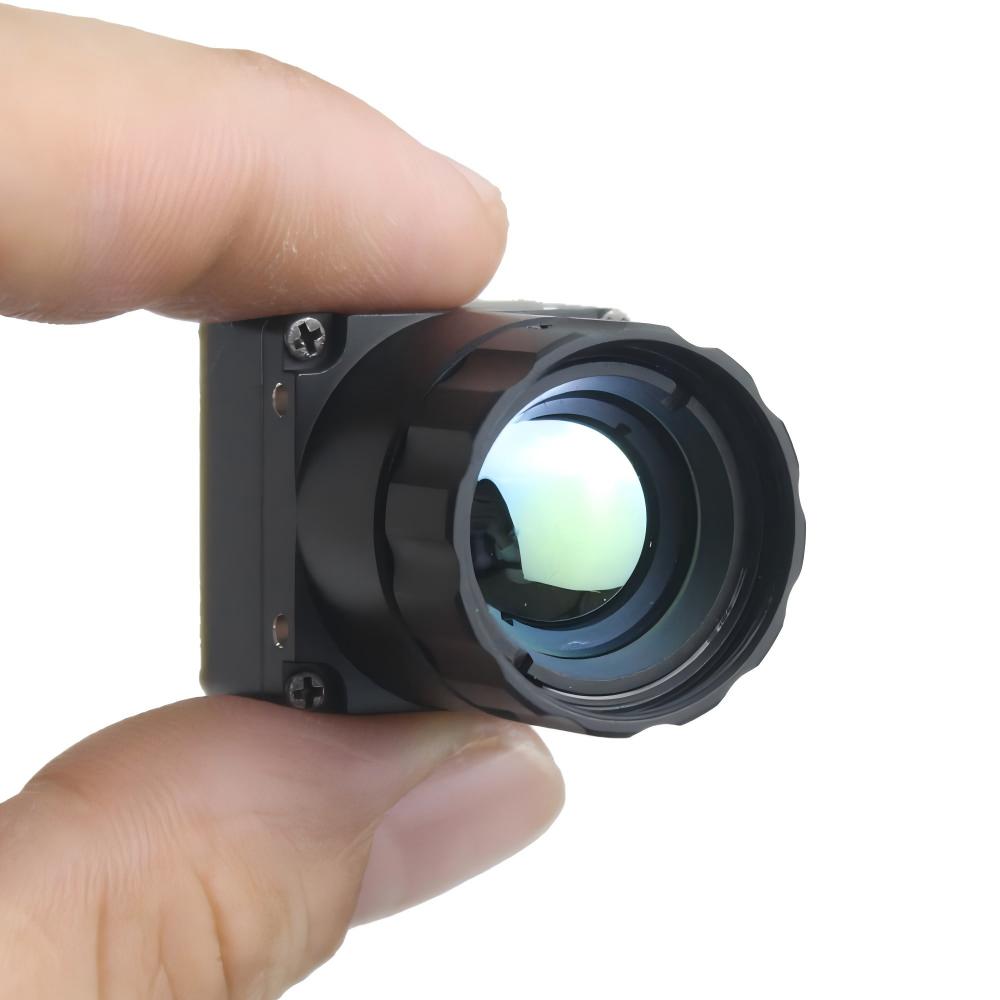
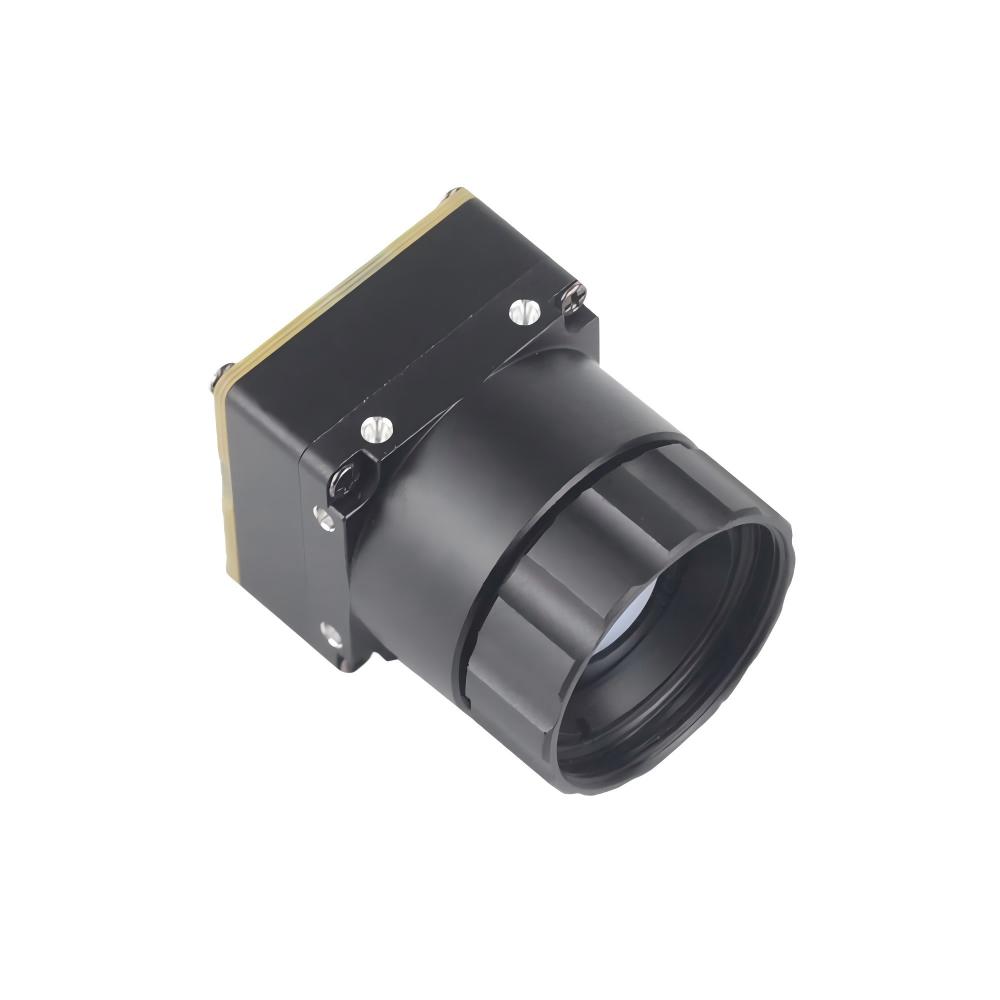
Uncooled Infrared RJ45 CVBS RTSP IP 640*512 ASIC Thermal Sensor Camera Module
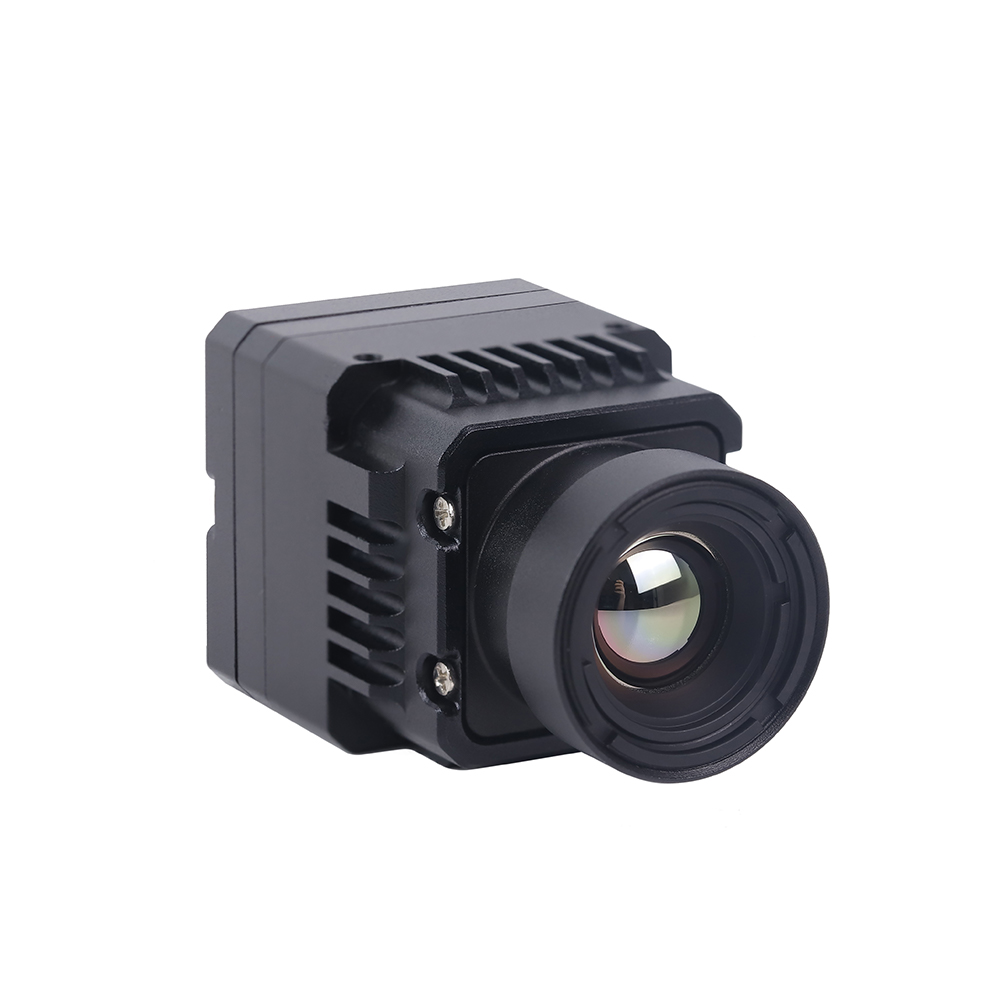
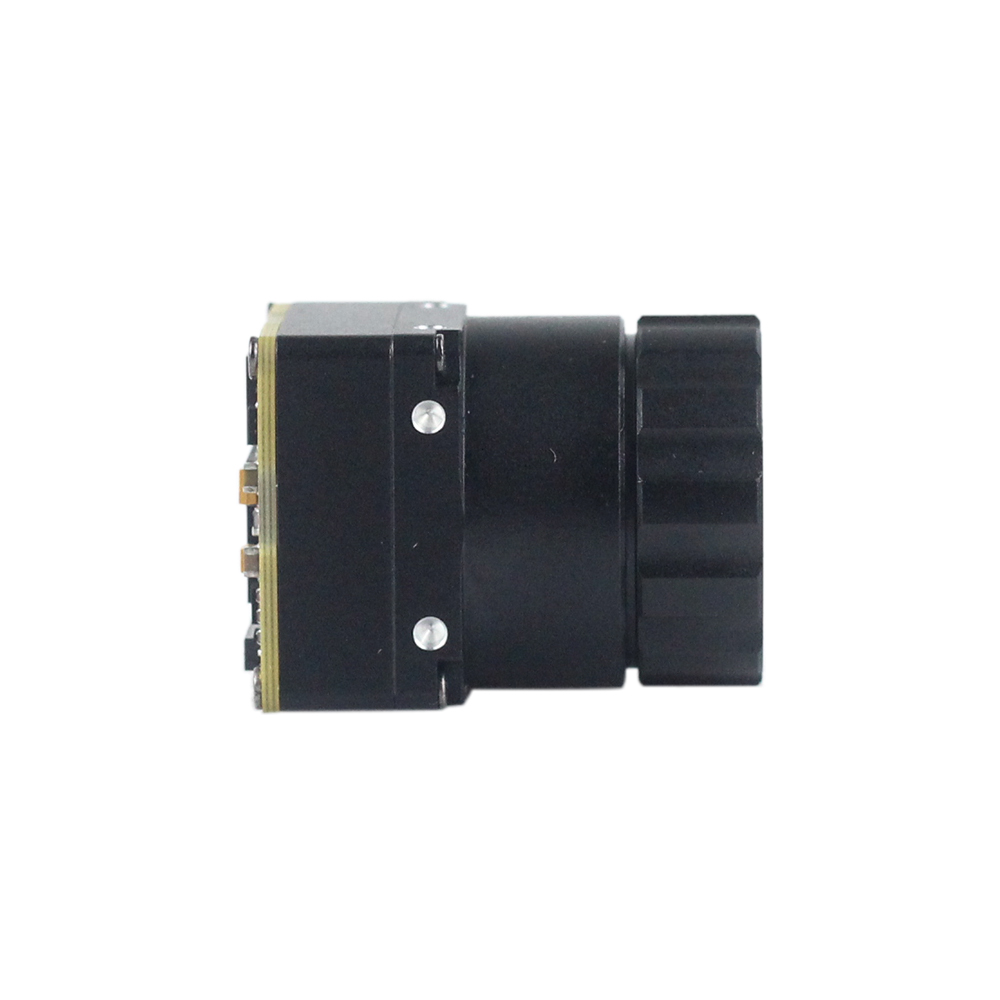
The Uncooled Infrared Mini 640*512 ASIC Thermal Imaging Camera Module For Drones is an elite, high-resolution LWIR camera engine specifically engineered for unmanned airborne systems, stabilized payload gimbals, and high-performance tactical reconnaissance. By deploying an advanced 12μm VOx microbolometer array driven entirely by a dedicated image processing ASIC, this module achieves full VGA 640×512 thermal imaging performance at a high 50Hz frame rate while maintaining an astonishingly low power dissipation envelope.
This core incorporates hardware-accelerated non-uniformity correction, dynamic range expansion, and on-die multi-stream video generation. The dual-video architecture enables concurrent output of zero-latency analog CVBS for immediate flight piloting and compressed digital RTSP/IP video streams over an ultra-lightweight RJ45 Ethernet PHY carrier board. It is the premier choice for aerospace integrators requiring extended target detection, recognition, and identification (DRI) ranges without adding excessive weight or power penalties to tactical aerial platforms.
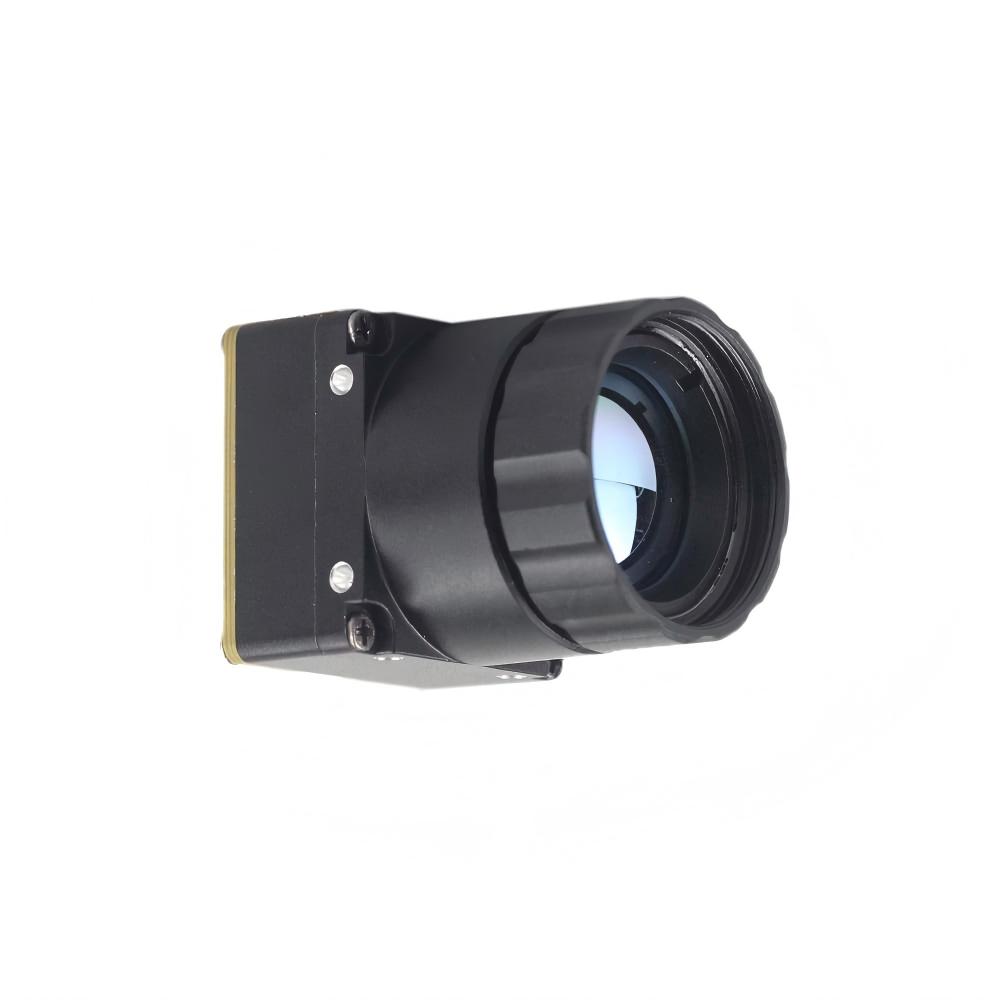
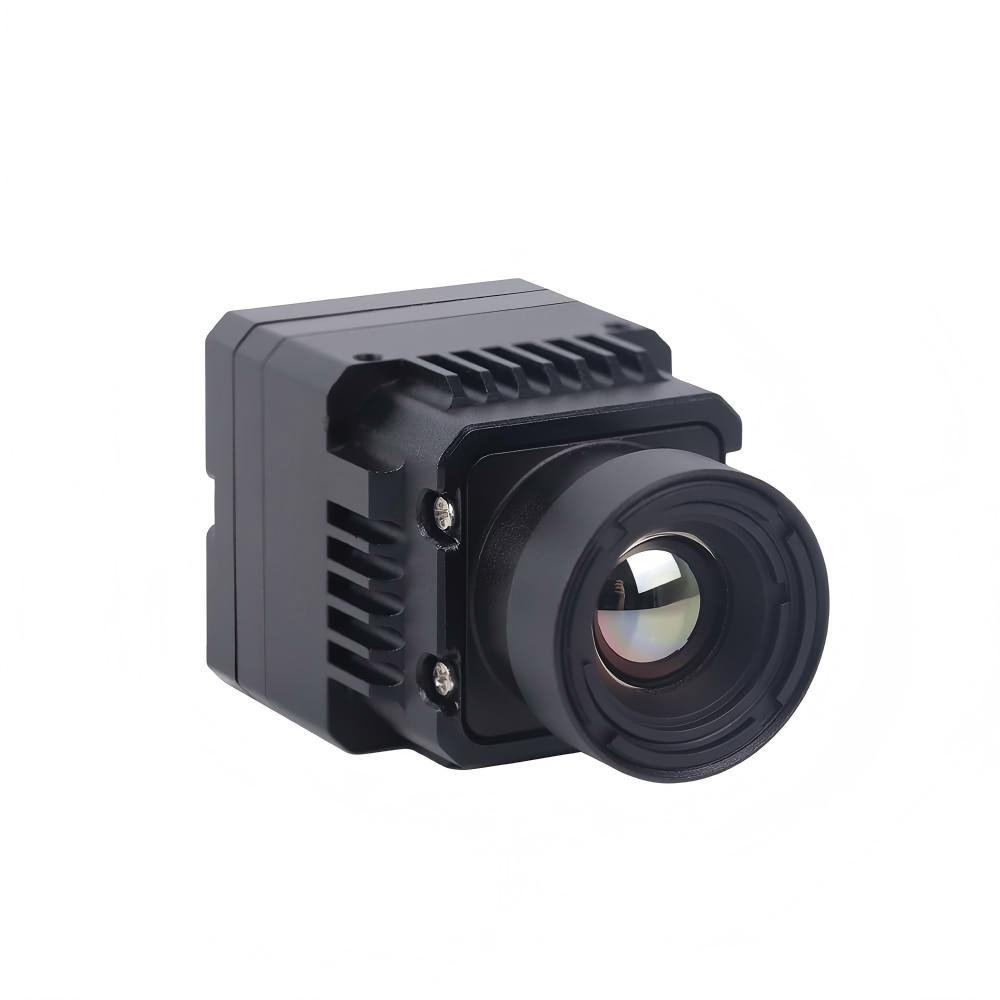
Uncooled Mini 384*288 Thermal Camera Module For Drones
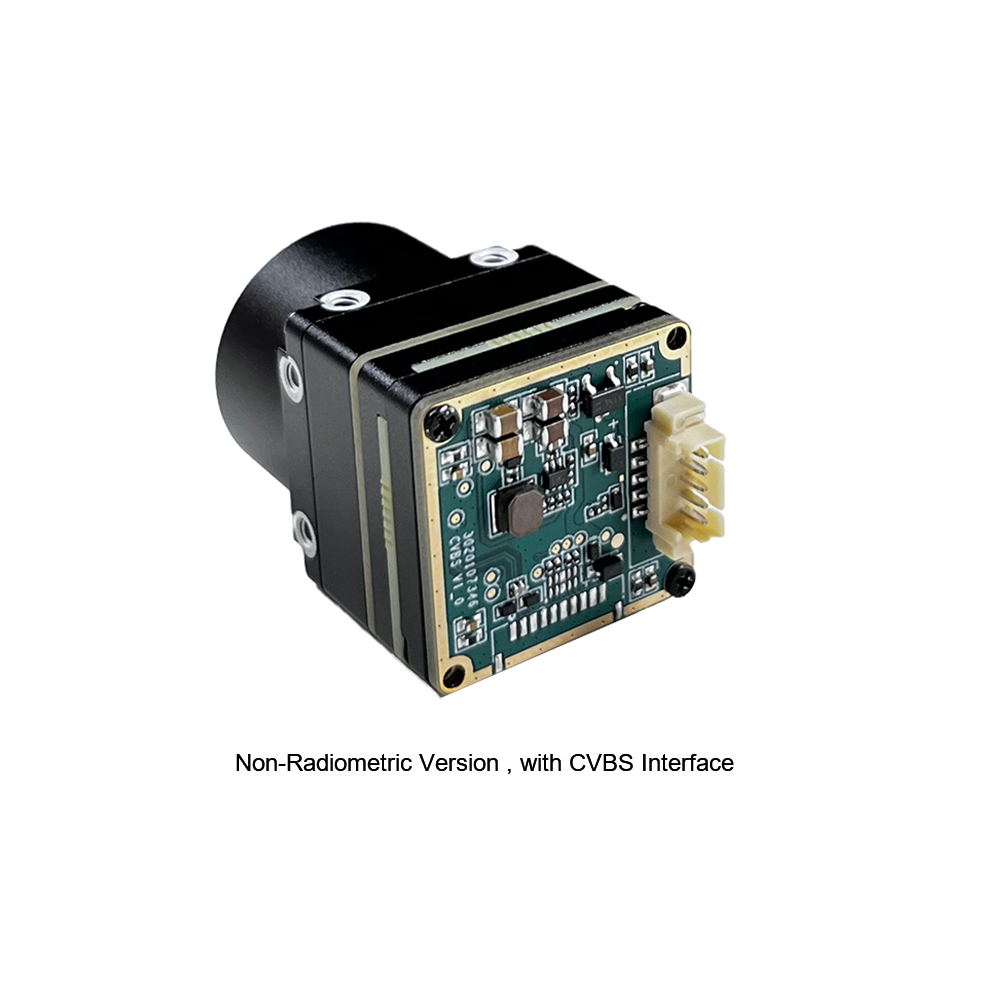
The MINI series infrared thermal imaging temperature measurement module is a high-precision, small-sized, and universal online temperature measurement infrared thermal imager. It uses high-quality uncooled 12μm VOx detectors, high resolution, stable performance, and powerful radiometric functions. Designed for tight physical constraints, the module provides per-pixel temperature measurement capabilities with industrial-grade accuracy across wide thermal ranges.
Equipped with multiple electronic interfaces including analog CVBS and multi-format digital output options, the MINI 384×288 core represents a preferred standard across diverse applications such as machine vision, automated safety inspection, intelligent manufacturing line monitoring, mechanical equipment predictive maintenance, and robotic drone airborne integration. Its minimal power signature ensures that internal heat generation remains negligible, entirely preventing sensor drift when mounted in sealed, dustproof, and waterproof drone enclosures.
6. Thermal Mass Calibration, Drift Compensation, and Noise Mitigation
Ask any electro-optical engineer about their biggest headache, and they will point straight to Fixed-Pattern Noise (FPN) and spatial drift. Microbolometers are sensitive enough to pick up microkelvin temperature variations. If your on-board image processor or power regulators start pumping out uneven heat, that thermal flux bleeds directly through the housing into the sensor array. That parasitic thermal gradient ruins the raw signal, introducing bad image vignetting and nasty vertical streak artifacts across your display.
The Physics of Self-Heating Elimination
In a typical 3W to 5W camera core crammed inside a sealed drone pod, internal ambient temperatures can easily shoot up by +25°C to +40°C over ambient. This rapid internal heating places the microbolometer substrate in constant non-equilibrium. To fight this, older systems are forced to slam a mechanical shutter shut every 30 to 60 seconds to execute a Flat-Field Correction (FFC). That shutter drop causes an audible click, introduces mechanical wear points, and worst of all, freezes the live video feed for up to a full second. If you're running high-speed autonomous navigation or tracking a tactical target, that one-second video freeze is unacceptable.
Here is the real magic of a sub-0.5W core: in a sealed enclosure, internal temperature rise stays under 2°C to 3°C above ambient. The entire core reaches thermal equilibrium with the lens barrel and enclosure almost immediately. Without localized internal hot spots, your microbolometer operates in a rock-solid, thermally stable environment.
Shutterless Dynamic Calibration Algorithms
Thanks to that extreme internal stability, modern ASIC cores use smart shutterless continuous calibration routines. Instead of dropping a mechanical flag in front of the sensor, the module reads high-precision thermistors embedded directly in the ROIC silicon substrate and the lens barrel to monitor real-time micro-deltas ($\Delta T$).
The ASIC dynamically references pre-calibrated multi-dimensional correction matrices in non-volatile memory, applying real-time algebraic polynomial corrections to offset and gain values for every individual pixel. You get completely silent operation, zero frame freezes, and continuous, crystal-clear 50Hz thermal video with industrial-grade radiometric accuracy from -40°C all the way up to +80°C.
7. Deep-Dive Technical FAQ
How does a <0.5W thermal module solve overheating and thermal throttling in compact drone gimbals?
Does reducing power consumption below 0.5W compromise imaging resolution, frame rate, or radiometric sensitivity?
What are the primary electrical and protocol interfaces used to integrate sub-0.5W cores with host processors?
Why is 12μm pixel pitch technology essential for achieving sub-500mW thermal core designs?
📚 References & Further Reading
- Industry Standard: Learn more about the physics and history of infrared sensing at Wikipedia Thermal Imaging.
- Interconnect Solutions: Explore flexible micro-coaxial transmission cabling at Micro Coaxial Cable Man.
- Related Guide: Discover handheld tactical optics in our Handheld Thermal Imaging Monocular Scope Guide.
- Arabic Engineering Insights: Read our technical overview on Embedded Thermal Night Vision Camera Modules.
- Technical Blog: Explore additional sensor architectures in our Specialized Thermal Engineering Knowledge Base.