
دليل أسعار وحدات الكاميرا الحرارية: عوامل التكلفة والمواصفات ومصادر OEM
11 سبتمبر 2026
الدليل الهندسي: تحديد المواصفات وشراء نوى كاميرات حرارية OEM عالية الأداء
إن دمج الاستشعار بالأشعة تحت الحمراء طويلة الموجة (LWIR) في المنصات الحرجة للمهام — مثل المحاور المستقرة للمركبات الجوية غير المأهولة (UAV)، والروبوتات المتحركة المستقلة (AMRs)، وخطوط الفحص البصري الآلي (AOI)، والأجهزة البصرية الإلكترونية المحمولة — يتطلب منهجية تصميم تحليلية تختلف جوهريًا عن التصوير القياسي بالطيف المرئي. فعندما يشرع مهندسو البصريات والفضاء والأنظمة في شراء نواة الكاميرا الحرارية الوحدات، فإنهم لا يختارون ببساطة مستشعرًا استهلاكيًا جاهزًا؛ بل يحددون محركًا كهربائيًا بصريًا يجب أن يوازن بدقة بين SWaP-C (الحجم والوزن والطاقة والتكلفة)، وفيزياء الحالة الصلبة للكاشف، والثوابت الزمنية الحرارية للميكروبولومتر، وخطوط أنابيب الفيديو ذات الكمون المنخفض الحتمي في ظل ظروف بيئية ديناميكية.
إن أي خطأ حسابي واحد في مواصفات المستشعر يتسلسل عبر كامل بنية العتاد المدمج. فالتقليل من تقدير فرق درجة الحرارة المكافئ للضوضاء (NETD) يؤدي إلى تدهور خوارزميات تقسيم الحواف الآلية في البيئات منخفضة التباين الحراري، كما هو الحال أثناء البحث والإنقاذ البحري أو فوق التضاريس الملبدة بالغيوم. كما أن تحديد واجهة عتاد غير مناسبة يمكن أن يرهق عرض النطاق الترددي لناقل النظام المضيف أو يُدخل كمونًا زجاجيًا إلى زجاجي لا يمكن إدارته، بينما يؤدي اختيار عدد بؤري بصري غير مناسب إلى المساس بشكل كبير بالدقة المكانية على مستوى النظام ومقاييس الكشف والتعرف والتمييز (DRI) للهدف. يقدم هذا الدليل التقني المعايير الرياضية والفيزيائية ومعايير التكامل اللازمة لتقييم واختيار وشراء نوى الميكروبولومتر غير المبردة من الدرجة المؤسسية (بدقات أصلية 640×512 و384×288) للتطبيقات الصناعية والروبوتية والفضائية المتقدمة.
جدول المحتويات
- 👉 البنية الأساسية للنواة: كيف تعمل وحدات LWIR من نوع OEM
- 👉 مقاييس التقييم الحرجة عند شراء نواة كاميرا حرارية
- 👉 الهندسة البصرية: اختيار العدسات، والبصريات الجرمانيومية، ومدى DRI
- 👉 واجهات العتاد، والمعالجة المدمجة، وتكامل النظام
- 👉 عرض مقارن للمنتجات: نوى LWIR من الدرجة المؤسسية 640 و384
- 👉 مصفوفة الاختيار الخاصة بالتطبيقات (الطائرات بدون طيار، الرؤية، الأجهزة البصرية الإلكترونية)
- 👉 المشتريات، والتوريد من الدرجة الأولى، واعتبارات دورة الحياة
- 👉 الأسئلة الشائعة (أسئلة تقنية متعمقة)
البنية الأساسية للنواة: كيف تعمل وحدات LWIR من نوع OEM
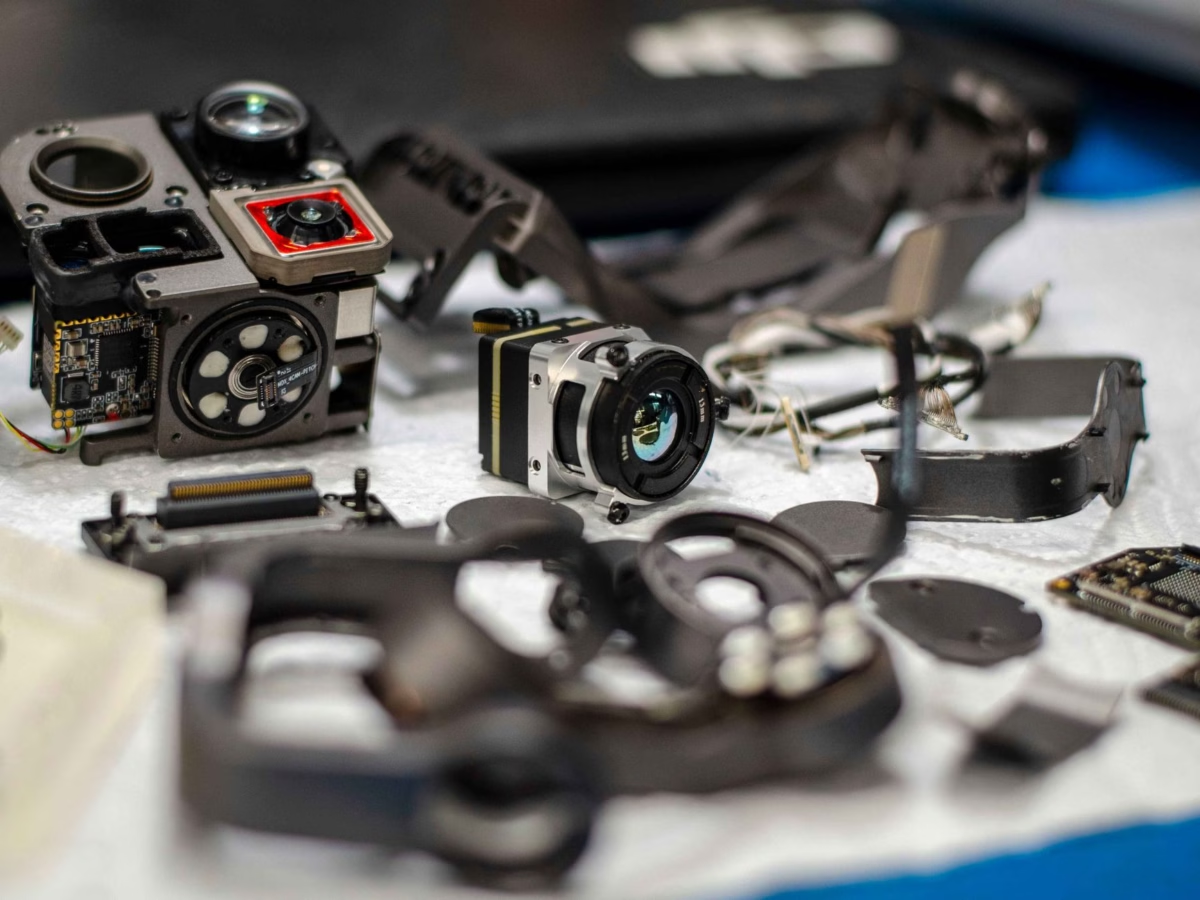
تقوم نواة التصوير الحراري OEM بتحويل التدفق الكهرومغناطيسي الإشعاعي الساقط ضمن طيف الأشعة تحت الحمراء طويلة الموجة (الذي يمتد عادة من 8 ميكرومتر إلى 14 ميكرومتر) إلى إطارات بيانات راديومترية رقمية خطية 14-بت أو 16-بت وتدفقات فيديو رقمية أو تناظرية قياسية. تعتمد وظيفة الوحدات الحرارية غير المبردة الحديثة على ثلاثة أنظمة فرعية مترابطة بإحكام: مصفوفة المستوى البؤري (FPA)، والدائرة المتكاملة للقراءة (ROIC)، ومعالج الإشارة الرقمية المدمج (عادة ما يكون FPGA أو محرك ASIC مخصص منخفض الطاقة).
ينبعث الإشعاع الحراري الساقط من الأجسام المستهدفة وفقًا لقانون بلانك للإشعاع، وينتقل عبر الغلاف الجوي وعبر عدسة بصرية مطلية بطبقة مضادة للانعكاس ليتركز مباشرة على مصفوفة الميكروبولومتر. تمتص مصفوفة المستوى البؤري هذه القدرة الضوئية، مما يغيّر المقاومة الكهربائية لكل غشاء بكسل بنسبة مباشرة مع درجة حرارته. تقوم دائرة القراءة المتكاملة (ROIC) بأخذ عينات من هذه الانحرافات المقاومية صفًا تلو الآخر، وترقمن التغيرات الدقيقة في الميكروفولت عبر محولات تناظرية رقمية (ADCs) مدمجة. ثم تُغذى البيانات الرقمية إلى خط معالجة FPGA مدمج مسؤول عن تصحيح عدم التجانس (NUC)، واستبدال البكسلات الميتة (BPR)، والترشيح المكاني، وضغط المدى الديناميكي قبل العرض عبر النواقل الخارجية.
من منظور الفيزياء الحرارية، يعمل كل بكسل ميكروبولومتر فردي كبنية ثرموديناميكية دقيقة معلقة في فراغ موضعي. عندما يصطدم تدفق الفوتونات الساقط بالطبقة الماصة (المكونة غالبًا من نيتريد السيليكون مع غشاء معدني مقاوم رقيق)، ترفع القدرة الممتصة درجة حرارة الغشاء النشط نسبة إلى ركيزة السيليكون الأساسية. تُعبر معادلة انتقال الحرارة الأساسية التي تحكم كل عنصر ميكروبولومتر على النحو التالي:
Cال · (dT/dt) + Gال · ΔT = η · Pفي
هنا،, Cال تمثل السعة الحرارية للبكسل،, Gال هي الموصلية الحرارية لأرجل الدعم الدقيقة المشغّلة آليًا،, الكفاءة هي كفاءة الامتصاص عبر النطاق الطيفي من 8μm إلى 14μm، و Pفي تمثل القدرة الإشعاعية الساقطة. الثابت الزمني الحراري τال = جال / Gال يحدد مدى سرعة استجابة الكاشف لانتقالات المشهد. إذا تحرك الهدف بسرعة أكبر مما يسمح به هذا الثابت الزمني الفيزيائي، فلن تتمكن البكسلات الفردية من التبريد قبل بدء دورة تكامل الإطار التالية، مما يسبب ذيلًا ملحوظًا وتدهورًا في دالة نقل التضمين (MTF).
فيزياء الميكروبولومتر: أكسيد الفاناديوم (VOx) مقابل السيليكون غير المتبلور (α-Si)
في أساس هندسة التصوير الحراري غير المبرد تكمن المادة الفعالة المستخدمة داخل غشاء جسر الميكروبولومتر. يتكون كل بكسل من صفيحة ماصة معلقة فوق ركيزة سيليكون أساسية بواسطة أرجل من نيتريد السيليكون مشغّلة آليًا توفر عزلًا حراريًا داخل تجويف مفرغ ومحكم الإغلاق.
- ✅ أكسيد الفاناديوم (VOx): يمثل VOx المعيار المرجعي في الصناعة للأنظمة الحرارية التجارية والصناعية والدفاعية. تُظهر المادة معامل مقاومة حراريًا مرتفعًا (TCR)، يتراوح عادة بين -2% إلى -3% لكل كلفن عند 300K، مقترنًا بضوضاء إلكترونية منخفضة للغاية من نوع 1/f (الوميض). يتيح معامل TCR المرتفع هذا لمستشعرات VOx تحقيق حساسية حرارية رائدة في الصناعة (NETD ≤ 30mK إلى 40mK) إلى جانب ثوابت زمنية حرارية سريعة (τ ≈ 8ms إلى 12ms). ونتيجة مباشرة لذلك، توفر مصفوفات المستوى البؤري VOx صورًا حادة مع أدنى حد من ضبابية الحركة، مما يجعلها الخيار المفضل للمنصات الجوية سريعة الحركة والملاحة الذاتية.
- ⚙️ السيليكون غير المتبلور (α-Si): في المقابل، يمكن تصنيع كواشف السيليكون غير المتبلور مباشرةً باستخدام خطوط الطباعة الحجرية لأشباه الموصلات CMOS القياسية، مما يخفض تكاليف إنتاج الرقاقات الخام. ومع ذلك، يُظهر α-Si ضوضاء 1/f جوهرية أعلى، وموصلية كهربائية أقل، وقيم TCR هيكلية أقل (تتراوح غالبًا حول -1.5% إلى -1.8%/كلفن). ونتيجةً لذلك، غالبًا ما تُظهر مستشعرات α-Si أرقام NETD أساسية أعلى (>50mK) وثوابت زمنية حرارية أبطأ (τ > 14ms). ويجب على محركات معالجة الإشارات اللاحقة تطبيق ترشيح زمني ثقيل لكبح الضوضاء الأساسية، مما يُدخل آثارًا ملحوظة للظلال وتأخرًا في الحواف عند تتبع الأهداف سريعة الحركة.
ديناميكيات تباعد البكسلات: التحول من تغليف 17μm إلى تغليف مقياس الرقاقة 12μm
على مدى العقد الماضي، انتقلت صناعة الأشعة تحت الحمراء من بنى البكسلات القديمة 17μm إلى تغليف مقياس الرقاقة 12μm (WSP). ويحقق هذا الانخفاض في تباعد البكسلات مزايا فيزيائية وبصرية كبيرة:
- ✅ الفتحة البصرية وبصمة الحمولة: ينخفض القطر الفيزيائي لمصفوفة المستشعر 640×512 من 13.93mm عند تباعد 17μm إلى 9.83mm فقط عند تباعد 12μm. ونظرًا لأن البعد البؤري المطلوب لتحقيق مجال رؤية مكافئ (FOV) يتناسب خطيًا مع قطر الكاشف، فإن نواة 12μm تتطلب عدسة بطول بؤري بصري أقصر بنحو 30% من نواة 17μm. وتنكمش الفتحة البصرية الصافية المقابلة للعدسة تناسبيًا، مما يقلل الكتلة والحجم الفيزيائي لبصريات الجرمانيوم أحادية البلورة باهظة الثمن بنسبة تصل إلى 50%. وهذا يمكّن المطورين من هندسة أنظمة فائقة الصغر، مثل وحدات بعامل شكل 21mm × 21mm تتسع بشكل مريح ضمن حمولات الطائرات المسيّرة المدمجة.
- ⚙️ حدود الحيود والتسامح البصري: في حين أن الأشكال الهندسية 12μm تتيح أغلفة SWaP-C فائقة الاكتناز، فإنها تدفع سلسلة التصوير البصري مباشرةً نحو حدود الحيود الفيزيائية لإشعاع LWIR (λ ≈ 10μm). بالنسبة لنظام بصري يعمل عند f/1.0، يُحسب قطر قرص آيري المركزي على النحو التالي:
dآيري = 2.44 × λ × f/# ≈ 2.44 × 10μm × 1.0 = 24.4μm
نظرًا لأن بقعة الحيود المركزية تمتد على أكثر من بكسلي 12μm بقليل، يجب على المهندسين البصريين تحديد عدسات جرمانيوم أو كالكوجينيد مُشكّلة بدقة ولا كروية تتميز بخطأ واجهة موجة منخفض وزيغ لوني أدنى لمنع التداخل البصري والحفاظ على تباين الصورة الديناميكي.
تصحيح عدم الانتظام (NUC): الغالق الميكانيكي مقابل الخوارزميات بدون غالق
بسبب الفروق الدقيقة في تصنيع أشباه الموصلات عبر مصفوفة الميكروبولومتر، يمتلك كل بكسل مقاومة أساسية ومنحنى استجابة حرارية مميزين. علاوةً على ذلك، يتسبب التسخين الذاتي الداخلي وتغير الظروف الحرارية المحيطة في انجراف الخرج الأساسي للبكسلات بشكل غير خطي مع مرور الوقت. وبدون تصحيح رياضي مستمر، تتدهور الصورة الحرارية إلى ضوضاء مكانية شديدة، تُعرف عاميًا باسم "ضوضاء النمط الثابت" (FPN). وتتصدى النوى الحديثة لهذا من خلال آليتين:
- ⚙️ معايرة الغالق الكهروميكانيكي (NUC أحادي النقطة): يقوم ملف لولبي مصغر مدمج بتأرجح راية ميكانيكية سوداء عالية الانبعاثية أمام مصفوفة المستوى البؤري (FPA) لمدة تتراوح بين 100 مللي ثانية و300 مللي ثانية. ومن خلال رؤية سطح حراري موحد بصريًا، يحسب المعالج المدمج معاملات إزاحة محدثة لكل بكسل على حدة، مما يعيد ضبط انتظام خط الأساس للمصفوفة. وبينما تضمن هذه التقنية دقة إشعاعية مثالية وضوضاء مكانية منخفضة، فإن آلية الغالق الفيزيائية تُدخل أجزاء متحركة عرضة للتآكل الميكانيكي، مع إيقاف بث الفيديو الرقمي المباشر مؤقتًا.
- ✅ تصحيح عدم الانتظام القائم على المشهد بدون غالق (SBNUC): بالنسبة لمنصات الطيران عالية الاهتزاز، أو التتبع المستمر، أو منصات المناظير التسليحية حيث لا يمكن تحمل انقطاع الفيديو، تطبق محركات معالجة الإشارات الرقمية المتطورة خوارزميات SBNUC متقدمة. يتتبع SBNUC باستمرار الانحرافات المكانية عالية التردد عبر إطارات الصور المتتالية، مستفيدًا من حركة المشهد الطبيعية لفصل البصمات الحرارية الحقيقية للأهداف عن انجراف النمط الثابت للمستشعر. ومع ذلك، تتطلب بنى SBNUC موارد حسابية كبيرة من مصفوفات البوابات القابلة للبرمجة (FPGA) ويمكن أن تنتج أحيانًا تشوهات شبيهة بالأشباح إذا ظلت الكاميرا الحرارية ثابتة أثناء رؤية مشهد ثابت ذي تدرجات حرارية عالية.
رياضيًا، يعمل تصحيح عدم الانتظام الخطي ثنائي النقطة على العدادات الرقمية الخام X١. ij الناتجة عن البكسل في الصف i and column j according to:
Y١. ij = G١. ij · X١. ij + O١. ij
حيث G١. ij represents the individual gain coefficient and O١. ij represents the real-time offset term. Because the offset vector migrates as ambient chassis temperatures fluctuate, the embedded FPGA must continuously interpolate offset lookup tables based on internal thermistor telemetry placed directly on the focal plane substrate.
مقاييس التقييم الحرجة عند شراء نواة كاميرا حرارية
When selecting and sourcing OEM thermal camera hardware, systems engineers must evaluate four core electro-optical and operational metrics to confirm operational fit:
فرق درجة الحرارة المكافئ للضوضاء (NETD)
Noise Equivalent Temperature Difference defines the minimum temperature variation across an object that generates a signal-to-noise ratio (SNR) of unity at the detector output. Measured in milliKelvins (mK), NETD serves as the primary figure of merit for microbolometer sensitivity. Industrial-grade modules exhibit ratings between ≤30mK and ≤40mK, while entry-level commercial units typically test above 50mK. An NETD of 35mK means the core can resolve scene variations as small as 0.035°C.
When evaluating vendor data sheets, engineers must audit the exact test conditions under which the NETD was measured. Sensitivities quoted without specifying the optical f-number (typically f/1.0), the ambient test temperature (typically 300K / 27°C), and the target frame rate (e.g., 50Hz) can be misleading. Operating an NETD ≤ 40mK core behind an f/1.4 lens, for example, cuts the flux reaching the detector by half, increasing effective system noise to nearly 80mK according to the inverse-square law of the f-number:
NETDالنظام ∝ (f/#)2 · (1 / τoptics)
Frame Rate Regimes and Global Dual-Use Export Controls
The temporal frame rate of an infrared core dictates its target-tracking capabilities and directly determines its international export classification:
- ⚙️ ≤ 9Hz Thermal Cores: Slow-frame-rate modules are generally exempt from strict multilateral defense export controls and can be acquired for commercial, civil, and consumer integration with straightforward documentation. However, a 9Hz temporal refresh rate is inadequate for closed-loop drone stabilization, high-speed automated sorting, or vehicle piloting, as camera movement at 9fps induces noticeable target judder, frame lag, and motion smear.
- ✅ 25Hz / 30Hz / 50Hz / 60Hz High-Speed Cores: High-frame-rate cores are required for real-time robotic perception, stabilized airborne tracking gimbals, search and rescue, and optronic scopes. These modules deliver smooth motion representation and ultra-low glass-to-glass latency (<30ms). However, procurement of thermal cores running at ≥25Hz is strictly regulated under dual-use export control regimes, including the Wassenaar Arrangement, United States International Traffic in Arms Regulations (ITAR) / Export Administration Regulations (EAR), and equivalent European Union regulations. Buyers must execute End-User Certificates (EUC) confirming non-proliferation compliance before procurement contracts can be fulfilled.
Radiometric Data Output vs. Qualitative Imaging
Procurement teams must distinguish between qualitative thermal imaging cores and quantitative radiometric measurement cores:
- ⚙️ Qualitative (Imaging-Only) Cores: The embedded FPGA converts the high-dynamic-range 14-bit microbolometer signal directly into an 8-bit standard output (YUV422 or RGB24) via adaptive dynamic range algorithms (such as Digital Detail Enhancement - DDE, local contrast optimization, and histogram equalization). The camera outputs an aesthetically sharp visual image tailored for human display systems, but discards raw sensor voltage values. True target temperatures cannot be extracted from the video stream.
- ✅ Quantitative (Radiometric) Cores: The module outputs a linear digital signal (typically 14-bit or 16-bit digital words per pixel) alongside or interleaved with the visual video stream. Each digital level (Digital Number - DN) maps directly to radiant energy or temperature via calibrated sensor lookup tables (LUTs) factoring in internal core temperatures. Radiometric output is essential for automated predictive maintenance, electrical substation inspection, wildland fire perimeter mapping, and automated machine vision. Systems engineers looking for deep architectural guidance on digital streaming buses should study this guide to high-performance MIPI thermal modules.
الهندسة البصرية: اختيار العدسات، والبصريات الجرمانيومية، ومدى DRI
Because silicate-based optical glass is completely opaque to electromagnetic radiation within the 8μm to 14μm waveband, thermal camera cores require specialized transmissive optical materials combined with high-performance anti-reflective thin-film coatings.
Optical Substrates: Monocrystalline Germanium vs. Chalcogenide Glass
Two primary optical substrates dominate the LWIR market:
- ✅ الجرمانيوم أحادي البلورة (Ge): Germanium possesses an exceptionally high refractive index (n ≈ 4.0 at 10μm), allowing optical engineers to design lenses with shallow surface curvatures, minimal spherical aberrations, and high optical power within compact physical dimensions. Germanium is mechanically robust and suited for harsh airborne environments. However, pure Germanium suffers from thermal runaway: as ambient optical temperatures surpass 60°C, free-electron absorption increases exponentially, causing the substrate to lose transparency. Consequently, external surfaces must feature durable Anti-Reflective (AR) or Diamond-Like Carbon (DLC) hard coatings to survive rain erosion, dust abrasion, and saline atmosphere.
- ⚙️ Chalcogenide Glass (e.g., GASIR): Chalcogenide materials consist of synthetic compounds containing sulfur, selenium, or tellurium. Unlike Germanium, Chalcogenide glasses can be molded via precision glass pressing rather than ground and polished with single-point diamond turning (SPDT). This allows cost-effective production of complex aspheric lens designs at volume. Furthermore, Chalcogenide exhibits an exceptionally low thermo-optic coefficient (dn/dT), simplifying the engineering of passively athermalized lens assemblies that stay in focus from -40°C to +85°C without active motor compensation.
DRI Range Calculations (Johnson’s Criteria Applied to 12μm Cores)
To project real-world target acquisition ranges for security, defense, and drone search missions, optical engineers employ Johnson’s Criteria. The spatial frequency requirements across a target’s critical dimension (traditionally a human target scaled to 1.8m × 0.5m with a 0.75m critical dimension, or a standard vehicle of 2.3m × 2.3m) are defined as:
- ⚙️ Detection (1.5 cycles / ~2 pixels on target): The observer can determine that an object of interest is present in the scene.
- ⚙️ Recognition (6.0 cycles / ~8 pixels on target): The observer can classify the target type (e.g., differentiating a human from an animal, or a truck from a passenger vehicle).
- ⚙️ Identification (12.0 cycles / ~16 pixels on target): The observer can identify specific details (e.g., identifying a commercial pickup versus an armed technical vehicle).
The Instantaneous Field of View (IFOV), representing the spatial angle subtended by a single physical pixel, is calculated as:
IFOV (mrad) = Pixel Pitch (p) / Lens Focal Length (f)
For a modern 12μm VOx thermal core:
- ✅ Wide-Angle Optics (f = 9mm): IFOV = 12μm / 9mm = 1.33 mrad. At an operational distance of 1,000 meters, one pixel spans 1.33 meters. This lens geometry provides an expansive field of view, ideal for short-range situational awareness, indoor mobile robotics, and localized aerial mapping.
- ✅ Telephoto Long-Range Optics (f = 75mm): IFOV = 12μm / 75mm = 0.16 mrad. At a distance of 1,000 meters, one pixel covers just 16 centimeters. This tighter spatial projection enables positive human target detection beyond 3,500 meters and vehicle identification past 2,000 meters.
When computing field DRI envelopes, systems integrators must also account for atmospheric attenuation using Beer-Lambert transmission modeling:
τالجوي(R) = exp(-γ · R)
حيث γ is the atmospheric extinction coefficient (dominated in the LWIR spectrum by absolute humidity and water-vapor continuum absorption) and R is the distance to the target. In humid maritime environments, γ can reduce effective detection ranges by 30% to 50% compared to dry desert testing scenarios.
Optical Mounts and Mechanics
OEM cores use threaded barrel configurations to ensure optical concentricity and maintain a stable focal position under continuous shock and vibration. Standard configurations include micro-threaded mounts (e.g., M10×0.5, M12×0.5, or proprietary coarse threadings) fitted with fluoroelastomer (Viton) O-rings. These O-rings seal the optical path against environmental moisture ingress, preserving IP67-rated enclosures in airborne payloads.
واجهات العتاد، والمعالجة المدمجة، وتكامل النظام
Integrating an uncooled thermal core into host electronics requires careful matching of data transfer bandwidth, power dissipation paths, and software communication pipelines.
Digital and Analog Video Pipelines
Thermal camera cores generally output video and telemetry over one or more of the following standard interfaces:
- ✅ USB 2.0 / USB 3.0 (UVC Architecture): Cores featuring USB endpoints implement the USB Video Class (UVC) protocol, enabling plug-and-play streaming into Linux, Windows, and ROS (Robot Operating System) hosts without requiring custom kernel drivers. The core streams 8-bit visual YUV/RGB frames alongside 14-bit uncompressed Y16 radiometric buffers over bulk transfer endpoints, simplifying software development.
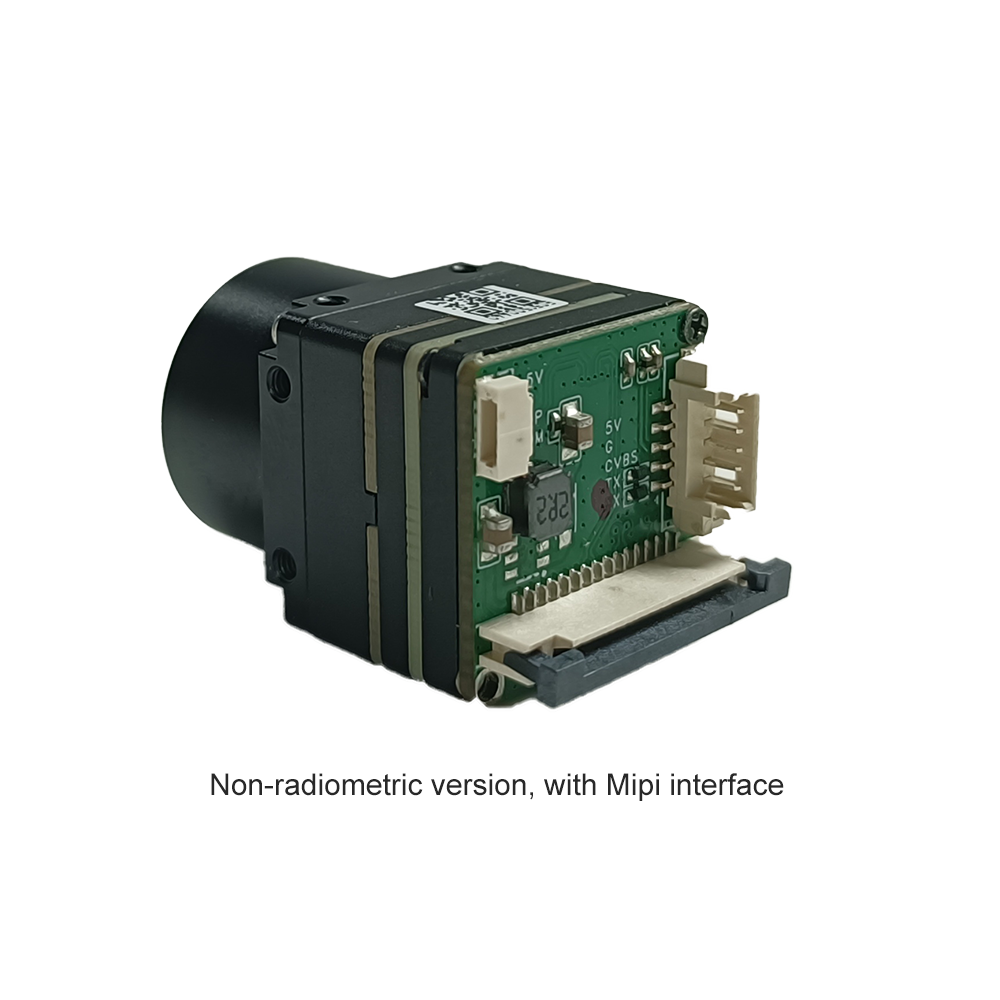
- ⚙️ MIPI-CSI2 (واجهة معالج صناعة الهواتف المحمولة): For lightweight embedded hardware running edge-AI processors (such as the NVIDIA Jetson Orin series or Rockchip RK3588), MIPI-CSI2 is the preferred interface. By routing differential serial clock and data lanes directly into the host processor's Image Signal Processing (ISP) pipeline, MIPI bypasses USB protocol conversion latency, cuts hardware component counts, and reduces power consumption.
- ⚙️ Analog Composite Video (CVBS - NTSC/PAL): Analog composite video remains popular in specialized airborne FPV systems, legacy target turrets, and real-time flight controls. Because CVBS output bypasses OS digital frame buffers, it delivers ultra-low end-to-end latency (≤10ms), preventing control loop instability during high-speed manual drone piloting.
Interfacing with Embedded Single-Board Computers and Microcontrollers
Modern autonomous platforms rely on split processing architectures to handle imaging pipelines and hardware controls efficiently:
- ✅ Single-Board Computers (SBCs): Systems integrators frequently pair USB or MIPI thermal modules with embedded platforms like the راسبيري باي to execute deep-learning object classifiers (e.g., YOLOv8-tiny) or perform automated thermal segmentation routines directly at the edge.
- ⚙️ Microcontrollers: For auxiliary tasks—such as sending NUC calibration pulses, adjusting motorized focus mechanisms, or reading ambient temperature sensors—engineers frequently link an أردوينو or comparable ARM Cortex-M microcontroller to the core’s UART or I²C control interfaces. For a detailed exploration of compact edge implementations, read our overview of low-power thermal camera modules for localized payloads.
Thermal Dissipation and Power Integrity
Because microbolometers measure microscopic changes in pixel temperature, they are sensitive to thermal fluctuations within the camera chassis itself. Poor mechanical heat-sinking creates asymmetric thermal gradients across the core housing, resulting in non-uniform spatial drift, localized shading artifacts, and frequent NUC shutter cycles.
To avoid these issues, engineers must mechanically couple the core’s primary chassis interface to an external aluminum heat sink using high-conductivity thermal gap pads (≥3.0 W/m·K). Furthermore, because ROIC readout noise correlates directly with power rail stability, system power supplies must be decoupled using low-noise Low Dropout (LDO) linear regulators. Power rail ripple must stay below 20mV peak-to-peak to prevent visible banding across the thermal image.
عرض مقارن للمنتجات: نوى LWIR من الدرجة المؤسسية 640 و384
When preparing to شراء نواة الكاميرا الحرارية modules, systems engineers must evaluate verified commercial hardware against their project’s SWaP-C requirements. Below are two industry-tested LWIR cores designed for integration into aerial gimbals, machine vision systems, and autonomous robotic platforms.
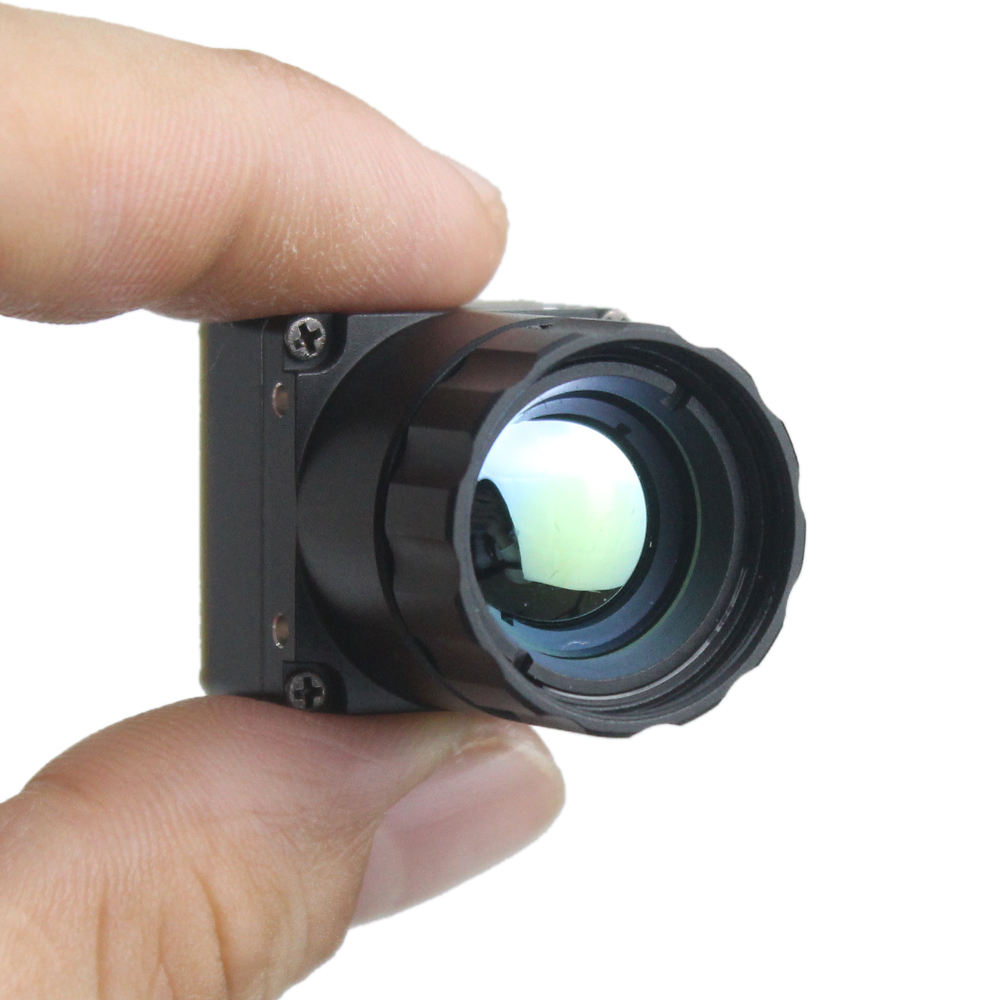
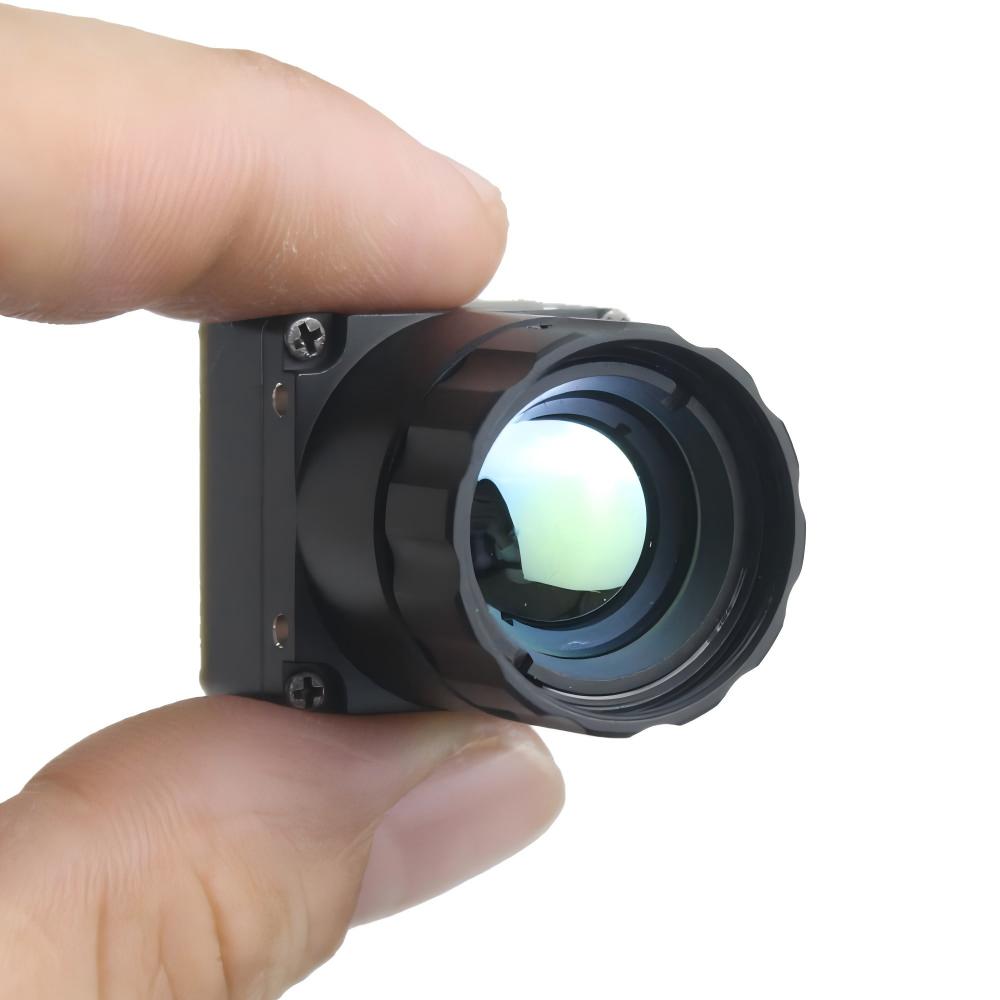
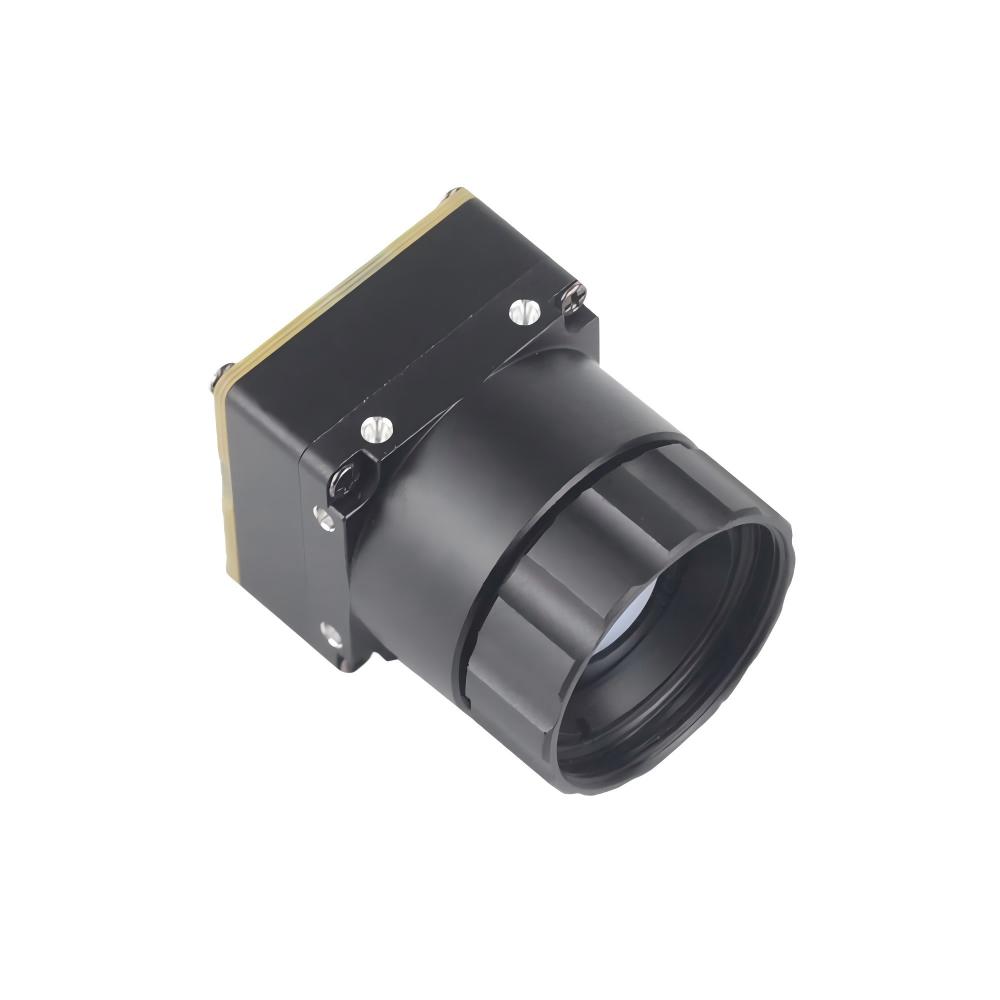
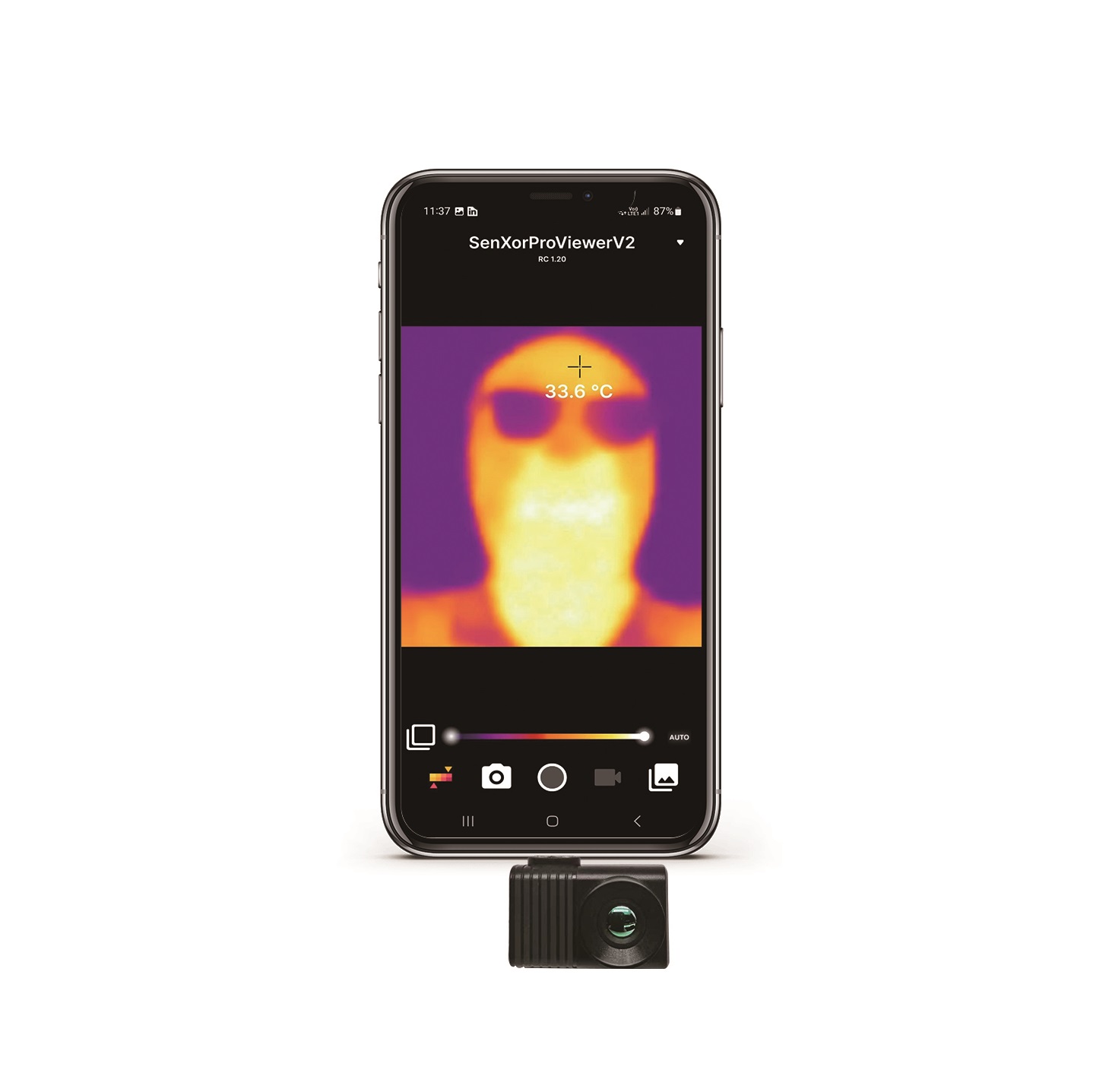
وحدة نواة كاميرا تصوير حراري مصغرة غير مبردة LWIR USB بدقة 640*512
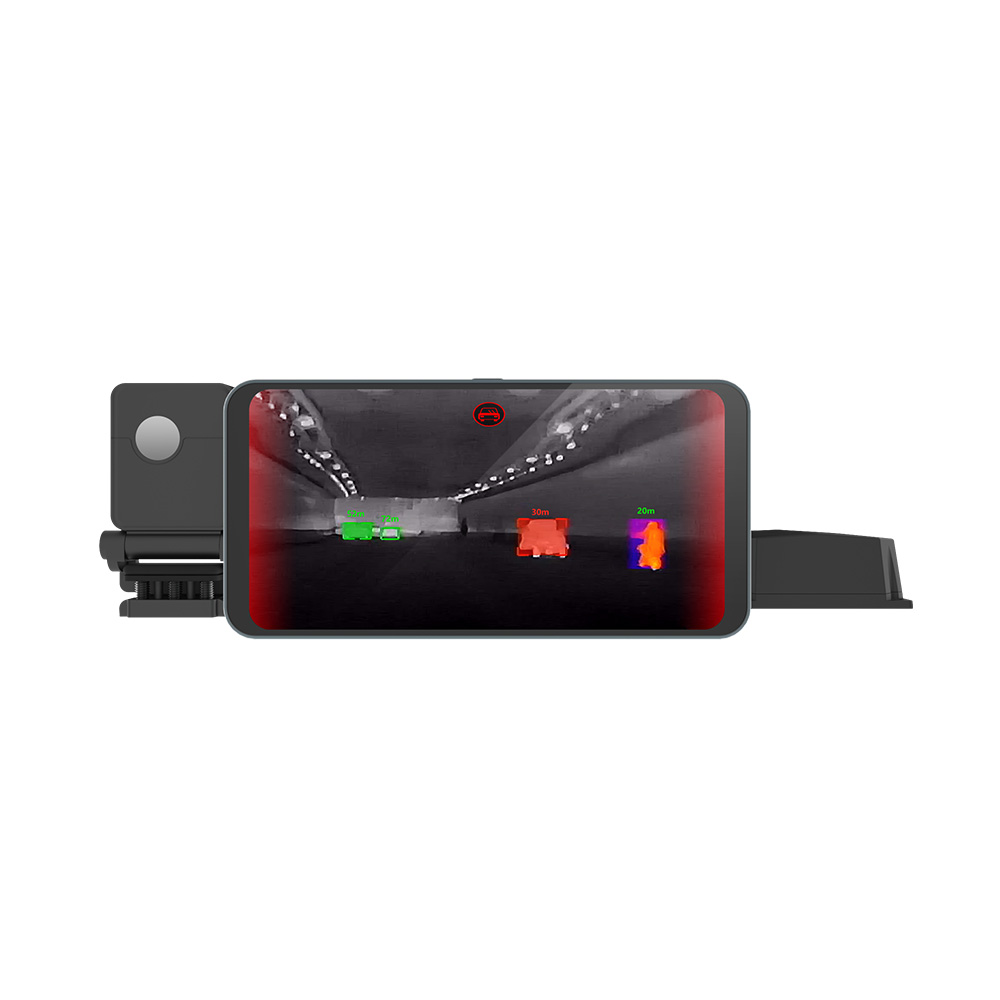
Designed specifically for UAV stabilized gimbals (comparable to enterprise DJI payload architectures), advanced thermal sights, and high-performance robotic tracking, this mini uncooled infrared thermal imaging core delivers sharp imagery within an ultra-compact footprint. Measuring just 21مم × 21مم, it combines high thermal sensitivity (≤40mK) with versatile optical options to support applications ranging from wide-angle aerial mapping to long-distance reconnaissance.
- ✅ Native Resolution: 640 × 512 (640 × 480 selectable operating mode)
- ✅ نوع الكاشف: High-sensitivity Uncooled VOx Microbolometer (12μm pixel pitch)
- ✅ الحساسية الحرارية: NETD ≤ 40mK @ f/1.0, 300K
- ⚙️ Extensive Lens Portfolio: 5mm, 9mm, 13mm, 18mm, 35mm, 50mm, 75mm, 100mm, and 150mm focal lengths
- ✅ عامل الشكل: Ultra-miniature 21mm × 21mm footprint for constrained enclosures
- ⚙️ الاتصال: USB 2.0 (UVC stream + full 14-bit radiometric raw telemetry) with UART serial control
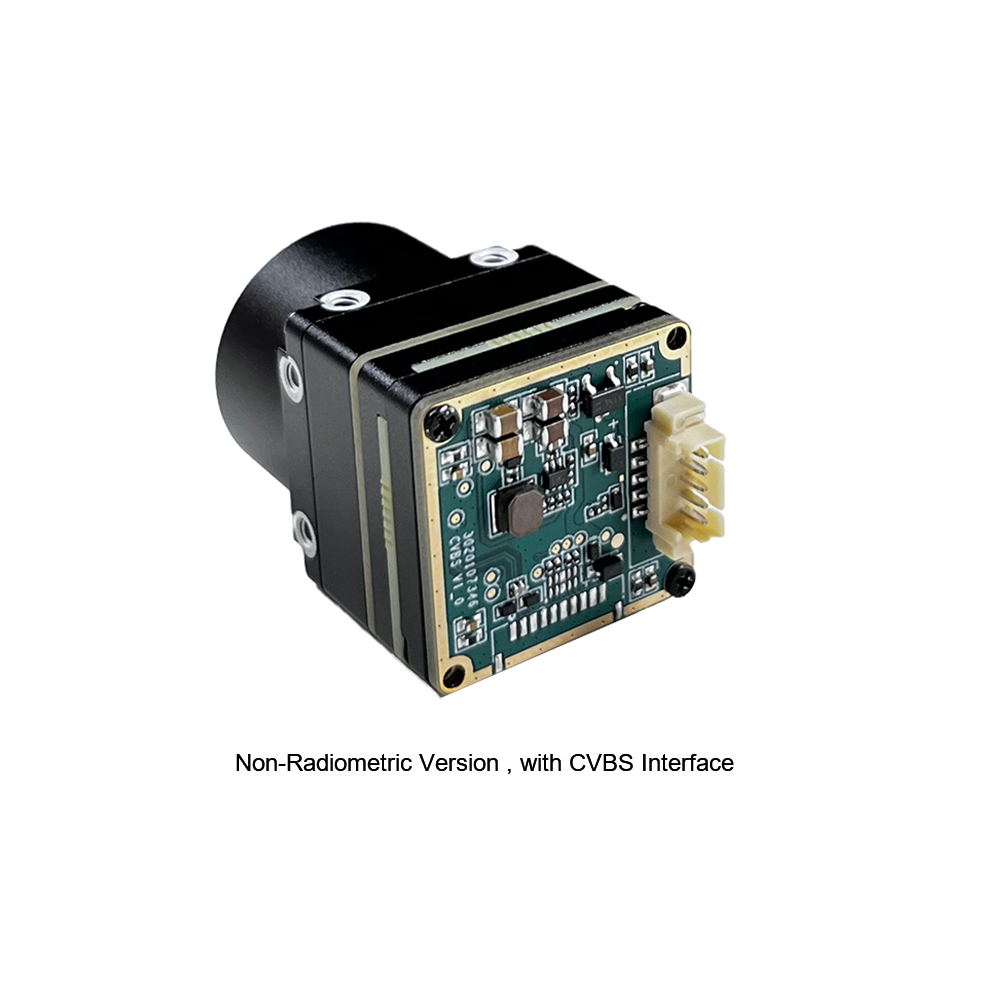
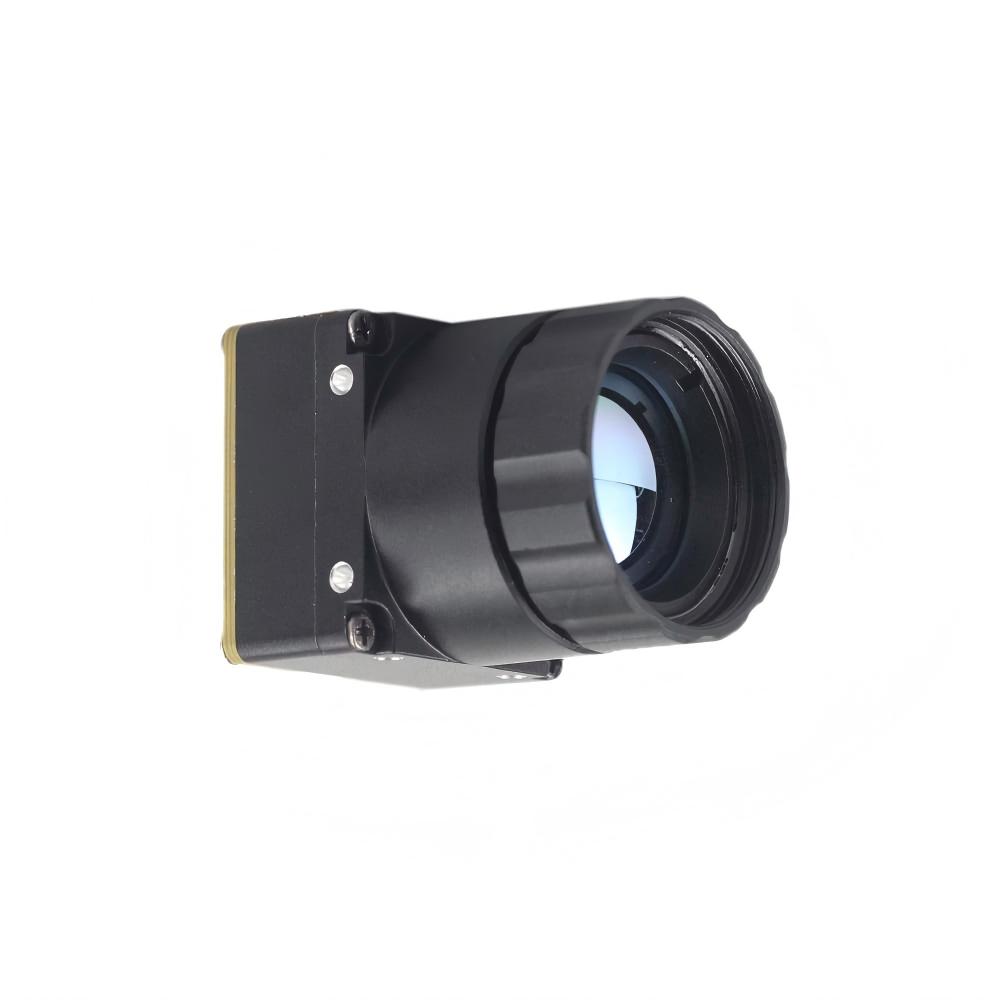
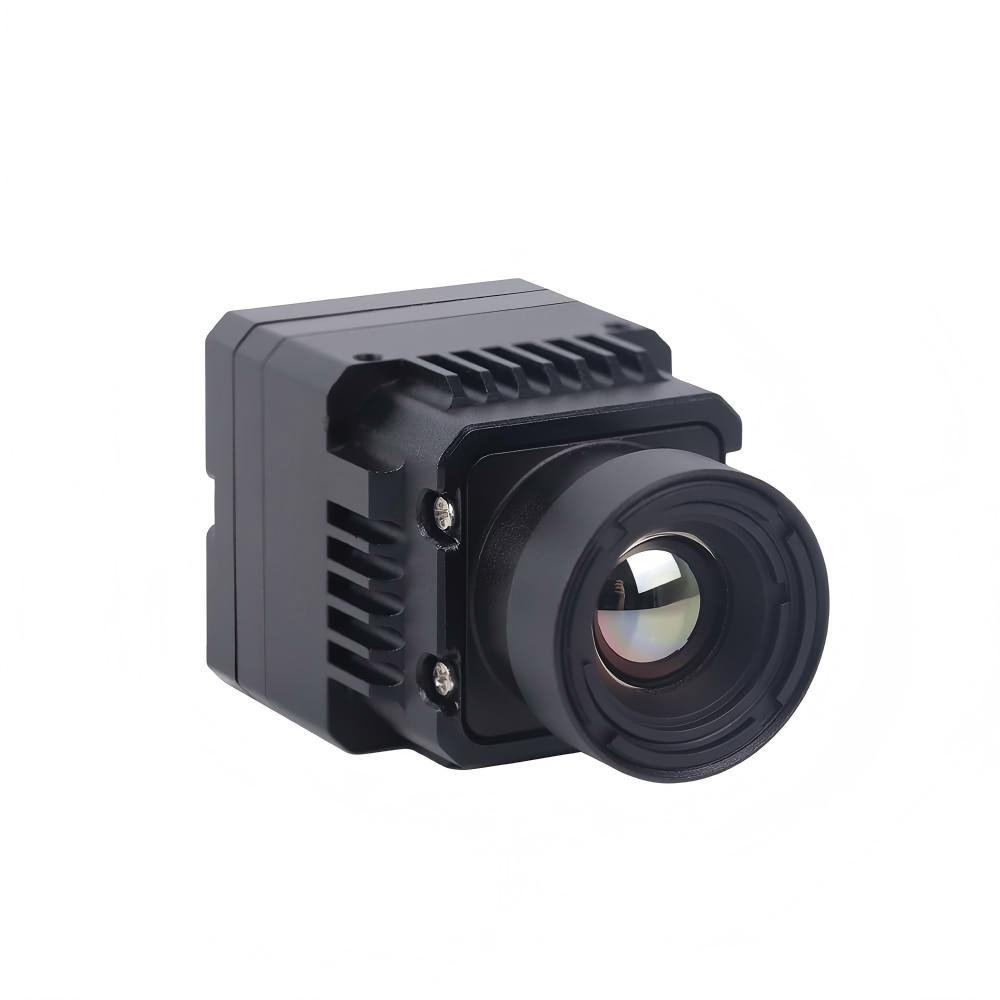
وحدة كاميرا حرارية مصغرة غير مبردة 384*288 للطائرات بدون طيار
The MINI series 384×288 infrared thermal module provides a balanced, small-form-factor solution for online temperature measurement and continuous industrial process monitoring. Utilizing high-performance detectors and low-latency processing, this core is engineered for machine vision inspection, factory safety systems, electrical switchgear maintenance, and lightweight drone payloads requiring reliable radiometric thermal imaging.
- ✅ Native Resolution: 384 × 288 active pixels
- ✅ Thermal Imaging Engine: High-precision uncooled focal plane array with stable drift compensation
- ⚙️ Precision Radiometry: Online industrial temperature measurement with point, line, and area analysis
- ⚙️ Interface Versatility: Direct analog CVBS composite video alongside digital outputs for display or transmission
- ✅ Primary Target Applications: Machine vision, automated safety inspection, equipment maintenance, and small aerial drones
Direct Engineering Comparison Table
| معلمة النظام | Mini 640×512 LWIR Module | Mini 384×288 LWIR Module |
|---|---|---|
| Active Pixel Matrix | 640 × 512 (Optional 640 × 480) | 384 × 288 |
| الأبعاد المادية | Ultra-miniature (21mm × 21mm × 21mm) | Compact MINI Series Envelope |
| Available Lens Lineup | 5, 9, 13, 18, 35, 50, 75, 100, 150mm | Standard MINI Series Optics (Fixed / Focusable) |
| Digital & Analog I/O | USB 2.0 (UVC + Y16 Radiometric) + UART | CVBS Composite Video + USB + UART |
| الحساسية الحرارية (NETD) | ≤ 40mK @ f/1.0, 300K | ≤ 40mK @ f/1.0, 300K |
| Target Integration Envelopes | DJI-class stabilized gimbals, advanced long-range security | Machine vision inspection, automated factory monitoring, sUAVs |
6. Application-Specific Selection Matrix
Selecting between 640×512 and 384×288 resolutions requires analyzing operational requirements against target platform constraints:
1. Stabilized Drone Gimbals and Tactical UAV Payloads
For aerial platforms, every additional gram of payload directly reduces flight endurance. Upgrading to an ultra-compact 21mm × 21mm 640×512 module provides high spatial resolution (327,680 individual pixels) without exceeding payload weight limits. In utility inspections (such as scanning high-voltage transmission lines or solar farms), this elevated pixel count lets drone pilots operate at a safe standoff distance while resolving fine thermal anomalies, such as failing cells or high-resistance connectors.
- ✅ Recommended Core: Mini 640×512 LWIR Module (VOx, 12μm).
- ⚙️ Key Optical Pairing: 13mm to 35mm athermalized Germanium optics with DLC external coating.
- ✅ Primary Advantage: Superior DRI metrics permitting safe standoff distance while retaining sub-30ms glass-to-glass latency for gimbal stabilization loops.
2. Automated Machine Vision and Industrial Monitoring
In high-speed manufacturing, robotic cells require continuous non-contact thermal inspection to catch mechanical bearing friction, PCB thermal anomalies, and injection molding defects. The Mini 384×288 Thermal Core provides a balanced combination of high reliability, compact sizing, and accessible cost for distributed industrial monitoring networks. Its onboard radiometric processing calculates automated alarms for user-defined Regions of Interest (ROIs), passing critical alerts directly to factory programmable logic controllers (PLCs).
- ✅ Recommended Core: Mini 384×288 Thermal Camera Module.
- ⚙️ Key Optical Pairing: 9mm or 13mm wide-angle optics with standard anti-reflective coating.
- ✅ Primary Advantage: Budget-conscious multi-camera deployment across manufacturing lines with direct 14-bit radiometric data extraction over USB or CVBS.
3. Security Optronics, Handheld Monoculars, and Sights
Weapon-mounted optics, perimeter monitoring systems, and search-and-rescue monoculars demand high spatial identification metrics. Pairing a 640×512 12μm core with narrow-field-of-view Germanium lenses (such as 50mm, 75mm, or 100mm optics) provides the angular resolution needed to detect and classify human targets beyond one kilometer in zero-lux conditions, through light foliage, or in smoke-filled environments.
- ✅ Recommended Core: Mini 640×512 LWIR Module.
- ⚙️ Key Optical Pairing: 50mm, 75mm, or 100mm narrow-angle manual or motorized focus lenses.
- ✅ Primary Advantage: Sub-mrad spatial resolution resolving human profiles at distances exceeding 1,500 meters under extreme environmental temperatures (-40°C to +70°C).
المشتريات، والتوريد من الدرجة الأولى، واعتبارات دورة الحياة
Procuring microbolometer cores for long-term production programs involves several operational and supply chain considerations:
- ⚙️ Wafer Supply Chain Stability: Ensure your core manufacturer maintains verified access to high-yield VOx semiconductor fabrication and raw monocrystalline Germanium. Fluctuations in raw material availability can introduce severe production delays.
- ⚙️ Radiometric Recalibration Support: Over continuous multi-year industrial or military deployments, thermal detectors can exhibit long-term baseline drift. Tier-1 suppliers provide software API suites that allow engineering teams to perform field recalibrations without having to return units to the factory.
- ✅ Software Toolkits and Driver Portability: A smooth hardware integration depends on clear, complete documentation. Ensure your core supplier provides functional Linux kernel drivers (Video4Linux2 / V4L2 compliant), comprehensive C/C++ SDKs, ROS wrappers, and detailed hardware register maps. Registered enterprise customers can download current SDK updates and firmware patches directly via their customer account portal.

الأسئلة الشائعة (أسئلة تقنية متعمقة)
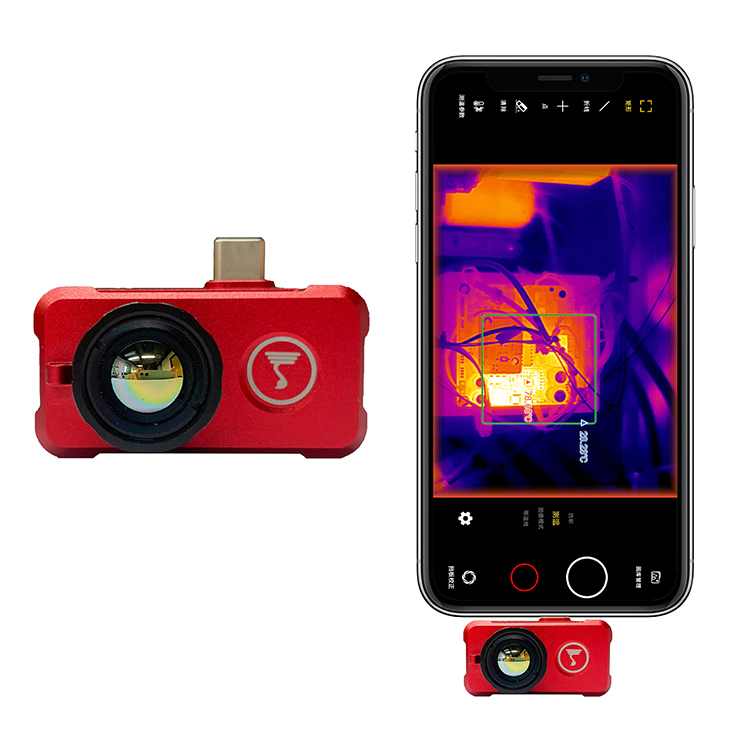
Are OEM thermal camera cores from specialized manufacturers worth buying compared to consumer dongles?
In contrast, specialized OEM thermal camera cores (such as the Purpleriver Mini 640 and 384 platforms) feature uncooled Vanadium Oxide (VOx) focal plane arrays with thermal sensitivity ≤40mK, ultra-compact 21mm × 21mm form factors, and deterministic sub-30ms hardware latency pipelines. These cores provide interchangeable, anti-reflective coated Germanium optics (with focal lengths up to 150mm), raw 14-bit linear radiometric output streams, and standard industrial interfaces (USB, CVBS, UART) that allow direct embedded integration into systems running on platforms like the Raspberry Pi or NVIDIA Jetson.
Can I replace or upgrade the thermal core inside an existing scope or drone gimbal?
The ultra-miniature 21mm × 21mm cross-section of the Mini 640 core allows it to drop into tight gimbal assemblies previously designed for older, bulkier sensor platforms. Integrators must verify that the host gimbal slip ring supports the core's chosen video format (such as low-latency CVBS analog composite or uncompressed USB UVC digital video). Additionally, command mapping for Non-Uniformity Correction (NUC) and color palette switching can be adapted using straightforward UART serial commands, allowing developers to upgrade legacy systems to modern 640×512 resolution without re-engineering the outer housing.
What should I evaluate before deciding to buy a thermal camera core for a DIY or commercial build?
1. الدقة وتباعد البكسل: Assess whether a 384×288 array meets your spatial resolution requirements, or if a high-definition 640×512 array is necessary to achieve your required Detection, Recognition, and Identification (DRI) metrics. A 12μm pixel pitch is generally preferable, as it significantly reduces overall lens volume and weight.
2. Optical Path and Aperture: Ensure your lens selection matches the core's microbolometer format and provides an appropriate f-number (ideally f/1.0 to f/1.2) to maintain rated thermal sensitivity without introducing optical vignetting.
3. Electrical and Software Integration: Verify that the core's output interface matches your onboard computing architecture. While USB UVC simplifies integration on single-board computers, direct MIPI or analog CVBS links may be required to minimize video latency.
4. Export Regulations: Determine whether your application requires a high-frame-rate (≥25Hz) module, and ensure your organization has the necessary compliance documentation in place to fulfill export control requirements.
عند إحكام إغلاق نواة حرارية غير مبردة داخل علبة مقاومة للطقس IP67/IP68، يكون التصميم الحراري السلبي حاسمًا لإيقاف الانحراف الحراري الأساسي وتدهور الصورة. لا تحتاج الميكروبولومترات إلى مبردات نشطة، لكن ASIC الصورة المدمجة ومشفرات الفيديو الشبكية تستهلك بين 1.0 واط و 2.5 واط أثناء التشغيل. في صندوق محكم ضيق بدون تدفق هواء، تخلق الحرارة الداخلية المحتبسة نقاطًا ساخنة عبر هيكل النواة ومصفوفة المستوى البؤري. تؤدي هذه التدرجات الحرارية الموضعية إلى خلل في قراءات درجة الحرارة الإشعاعية وتزيد من ضوضاء المستشعر، مما يقلل من حساسية NETD الفعالة لديك. لحل هذا، صمم مسارات مباشرة لتبديد الحرارة المعدنية—مثل كتلة باردة من الألومنيوم أو النحاس مقترنة بوسادات فجوة عالية التوصيل—تربط اللوحة الحرارية للوحدة مباشرة بالغلاف المعدني الخارجي. هذا يحول كامل الهيكل الخارجي إلى مشتت حراري كبير. أيضًا، تجنب تركيب أجزاء عالية الطاقة (مثل أجهزة الراديو RF أو محولات الطاقة الساخنة) بجوار النواة البصرية مباشرة للحفاظ على استقرار الظروف الحرارية عبر المستشعر.
- Industry Standard Embedded Compute: Raspberry Pi Foundation Embedded Processing Systems
- Hardware Control Platforms: Arduino Microcontroller Architecture and Interfaces
- Related Guide (Russian): Обзор низкопотребляющих модулей тепловизионных камер
- Related Guide (Arabic): دليل وحدات الكاميرا الحرارية عالية الأداء عبر واجهة MIPI