
Руководство по ценам на модули тепловизионных камер: факторы стоимости, характеристики и OEM-закупки
11 сентября 2026 г.
Инженерное руководство: выбор и закупка высокопроизводительных OEM-ядер тепловизионных камер
Интеграция длинноволнового инфракрасного (LWIR) зондирования в критически важные платформы — такие как стабилизированные подвесы беспилотных летательных аппаратов (БПЛА), автономные мобильные роботы (AMR), линии автоматизированного оптического контроля (AOI) и портативные оптронные системы — требует аналитической методологии проектирования, принципиально отличной от стандартной видимости спектральной визуализации. Когда инженеры-оптики, аэрокосмические и системные инженеры приступают к покупке ядра тепловизионной камеры модулей, они не просто выбирают готовый потребительский датчик; они задают электрооптический двигатель, который должен строго балансировать SWaP-C (размер, вес, мощность и стоимость), физику твердотельного детектора, тепловые постоянные времени микроболометра и детерминированные видеоконвейеры с низкой задержкой в динамических условиях окружающей среды.
Один-единственный просчёт в спецификации датчика каскадно распространяется на всю встроенную аппаратную архитектуру. Недооценка разности температур, эквивалентной шуму (NETD), ухудшает автоматизированные алгоритмы краевой сегментации в средах с низким тепловым контрастом, например во время морских поисково-спасательных операций или над облачными участками местности. Выбор неподходящего аппаратного интерфейса может перегрузить пропускную способность системной шины хост-устройства или внести неуправляемую задержку «от стекла до стекла», а выбор неправильного оптического f-числа существенно снижает системное пространственное разрешение и показатели обнаружения, распознавания и идентификации цели (DRI). Это техническое руководство предоставляет математические, физические и интеграционные критерии, необходимые для оценки, выбора и закупки неохлаждаемых микроболометрических ядер корпоративного класса (с нативным разрешением 640×512 и 384×288) для передовых промышленных, робототехнических и аэрокосмических применений.
Содержание
- 👉 Фундаментальная архитектура ядра: как работают OEM LWIR-модули
- 👉 Критические метрики оценки при покупке ядра тепловизионной камеры
- 👉 Оптическая инженерия: выбор объектива, германиевая оптика и дальности DRI
- 👉 Аппаратные интерфейсы, встроенная обработка и системная интеграция
- 👉 Сравнительная витрина продуктов: LWIR-ядра корпоративного класса 640 и 384
- 👉 Матрица выбора для конкретных применений (дроны, техническое зрение, оптроника)
- 👉 Закупка, поиск поставщиков уровня Tier-1 и соображения жизненного цикла
- 👉 Часто задаваемые вопросы (углублённый технический FAQ)
Фундаментальная архитектура ядра: как работают OEM LWIR-модули
OEM-ядро тепловизионной камеры преобразует падающий лучистый электромагнитный поток в длинноволновом инфракрасном спектре (обычно охватывающем от 8 мкм до 14 мкм) в линейные 14-битные или 16-битные цифровые радиометрические кадры данных и стандартизированные цифровые или аналоговые видеопотоки. Функциональность современных неохлаждаемых тепловизионных модулей зависит от трёх тесно связанных подсистем: матрицы фокальной плоскости (FPA), интегральной схемы считывания (ROIC) и бортового цифрового сигнального процессора (обычно FPGA или специализированного малопотребляющего ASIC-движка).
Падающее тепловое излучение испускается целевыми телами в соответствии с законом излучения Планка, проходит через атмосферу и через просветлённую оптическую линзу, фокусируясь непосредственно на матрице микроболометров. Матрица в фокальной плоскости поглощает эту оптическую мощность, что изменяет электрическое сопротивление каждой пиксельной мембраны прямо пропорционально её температуре. Интегральная схема считывания (ROIC) построчно опрашивает эти резистивные отклонения, оцифровывая слабые микровольтовые изменения с помощью встроенных аналого-цифровых преобразователей (АЦП). Затем цифровая телеметрия поступает во встроенный конвейер FPGA, отвечающий за коррекцию неравномерности (NUC), замену дефектных пикселей (BPR), пространственную фильтрацию и сжатие динамического диапазона перед выводом на внешние шины.
С точки зрения тепловой физики каждый отдельный пиксель микроболометра функционирует как тонкая термодинамическая структура, подвешенная в локальном вакууме. Когда падающий поток фотонов попадает на поглощающий слой (часто состоящий из нитрида кремния в сочетании с тонкой резистивной металлической плёнкой), поглощённая мощность повышает температуру активной мембраны относительно нижележащей кремниевой подложки. Основное уравнение теплопередачи, описывающее каждый элемент микроболометра, выражается как:
C-го · (dT/dt) + G-го · ΔT = η · Pв
Здесь, C-го представляет собой тепловую теплоёмкость пикселя, G-го — тепловая проводимость узких микромеханических опорных ножек, η — эффективность поглощения в спектральном диапазоне от 8 мкм до 14 мкм, а Pв представляет падающую лучистую мощность. Тепловая постоянная времени τ-го = C-го / G-го определяет, насколько быстро детектор реагирует на смену сцены. Если цель движется быстрее, чем позволяет эта физическая постоянная времени, отдельные пиксели не успевают остыть до начала следующего цикла интегрирования кадра, что вызывает заметное «хвостатость» и ухудшение модуляционной передаточной функции (MTF).
Физика микроболометров: оксид ванадия (VOx) против аморфного кремния (α-Si)
В основе неохлаждаемой тепловизионной техники лежит активный материал, используемый в мостиковой мембране микроболометра. Каждый пиксель состоит из поглощающей пластины, подвешенной над нижележащей кремниевой подложкой на микромеханических ножках из нитрида кремния, которые обеспечивают тепловую изоляцию внутри вакуумированной, герметично закрытой полости.
- ✅ Оксид ванадия (VOx): VOx является отраслевым эталоном для коммерческих, промышленных и оборонных тепловизионных систем. Материал демонстрирует высокий температурный коэффициент сопротивления (ТКС), обычно составляющий от -2% до -3% на кельвин при 300K, в сочетании с исключительно низким электронным шумом 1/f (фликкер-шумом). Этот повышенный ТКС позволяет датчикам VOx достигать ведущей в отрасли тепловой чувствительности (NETD ≤ 30 мК–40 мК) наряду с быстрыми тепловыми постоянными времени (τ ≈ 8 мс–12 мс). Как прямое следствие, матрицы VOx обеспечивают чёткое изображение с минимальным смазыванием движения, что делает их предпочтительным выбором для быстродвижущихся авиационных гиростабилизированных платформ и автономной навигации.
- ⚙️ Аморфный кремний (α-Si): В отличие от этого, детекторы на основе аморфного кремния могут изготавливаться непосредственно на стандартных линиях КМОП-полупроводниковой литографии, что снижает себестоимость производства пластин. Однако α-Si характеризуется более высоким собственным шумом 1/f, более низкой электропроводностью и более низкими структурными значениями ТКС (часто около -1,5% до -1,8%/К). Вследствие этого датчики α-Si часто демонстрируют более высокие базовые показатели NETD (>50 мК) и более медленные тепловые постоянные времени (τ > 14 мс). Последующим алгоритмам обработки сигнала приходится применять интенсивную временную фильтрацию для подавления базового шума, что приводит к заметному «призрачному» эффекту и задержке контуров при отслеживании быстродвижущихся целей.
Динамика шага пикселя: переход от 17 мкм к корпусированию на уровне пластины 12 мкм
За последнее десятилетие инфракрасная отрасль перешла от устаревших архитектур с шагом пикселя 17 мкм к корпусированию на уровне пластины (WSP) с шагом 12 мкм. Такое уменьшение шага пикселя даёт значительные физические и оптические преимущества:
- ✅ Оптическая апертура и габариты полезной нагрузки: Физическая диагональ матрицы датчика 640×512 уменьшается с 13,93 мм при шаге 17 мкм до всего 9,83 мм при шаге 12 мкм. Поскольку фокусное расстояние, необходимое для достижения эквивалентного поля зрения (FOV), линейно зависит от диагонали детектора, ядро с шагом 12 мкм требует объектива с оптическим фокусным расстоянием примерно на 30% короче, чем у ядра с шагом 17 мкм. Соответствующая световая апертура объектива пропорционально уменьшается, снижая физическую массу и объём дорогостоящей монокристаллической германиевой оптики до 50%. Это позволяет разработчикам создавать ультраминиатюрные системы, например модули форм-фактора 21 мм × 21 мм, которые удобно размещаются в компактных полезных нагрузках беспилотников.
- ⚙️ Дифракционные пределы и оптические допуски: Хотя геометрия 12 мкм обеспечивает сверхкомпактные характеристики SWaP-C, она подводит оптический тракт формирования изображения непосредственно к физическим дифракционным пределам длинноволнового ИК-излучения (λ ≈ 10 мкм). Для оптической системы, работающей при f/1.0, центральный диаметр диска Эйри рассчитывается как:
dЭйри = 2,44 × λ × f/# ≈ 2,44 × 10 мкм × 1,0 = 24,4 мкм
Поскольку центральное дифракционное пятно охватывает чуть более двух пикселей размером 12 мкм, оптические инженеры должны использовать прецизионно обработанные асферические германиевые или халькогенидные линзы с низкой ошибкой волнового фронта и минимальной хроматической аберрацией, чтобы предотвратить оптические перекрёстные помехи и сохранить динамический контраст изображения.
Коррекция неоднородности (NUC): механический затвор против бесзатворных алгоритмов
Из-за незначительных производственных отклонений в полупроводниковой матрице микроболометра каждый пиксель обладает собственным базовым сопротивлением и кривой теплового отклика. Кроме того, внутренний самонагрев и изменение внешних тепловых условий приводят к нелинейному дрейфу базового выходного сигнала пикселей с течением времени. Без непрерывной математической коррекции тепловое изображение деградирует в сильный пространственный шум, обычно называемый "фиксированным структурным шумом" (FPN). Современные ядра противодействуют этому с помощью двух механизмов:
- ⚙️ Калибровка с помощью электромеханического затвора (1-точечная NUC): Бортовой миниатюрный соленоид периодически выдвигает затемнённый механический флажок с высокой излучательной способностью перед матрицей FPA на 100–300 мс. Наблюдая оптически однородную тепловую поверхность, бортовой процессор вычисляет обновлённые коэффициенты смещения для каждого отдельного пикселя, сбрасывая базовую однородность матрицы. Хотя этот метод гарантирует оптимальную радиометрическую точность и низкий пространственный шум, физический механизм затвора вносит подвижные части, подверженные механическому износу, при этом на мгновение приостанавливая живой цифровой видеопоток.
- ✅ Бесшторная коррекция неоднородности на основе сцены (SBNUC): Для высоковибрационных аэрокосмических платформ, непрерывного сопровождения или оружейных прицелов, где прерывание видеосигнала недопустимо, высокопроизводительные DSP-движки реализуют продвинутые алгоритмы SBNUC. SBNUC непрерывно отслеживает высокочастотные пространственные отклонения между последовательными кадрами изображения, используя естественное движение сцены для отделения истинных тепловых сигнатур целей от дрейфа фиксированного паттерна сенсора. Однако архитектуры SBNUC требуют значительных вычислительных ресурсов FPGA и иногда могут создавать артефакты двоения, если тепловая камера остаётся неподвижной при наблюдении статичной сцены с высокими тепловыми градиентами.
Математически линейная двухточечная коррекция неоднородности оперирует исходными цифровыми отсчётами Xij генерируемыми пикселем в строке i and column j according to:
Yij = Gij · Xij + Oij
Где Gij represents the individual gain coefficient and Oij represents the real-time offset term. Because the offset vector migrates as ambient chassis temperatures fluctuate, the embedded FPGA must continuously interpolate offset lookup tables based on internal thermistor telemetry placed directly on the focal plane substrate.
Критические метрики оценки при покупке ядра тепловизионной камеры
When selecting and sourcing OEM thermal camera hardware, systems engineers must evaluate four core electro-optical and operational metrics to confirm operational fit:
Разность температур, эквивалентная шуму (NETD)
Noise Equivalent Temperature Difference defines the minimum temperature variation across an object that generates a signal-to-noise ratio (SNR) of unity at the detector output. Measured in milliKelvins (mK), NETD serves as the primary figure of merit for microbolometer sensitivity. Industrial-grade modules exhibit ratings between ≤30mK and ≤40mK, while entry-level commercial units typically test above 50mK. An NETD of 35mK means the core can resolve scene variations as small as 0.035°C.
When evaluating vendor data sheets, engineers must audit the exact test conditions under which the NETD was measured. Sensitivities quoted without specifying the optical f-number (typically f/1.0), the ambient test temperature (typically 300K / 27°C), and the target frame rate (e.g., 50Hz) can be misleading. Operating an NETD ≤ 40mK core behind an f/1.4 lens, for example, cuts the flux reaching the detector by half, increasing effective system noise to nearly 80mK according to the inverse-square law of the f-number:
NETDсистема ∝ (f/#)2 · (1 / τoptics)
Frame Rate Regimes and Global Dual-Use Export Controls
The temporal frame rate of an infrared core dictates its target-tracking capabilities and directly determines its international export classification:
- ⚙️ ≤ 9Hz Thermal Cores: Slow-frame-rate modules are generally exempt from strict multilateral defense export controls and can be acquired for commercial, civil, and consumer integration with straightforward documentation. However, a 9Hz temporal refresh rate is inadequate for closed-loop drone stabilization, high-speed automated sorting, or vehicle piloting, as camera movement at 9fps induces noticeable target judder, frame lag, and motion smear.
- ✅ 25Hz / 30Hz / 50Hz / 60Hz High-Speed Cores: High-frame-rate cores are required for real-time robotic perception, stabilized airborne tracking gimbals, search and rescue, and optronic scopes. These modules deliver smooth motion representation and ultra-low glass-to-glass latency (<30ms). However, procurement of thermal cores running at ≥25Hz is strictly regulated under dual-use export control regimes, including the Wassenaar Arrangement, United States International Traffic in Arms Regulations (ITAR) / Export Administration Regulations (EAR), and equivalent European Union regulations. Buyers must execute End-User Certificates (EUC) confirming non-proliferation compliance before procurement contracts can be fulfilled.
Radiometric Data Output vs. Qualitative Imaging
Procurement teams must distinguish between qualitative thermal imaging cores and quantitative radiometric measurement cores:
- ⚙️ Qualitative (Imaging-Only) Cores: The embedded FPGA converts the high-dynamic-range 14-bit microbolometer signal directly into an 8-bit standard output (YUV422 or RGB24) via adaptive dynamic range algorithms (such as Digital Detail Enhancement - DDE, local contrast optimization, and histogram equalization). The camera outputs an aesthetically sharp visual image tailored for human display systems, but discards raw sensor voltage values. True target temperatures cannot be extracted from the video stream.
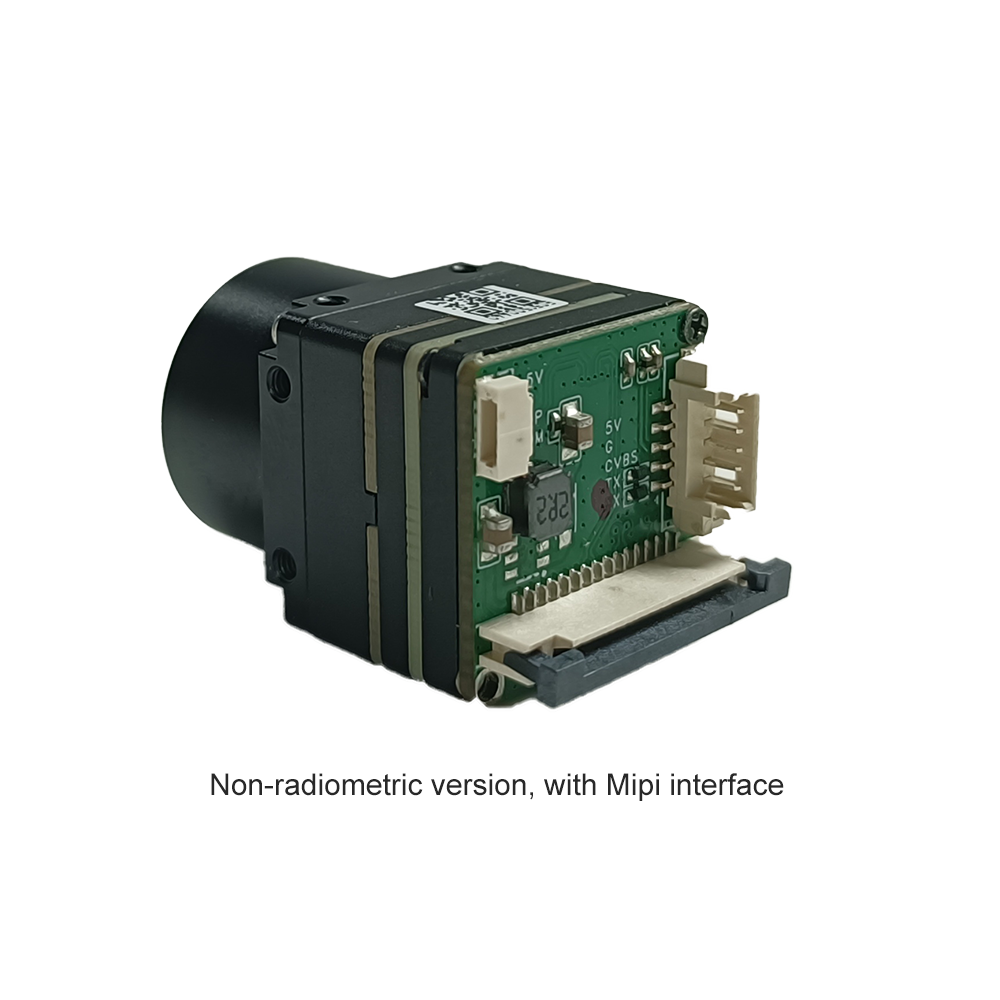
- ✅ Quantitative (Radiometric) Cores: The module outputs a linear digital signal (typically 14-bit or 16-bit digital words per pixel) alongside or interleaved with the visual video stream. Each digital level (Digital Number - DN) maps directly to radiant energy or temperature via calibrated sensor lookup tables (LUTs) factoring in internal core temperatures. Radiometric output is essential for automated predictive maintenance, electrical substation inspection, wildland fire perimeter mapping, and automated machine vision. Systems engineers looking for deep architectural guidance on digital streaming buses should study this guide to high-performance MIPI thermal modules.
Оптическая инженерия: выбор объектива, германиевая оптика и дальности DRI
Because silicate-based optical glass is completely opaque to electromagnetic radiation within the 8μm to 14μm waveband, thermal camera cores require specialized transmissive optical materials combined with high-performance anti-reflective thin-film coatings.
Optical Substrates: Monocrystalline Germanium vs. Chalcogenide Glass
Two primary optical substrates dominate the LWIR market:
- ✅ Монокристаллический германий (Ge): Germanium possesses an exceptionally high refractive index (n ≈ 4.0 at 10μm), allowing optical engineers to design lenses with shallow surface curvatures, minimal spherical aberrations, and high optical power within compact physical dimensions. Germanium is mechanically robust and suited for harsh airborne environments. However, pure Germanium suffers from thermal runaway: as ambient optical temperatures surpass 60°C, free-electron absorption increases exponentially, causing the substrate to lose transparency. Consequently, external surfaces must feature durable Anti-Reflective (AR) or Diamond-Like Carbon (DLC) hard coatings to survive rain erosion, dust abrasion, and saline atmosphere.
- ⚙️ Chalcogenide Glass (e.g., GASIR): Chalcogenide materials consist of synthetic compounds containing sulfur, selenium, or tellurium. Unlike Germanium, Chalcogenide glasses can be molded via precision glass pressing rather than ground and polished with single-point diamond turning (SPDT). This allows cost-effective production of complex aspheric lens designs at volume. Furthermore, Chalcogenide exhibits an exceptionally low thermo-optic coefficient (dn/dT), simplifying the engineering of passively athermalized lens assemblies that stay in focus from -40°C to +85°C without active motor compensation.
DRI Range Calculations (Johnson’s Criteria Applied to 12μm Cores)
To project real-world target acquisition ranges for security, defense, and drone search missions, optical engineers employ Johnson’s Criteria. The spatial frequency requirements across a target’s critical dimension (traditionally a human target scaled to 1.8m × 0.5m with a 0.75m critical dimension, or a standard vehicle of 2.3m × 2.3m) are defined as:
- ⚙️ Detection (1.5 cycles / ~2 pixels on target): The observer can determine that an object of interest is present in the scene.
- ⚙️ Recognition (6.0 cycles / ~8 pixels on target): The observer can classify the target type (e.g., differentiating a human from an animal, or a truck from a passenger vehicle).
- ⚙️ Identification (12.0 cycles / ~16 pixels on target): The observer can identify specific details (e.g., identifying a commercial pickup versus an armed technical vehicle).
The Instantaneous Field of View (IFOV), representing the spatial angle subtended by a single physical pixel, is calculated as:
IFOV (mrad) = Pixel Pitch (p) / Lens Focal Length (f)
For a modern 12μm VOx thermal core:
- ✅ Wide-Angle Optics (f = 9mm): IFOV = 12μm / 9mm = 1.33 mrad. At an operational distance of 1,000 meters, one pixel spans 1.33 meters. This lens geometry provides an expansive field of view, ideal for short-range situational awareness, indoor mobile robotics, and localized aerial mapping.
- ✅ Telephoto Long-Range Optics (f = 75mm): IFOV = 12μm / 75mm = 0.16 mrad. At a distance of 1,000 meters, one pixel covers just 16 centimeters. This tighter spatial projection enables positive human target detection beyond 3,500 meters and vehicle identification past 2,000 meters.
When computing field DRI envelopes, systems integrators must also account for atmospheric attenuation using Beer-Lambert transmission modeling:
τатм(R) = exp(-γ · R)
Где γ is the atmospheric extinction coefficient (dominated in the LWIR spectrum by absolute humidity and water-vapor continuum absorption) and R is the distance to the target. In humid maritime environments, γ can reduce effective detection ranges by 30% to 50% compared to dry desert testing scenarios.
Optical Mounts and Mechanics
OEM cores use threaded barrel configurations to ensure optical concentricity and maintain a stable focal position under continuous shock and vibration. Standard configurations include micro-threaded mounts (e.g., M10×0.5, M12×0.5, or proprietary coarse threadings) fitted with fluoroelastomer (Viton) O-rings. These O-rings seal the optical path against environmental moisture ingress, preserving IP67-rated enclosures in airborne payloads.
Аппаратные интерфейсы, встроенная обработка и системная интеграция
Integrating an uncooled thermal core into host electronics requires careful matching of data transfer bandwidth, power dissipation paths, and software communication pipelines.
Digital and Analog Video Pipelines
Thermal camera cores generally output video and telemetry over one or more of the following standard interfaces:
- ✅ USB 2.0 / USB 3.0 (UVC Architecture): Cores featuring USB endpoints implement the USB Video Class (UVC) protocol, enabling plug-and-play streaming into Linux, Windows, and ROS (Robot Operating System) hosts without requiring custom kernel drivers. The core streams 8-bit visual YUV/RGB frames alongside 14-bit uncompressed Y16 radiometric buffers over bulk transfer endpoints, simplifying software development.
- ⚙️ MIPI-CSI2 (Интерфейс процессора мобильной индустрии): For lightweight embedded hardware running edge-AI processors (such as the NVIDIA Jetson Orin series or Rockchip RK3588), MIPI-CSI2 is the preferred interface. By routing differential serial clock and data lanes directly into the host processor's Image Signal Processing (ISP) pipeline, MIPI bypasses USB protocol conversion latency, cuts hardware component counts, and reduces power consumption.
- ⚙️ Analog Composite Video (CVBS - NTSC/PAL): Analog composite video remains popular in specialized airborne FPV systems, legacy target turrets, and real-time flight controls. Because CVBS output bypasses OS digital frame buffers, it delivers ultra-low end-to-end latency (≤10ms), preventing control loop instability during high-speed manual drone piloting.
Interfacing with Embedded Single-Board Computers and Microcontrollers
Modern autonomous platforms rely on split processing architectures to handle imaging pipelines and hardware controls efficiently:
- ✅ Single-Board Computers (SBCs): Systems integrators frequently pair USB or MIPI thermal modules with embedded platforms like the Raspberry Pi to execute deep-learning object classifiers (e.g., YOLOv8-tiny) or perform automated thermal segmentation routines directly at the edge.
- ⚙️ Microcontrollers: For auxiliary tasks—such as sending NUC calibration pulses, adjusting motorized focus mechanisms, or reading ambient temperature sensors—engineers frequently link an Arduino or comparable ARM Cortex-M microcontroller to the core’s UART or I²C control interfaces. For a detailed exploration of compact edge implementations, read our overview of low-power thermal camera modules for localized payloads.
Thermal Dissipation and Power Integrity
Because microbolometers measure microscopic changes in pixel temperature, they are sensitive to thermal fluctuations within the camera chassis itself. Poor mechanical heat-sinking creates asymmetric thermal gradients across the core housing, resulting in non-uniform spatial drift, localized shading artifacts, and frequent NUC shutter cycles.
To avoid these issues, engineers must mechanically couple the core’s primary chassis interface to an external aluminum heat sink using high-conductivity thermal gap pads (≥3.0 W/m·K). Furthermore, because ROIC readout noise correlates directly with power rail stability, system power supplies must be decoupled using low-noise Low Dropout (LDO) linear regulators. Power rail ripple must stay below 20mV peak-to-peak to prevent visible banding across the thermal image.
Сравнительная витрина продуктов: LWIR-ядра корпоративного класса 640 и 384
When preparing to покупке ядра тепловизионной камеры modules, systems engineers must evaluate verified commercial hardware against their project’s SWaP-C requirements. Below are two industry-tested LWIR cores designed for integration into aerial gimbals, machine vision systems, and autonomous robotic platforms.
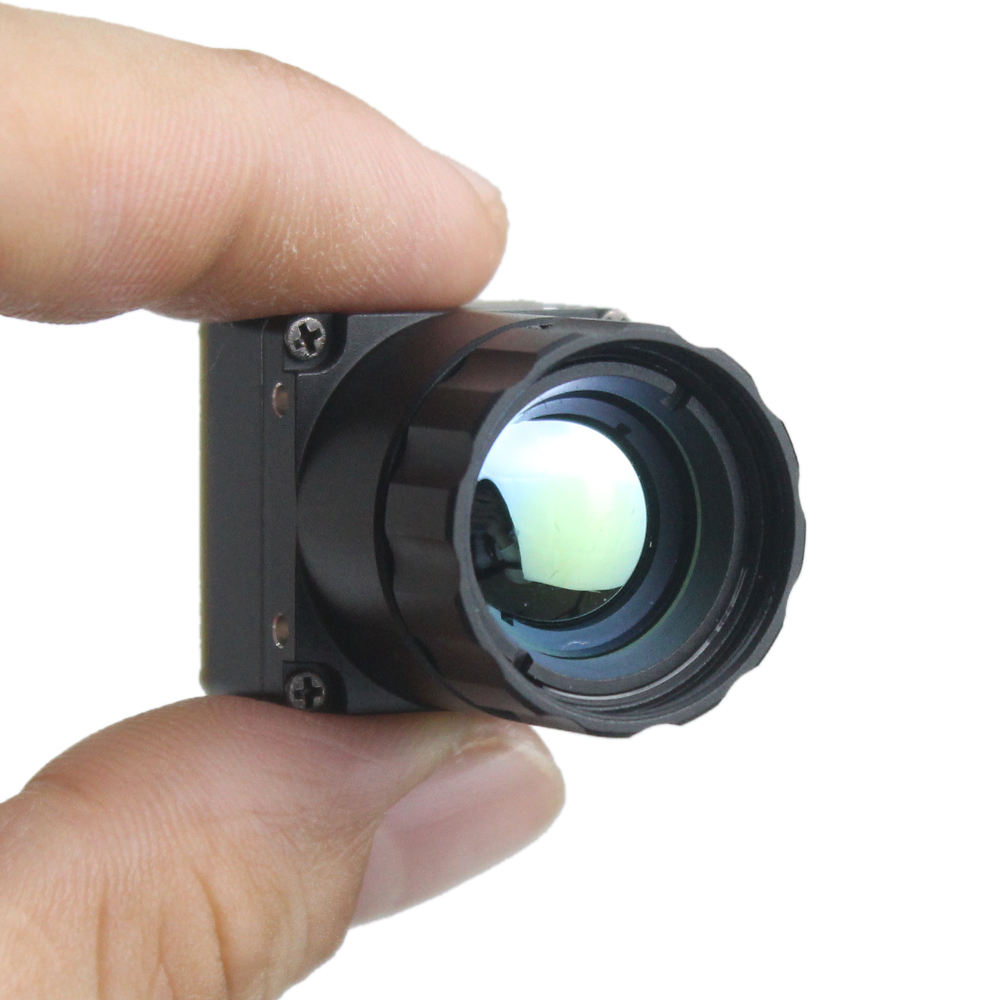
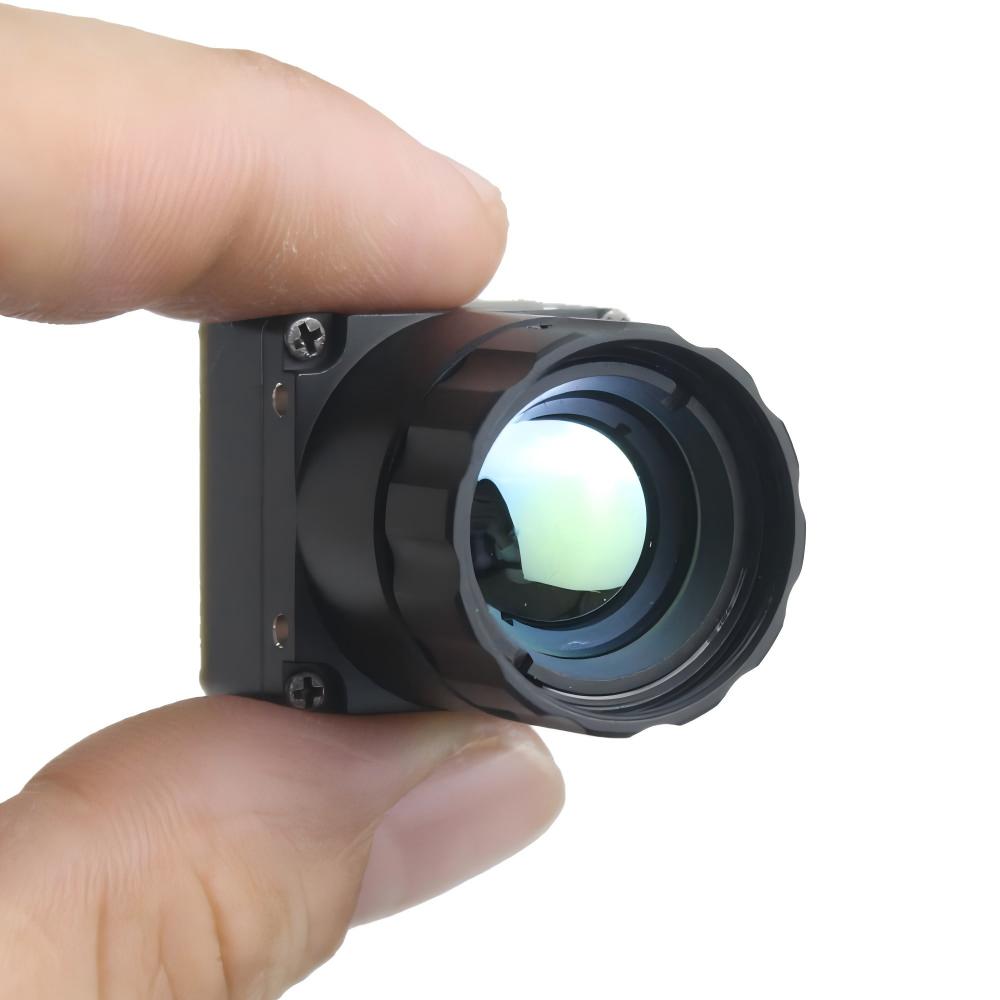
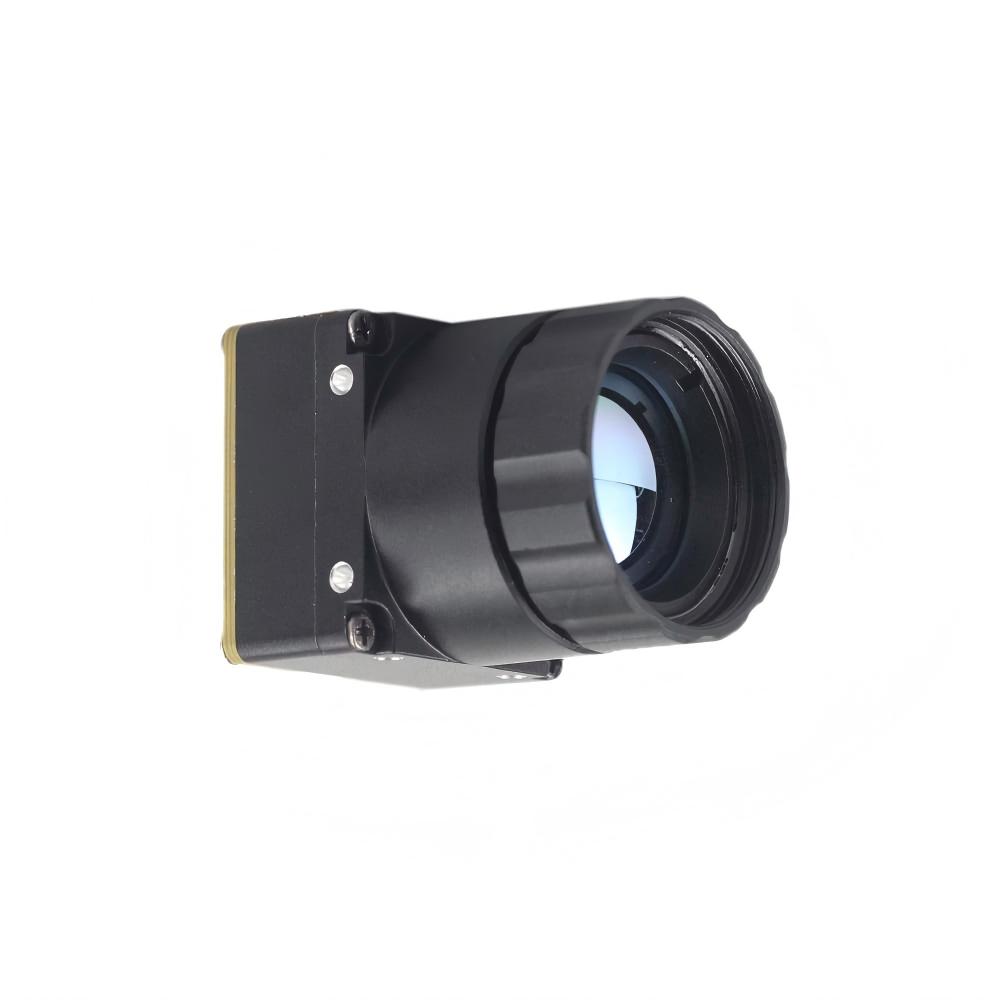
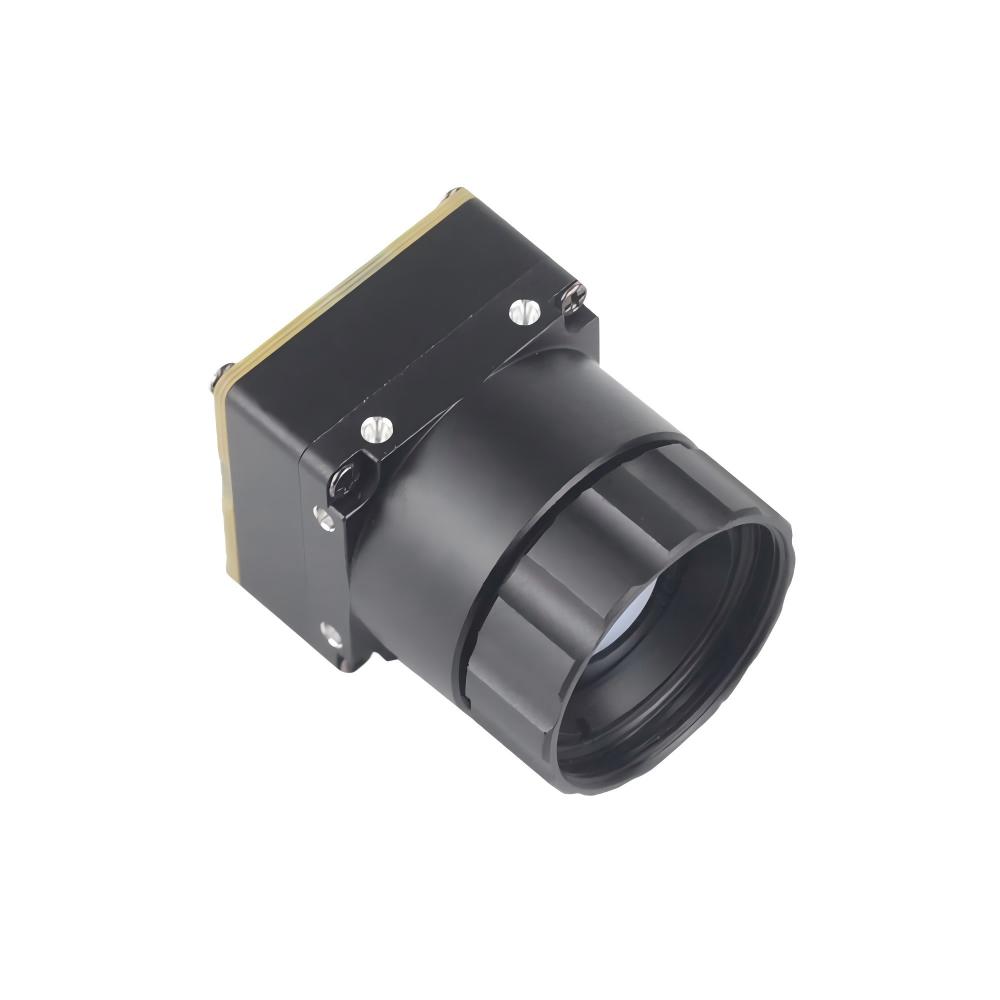
Неохлаждаемый LWIR USB миниатюрный модуль ядра тепловизионной камеры 640*512
Designed specifically for UAV stabilized gimbals (comparable to enterprise DJI payload architectures), advanced thermal sights, and high-performance robotic tracking, this mini uncooled infrared thermal imaging core delivers sharp imagery within an ultra-compact footprint. Measuring just 21 мм × 21 мм, it combines high thermal sensitivity (≤40mK) with versatile optical options to support applications ranging from wide-angle aerial mapping to long-distance reconnaissance.
- ✅ Native Resolution: 640 × 512 (640 × 480 selectable operating mode)
- ✅ Тип детектора: High-sensitivity Uncooled VOx Microbolometer (12μm pixel pitch)
- ✅ Тепловая чувствительность: NETD ≤ 40mK @ f/1.0, 300K
- ⚙️ Extensive Lens Portfolio: 5mm, 9mm, 13mm, 18mm, 35mm, 50mm, 75mm, 100mm, and 150mm focal lengths
- ✅ Форм-фактор: Ultra-miniature 21mm × 21mm footprint for constrained enclosures
- ⚙️ Подключение: USB 2.0 (UVC stream + full 14-bit radiometric raw telemetry) with UART serial control
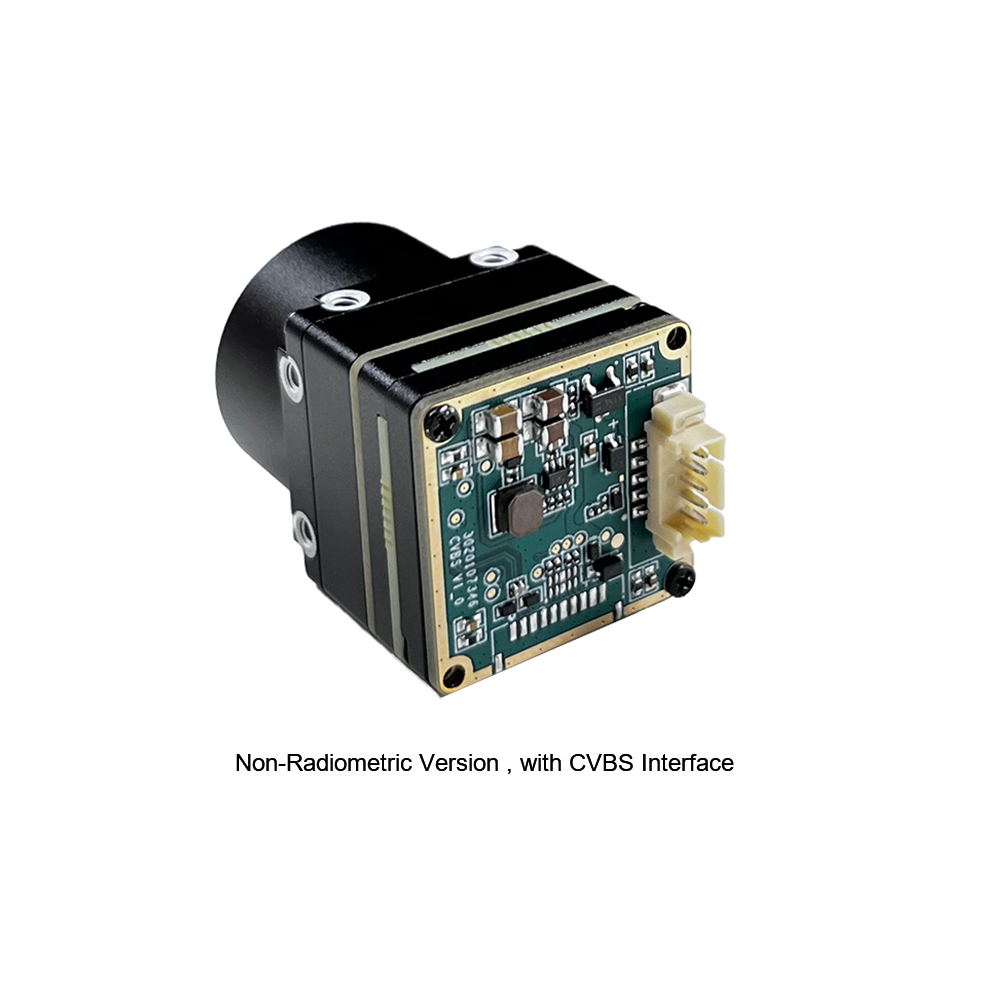
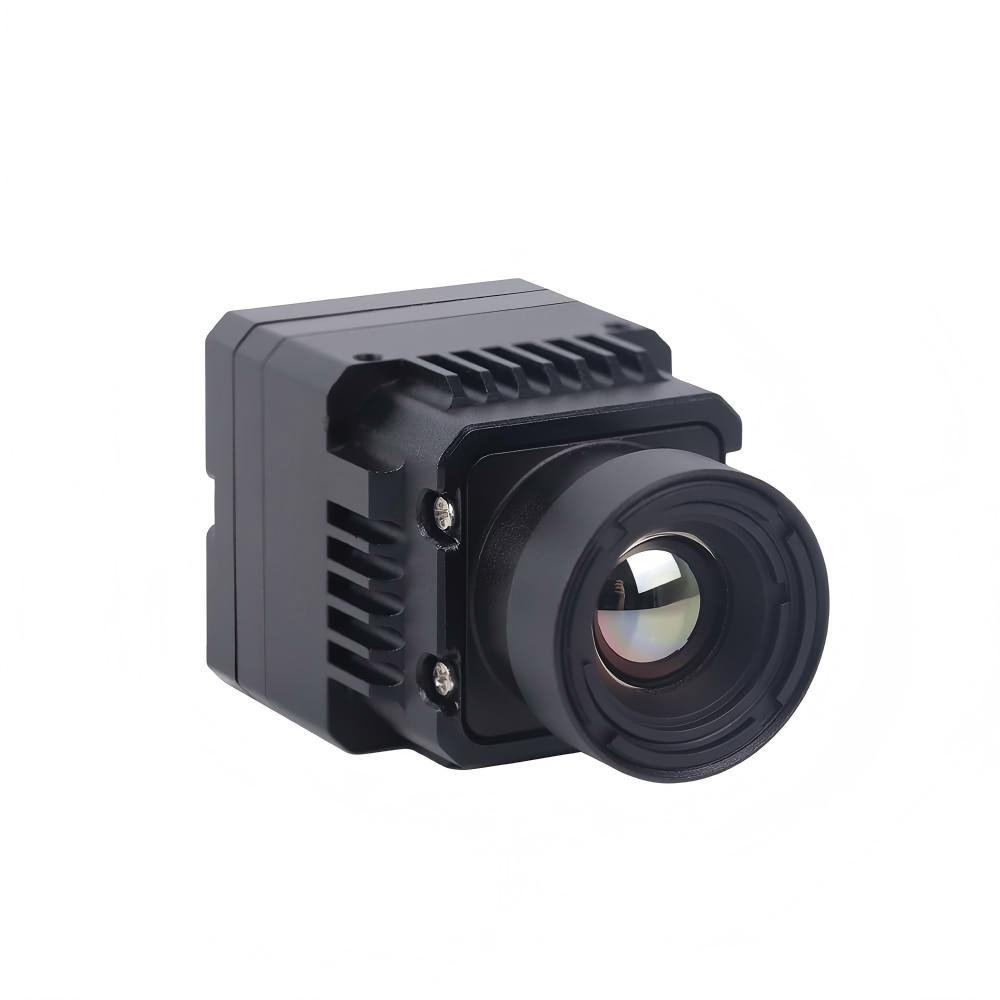
Неохлаждаемый мини 384*288 тепловизионный модуль камеры для дронов
The MINI series 384×288 infrared thermal module provides a balanced, small-form-factor solution for online temperature measurement and continuous industrial process monitoring. Utilizing high-performance detectors and low-latency processing, this core is engineered for machine vision inspection, factory safety systems, electrical switchgear maintenance, and lightweight drone payloads requiring reliable radiometric thermal imaging.
- ✅ Native Resolution: 384 × 288 active pixels
- ✅ Thermal Imaging Engine: High-precision uncooled focal plane array with stable drift compensation
- ⚙️ Precision Radiometry: Online industrial temperature measurement with point, line, and area analysis
- ⚙️ Interface Versatility: Direct analog CVBS composite video alongside digital outputs for display or transmission
- ✅ Primary Target Applications: Machine vision, automated safety inspection, equipment maintenance, and small aerial drones
Direct Engineering Comparison Table
| Системный параметр | Mini 640×512 LWIR Module | Mini 384×288 LWIR Module |
|---|---|---|
| Active Pixel Matrix | 640 × 512 (Optional 640 × 480) | 384 × 288 |
| Физические размеры | Ultra-miniature (21mm × 21mm × 21mm) | Compact MINI Series Envelope |
| Available Lens Lineup | 5, 9, 13, 18, 35, 50, 75, 100, 150mm | Standard MINI Series Optics (Fixed / Focusable) |
| Digital & Analog I/O | USB 2.0 (UVC + Y16 Radiometric) + UART | CVBS Composite Video + USB + UART |
| Тепловая чувствительность (NETD) | ≤ 40mK @ f/1.0, 300K | ≤ 40mK @ f/1.0, 300K |
| Target Integration Envelopes | DJI-class stabilized gimbals, advanced long-range security | Machine vision inspection, automated factory monitoring, sUAVs |
6. Application-Specific Selection Matrix
Selecting between 640×512 and 384×288 resolutions requires analyzing operational requirements against target platform constraints:
1. Stabilized Drone Gimbals and Tactical UAV Payloads
For aerial platforms, every additional gram of payload directly reduces flight endurance. Upgrading to an ultra-compact 21mm × 21mm 640×512 module provides high spatial resolution (327,680 individual pixels) without exceeding payload weight limits. In utility inspections (such as scanning high-voltage transmission lines or solar farms), this elevated pixel count lets drone pilots operate at a safe standoff distance while resolving fine thermal anomalies, such as failing cells or high-resistance connectors.
- ✅ Recommended Core: Mini 640×512 LWIR Module (VOx, 12μm).
- ⚙️ Key Optical Pairing: 13mm to 35mm athermalized Germanium optics with DLC external coating.
- ✅ Primary Advantage: Superior DRI metrics permitting safe standoff distance while retaining sub-30ms glass-to-glass latency for gimbal stabilization loops.
2. Automated Machine Vision and Industrial Monitoring
In high-speed manufacturing, robotic cells require continuous non-contact thermal inspection to catch mechanical bearing friction, PCB thermal anomalies, and injection molding defects. The Mini 384×288 Thermal Core provides a balanced combination of high reliability, compact sizing, and accessible cost for distributed industrial monitoring networks. Its onboard radiometric processing calculates automated alarms for user-defined Regions of Interest (ROIs), passing critical alerts directly to factory programmable logic controllers (PLCs).
- ✅ Recommended Core: Mini 384×288 Thermal Camera Module.
- ⚙️ Key Optical Pairing: 9mm or 13mm wide-angle optics with standard anti-reflective coating.
- ✅ Primary Advantage: Budget-conscious multi-camera deployment across manufacturing lines with direct 14-bit radiometric data extraction over USB or CVBS.
3. Security Optronics, Handheld Monoculars, and Sights
Weapon-mounted optics, perimeter monitoring systems, and search-and-rescue monoculars demand high spatial identification metrics. Pairing a 640×512 12μm core with narrow-field-of-view Germanium lenses (such as 50mm, 75mm, or 100mm optics) provides the angular resolution needed to detect and classify human targets beyond one kilometer in zero-lux conditions, through light foliage, or in smoke-filled environments.
- ✅ Recommended Core: Mini 640×512 LWIR Module.
- ⚙️ Key Optical Pairing: 50mm, 75mm, or 100mm narrow-angle manual or motorized focus lenses.
- ✅ Primary Advantage: Sub-mrad spatial resolution resolving human profiles at distances exceeding 1,500 meters under extreme environmental temperatures (-40°C to +70°C).
Закупка, поиск поставщиков уровня Tier-1 и соображения жизненного цикла
Procuring microbolometer cores for long-term production programs involves several operational and supply chain considerations:
- ⚙️ Wafer Supply Chain Stability: Ensure your core manufacturer maintains verified access to high-yield VOx semiconductor fabrication and raw monocrystalline Germanium. Fluctuations in raw material availability can introduce severe production delays.
- ⚙️ Radiometric Recalibration Support: Over continuous multi-year industrial or military deployments, thermal detectors can exhibit long-term baseline drift. Tier-1 suppliers provide software API suites that allow engineering teams to perform field recalibrations without having to return units to the factory.
- ✅ Software Toolkits and Driver Portability: A smooth hardware integration depends on clear, complete documentation. Ensure your core supplier provides functional Linux kernel drivers (Video4Linux2 / V4L2 compliant), comprehensive C/C++ SDKs, ROS wrappers, and detailed hardware register maps. Registered enterprise customers can download current SDK updates and firmware patches directly via their customer account portal.

Часто задаваемые вопросы (углублённый технический FAQ)
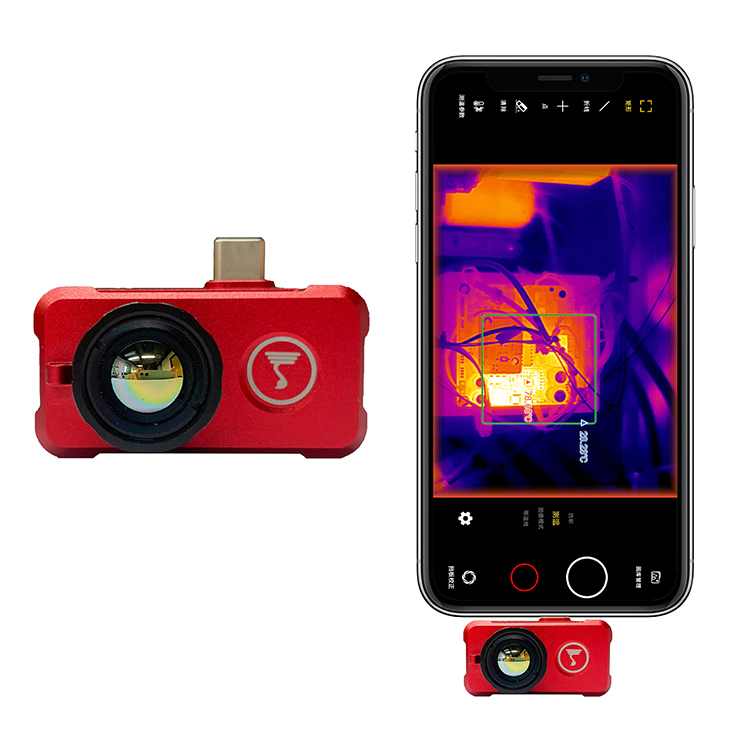
Are OEM thermal camera cores from specialized manufacturers worth buying compared to consumer dongles?
In contrast, specialized OEM thermal camera cores (such as the Purpleriver Mini 640 and 384 platforms) feature uncooled Vanadium Oxide (VOx) focal plane arrays with thermal sensitivity ≤40mK, ultra-compact 21mm × 21mm form factors, and deterministic sub-30ms hardware latency pipelines. These cores provide interchangeable, anti-reflective coated Germanium optics (with focal lengths up to 150mm), raw 14-bit linear radiometric output streams, and standard industrial interfaces (USB, CVBS, UART) that allow direct embedded integration into systems running on platforms like the Raspberry Pi or NVIDIA Jetson.
Can I replace or upgrade the thermal core inside an existing scope or drone gimbal?
The ultra-miniature 21mm × 21mm cross-section of the Mini 640 core allows it to drop into tight gimbal assemblies previously designed for older, bulkier sensor platforms. Integrators must verify that the host gimbal slip ring supports the core's chosen video format (such as low-latency CVBS analog composite or uncompressed USB UVC digital video). Additionally, command mapping for Non-Uniformity Correction (NUC) and color palette switching can be adapted using straightforward UART serial commands, allowing developers to upgrade legacy systems to modern 640×512 resolution without re-engineering the outer housing.
What should I evaluate before deciding to buy a thermal camera core for a DIY or commercial build?
1. print("Ошибка: не удалось подключиться к потоку тепловизионного модуля.") Assess whether a 384×288 array meets your spatial resolution requirements, or if a high-definition 640×512 array is necessary to achieve your required Detection, Recognition, and Identification (DRI) metrics. A 12μm pixel pitch is generally preferable, as it significantly reduces overall lens volume and weight.
2. Optical Path and Aperture: Ensure your lens selection matches the core's microbolometer format and provides an appropriate f-number (ideally f/1.0 to f/1.2) to maintain rated thermal sensitivity without introducing optical vignetting.
3. Electrical and Software Integration: Verify that the core's output interface matches your onboard computing architecture. While USB UVC simplifies integration on single-board computers, direct MIPI or analog CVBS links may be required to minimize video latency.
4. Export Regulations: Determine whether your application requires a high-frame-rate (≥25Hz) module, and ensure your organization has the necessary compliance documentation in place to fulfill export control requirements.
📚 Ссылки и дополнительная литература
- Industry Standard Embedded Compute: Raspberry Pi Foundation Embedded Processing Systems
- Hardware Control Platforms: Arduino Microcontroller Architecture and Interfaces
- Related Guide (Russian): Обзор низкопотребляющих модулей тепловизионных камер
- Related Guide (Arabic): دليل وحدات الكاميرا الحرارية عالية الأداء عبر واجهة MIPI