
Guangzhou Purple River MIPI USB Thermal Camera Module: High-Res Embedded IR Solutions
2026年7月17日
MIPI Thermal Camera Module Guide: High-Res Edge AI Integration for Raspberry Pi & Drones
2026年7月20日
640x512 Thermal Camera Module: The Ultimate Guide for Drone & Edge AI Integration
Here's the raw truth about modern aerospace engineering, autonomous robotics, and edge-computing designs: visual spectrum cameras only tell half the story. If you're building systems that need to operate in pitch-black conditions, cut through heavy dust, or track targets through dense foliage, standard RGB sensors aren't going to cut it. As automation systems demand 24/7 situational awareness, the integration of high-resolution, uncooled Long-Wave Infrared (LWIR) sensors has transitioned from an expensive, military-exclusive luxury to a core architectural necessity. Among the various thermal sensor layouts, the 640x512 thermal camera module has emerged as the definitive industry benchmark, balancing crucial spatial resolution with optimized Size, Weight, Power, and Cost (SWaP-C) payloads.
Look, we aren't just talking about slapped-together hobbyist gear here. This document serves as an exhaustive, blueprint-level integration guide for systems architects, payload engineers, and edge AI developers who are putting these sensors into the field. Whether your objective is to mount a lightweight radiometric sensor on an active drone gimbal, parse raw thermal data pipelines on an ultra-compact single-board computer, or run heavy real-time deep learning models at the edge, this guide provides the exact engineering specifications, optical physical models, interface analysis, and hardware blueprints required to deploy these uncooled LWIR cores without wasting time or blowing your budget.
Table of Contents
- 👉 1. Sensor Physics and Engineering: Deep-Dive of Uncooled LWIR 640x512 Cores
- 👉 2. SWaP-C Design Practices for Unmanned Aerial Systems (UAVs)
- 👉 3. Passive Optics: Focal Length Engineering and DRI Mathematical Calculations
- 👉 4. Digital Interfaces, RTOS Integration, and Edge AI Architectures
- 👉 5. High-Performance Hardware Solutions: Comprehensive Specifications Table
- 👉 6. Deep-Dive Hardware Integration FAQ
1. Sensor Physics and Engineering: Deep-Dive of Uncooled LWIR 640x512 Cores
To deploy a thermal module effectively, you have to master the underlying solid-state physics of the sensor. A 640x512 thermal camera module relies on an uncooled microbolometer array operating in the Long-Wave Infrared (LWIR) atmospheric window, which spans 8 μm to 14 μm. This specific band is crucial because it aligns perfectly with the peak blackbody radiation of terrestrial objects at ambient temperatures (around 300 Kelvin). Unlike cooled Cryogenic Quantum Well Infrared Photodetectors (QWIP) or Mercury Cadmium Telluride (MCT) sensors that require heavy, power-hungry helium cryocoolers reaching 77 Kelvin, uncooled microbolometers function at ambient system temperatures. They achieve this by leveraging robust chemical compounds engineered directly onto a silicon read-out integrated circuit (ROIC).
Vanadium Oxide (VOx) vs. Amorphous Silicon (a-Si)
The active thermal sensing element consists of an incredibly thin membrane suspended over an optimized reflective substrate by microscopic, high-aspect-ratio mechanical support legs. This structure serves as a microscale resonant cavity designed to capture incoming LWIR photons. The core material composition of this suspended microbolometer resistor dictates your sensor's signal-to-noise ratio in harsh environments, and you generally run into two competing options in the shop:
- ✅ Vanadium Oxide (VOx): VOx is the premier material for high-reliability military, aerospace, and commercial inspection applications. It exhibits a high Temperature Coefficient of Resistance (TCR), typically hovering around -2%/K to -3%/K. In plain English, this means its electrical resistance changes dramatically with even the slightest temperature shift. This translated characteristic yields highly stable thermal images with minimal temporal noise and drift.
- ❌ Amorphous Silicon (a-Si): While simpler and cheaper to manufacture, a-Si arrays offer lower overall TCR performance. They suffer from high 1/f noise and structural drift over time, necessitating frequent Flat Field Correction (FFC / Shutter Calibration) pauses during operation. In high-speed drone applications, a shutter drop that freezes your video stream for half a second can cause an autonomous navigation loop to desynchronize or miss a critical tracking waypoint.
For drone and edge AI workloads where rapid, dynamic scenery demands continuous, undisturbed streams of high-contrast imagery, VOx microbolometers are the clear winner. They deliver superior thermal sensitivity, lower 1/f noise, and exceptional spatial consistency, making them ideal for high-precision autonomous operations where failure isn't an option.
The Spatial Resolution Equation: 640x512 vs. Competitors
Let's talk resolution. A 640x512 pixel array yields a total native canvas of 327,680 individual sensing microbolometer pixels. When evaluating this spatial density against lower-resolution alternatives on the market, the exponential leap in data fidelity is night and day:
- 📌 256x192 Modules (49,152 pixels): Commonly used in entry-level rugged hand tools or close-up industrial troubleshooting. Once your target moves past 15 meters, these sensors suffer from severe spatial aliasing and turn your targets into unrecognizable boxes of pixels.
- 📌 384x288 Modules (110,592 pixels): A common mid-range option, but it often lacks the fine spatial detail required for neural network pipelines targeting objects beyond 50 meters.
- 📌 640x512 Modules (327,680 pixels): Delivers more than 6.6 times the spatial data density of a 256px sensor and nearly 3 times that of a 384px sensor.
This massive jump in pixel count is a game-changer for Edge AI deployments. Deep learning models, such as YOLOv8-obb or Single Shot MultiBox Detectors (SSD), require a minimum target bounding footprint of roughly 12x12 to 24x24 pixels to achieve inference confidence ratings above 85%. A 640x512 module provides these critical pixels at significantly longer ranges, letting you resolve the structural details of humans, fauna, vehicles, and high-voltage transmission anomalies where lower-resolution sensors yield only a blurry heat blob.
Pixel Pitch and Thermal Sensitivity (NETD)
Two essential technical specifications define the raw sensing resolution and sensitivity limit of modern microbolometer cores:
- ⚙️ Pixel Pitch (12 μm vs. 17 μm): Legacy 640 cores utilize a 17 μm pixel pitch microbolometer array. To minimize physical payload size, modern top-tier modules utilize a 12 μm pixel pitch. Shrinking this footprint allows for a smaller sensor die, which in turn reduces the physical diameter requirements of costly Germanium optics while maintaining a wide Field of View (FOV).
- ⚙️ Noise Equivalent Temperature Difference (NETD): NETD is the standard metric used to quantify a thermal sensor's signal-to-noise ratio. It measures the minimum temperature difference resolving a signal equal to the system’s intrinsic electronic noise floor. Expressed in milli-Kelvins (mK), a premier 640x512 camera module exhibits an NETD ≤ 40 mK (at F/1.0, 30°C). Sensors achieving <40mK sensitivity can easily isolate fine features—such as dampness on insulated piping, thermal footprints in thick foliage, or early-stage motor bearings heating up—even in low-contrast, overcast, or sub-zero environments.
2. SWaP-C Design Practices for Unmanned Aerial Systems (UAVs)
When you're integrating sub-systems into Unmanned Aerial Vehicles (UAVs), you live and die by SWaP-C (Size, Weight, Power, and Cost) limitations. In micro, mini, and tactical drone classifications, extra weight directly degrades airtime endurance, while volatile power draws compromise the aircraft's onboard power distribution networks.
Mechanical Footprint & Microscale Assemblies
Traditional cooled thermal cameras weigh upwards of 500g to 1.5kg, making them completely useless for sub-250g drone categories or commercial drone standard gimbal structures. Modern uncooled 640x512 thermal modules challenge these limits with incredibly compact profiles.
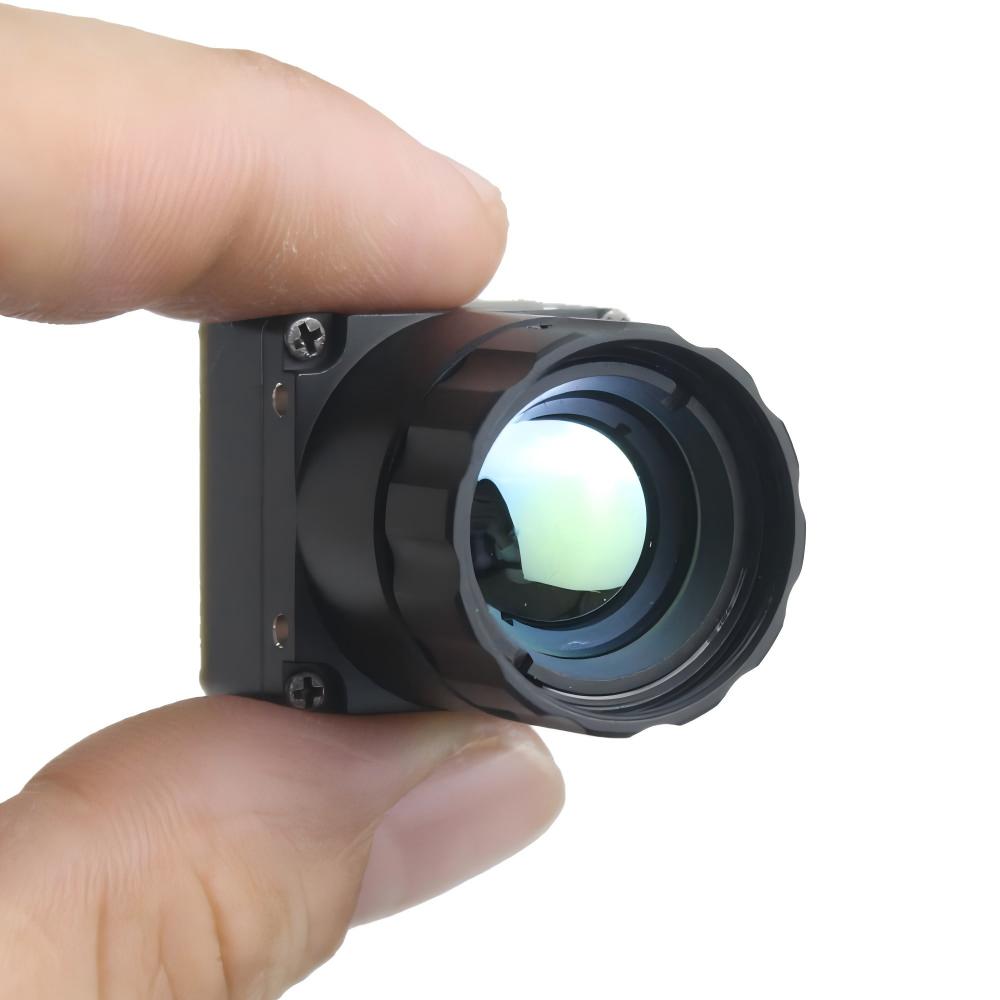
By leveraging Application-Specific Integrated Circuit (ASIC) processing chips rather than bulkier, multi-board Field-Programmable Gate Array (FPGA) stacks, specialized design houses have shrunk the core camera electronics to an ultra-compact footprint of 21mm × 21mm.
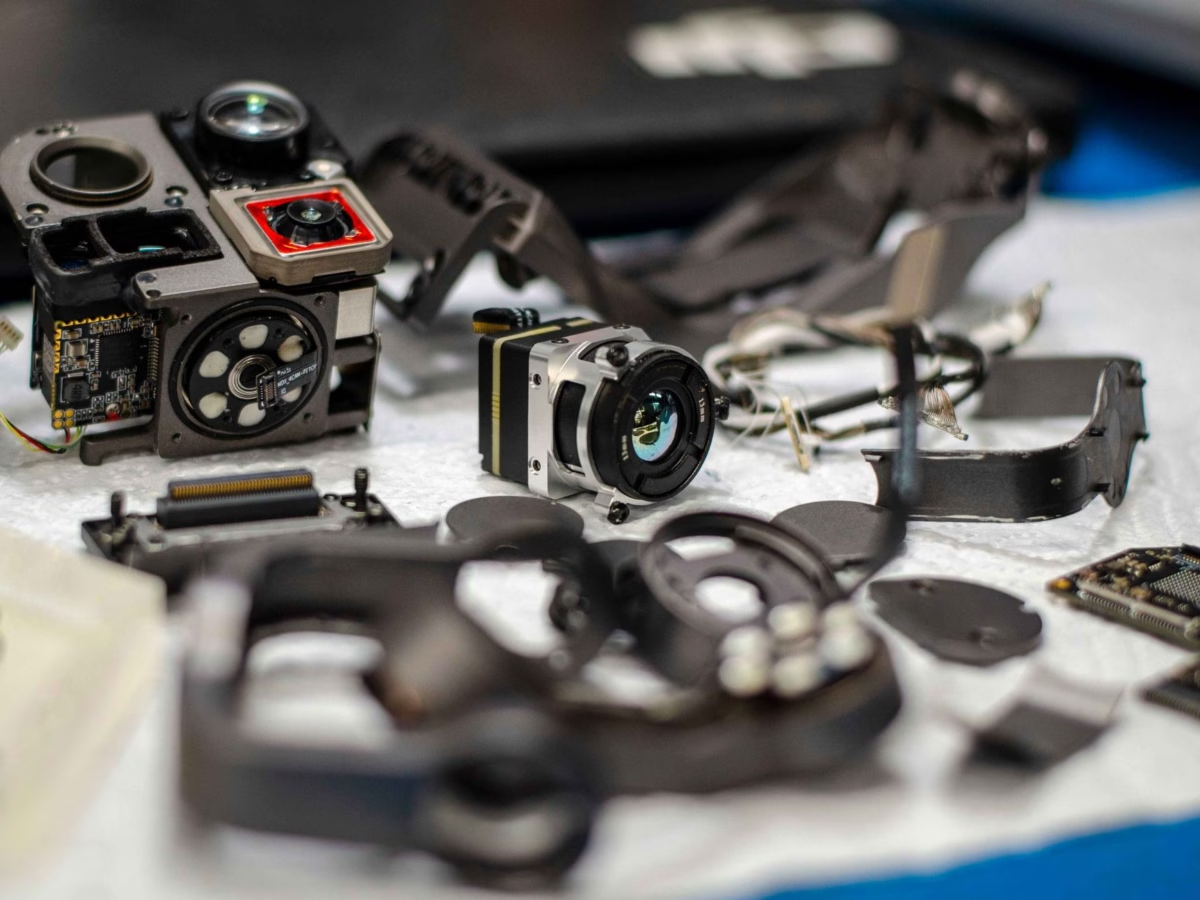
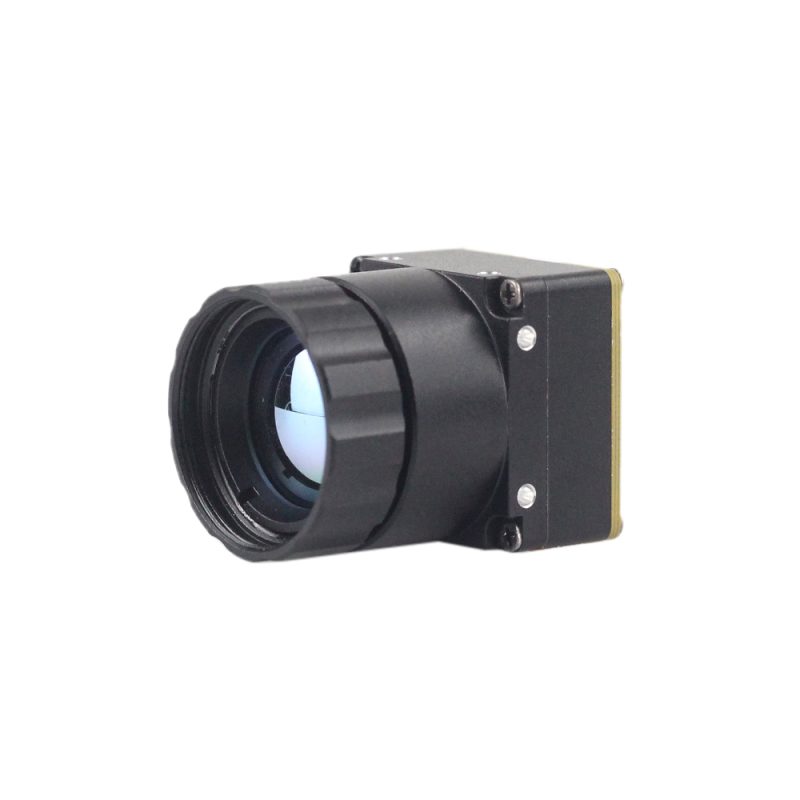
With an unthreaded frame core weighing less than 15 grams, payload designers can deploy dual-sensor electro-optical/infrared (EO/IR) stabilized gimbals without exceeding drone payload thresholds. Utilizing compact modules like the Mini 640 Uncooled LWIR Thermal Camera Module allows engineering teams to construct lightweight gimbals that minimize stress on the aircraft's servo motors. This preserves battery life and ensures optimal system stability during flight. For deeper background on the design benefits of this small form factor, see the parent company's in-depth mini-640 module review.
Thermomechanical Dissipation and Shock Resistance
Because uncooled thermal cores use software-based drift corrections relative to their housing temperature, stabilizing the module's thermal environment is crucial for consistent image quality. If your sensor housing heats up asymmetrically, you'll get nasty spatial gradients across your stream.
- ⚙️ Heat Dissipation: Although an ASIC-based 640x512 core draws minimal power (typically < 1.2 Watts during continuous capture), stagnant heat build-up will cause sensor drift, resulting in progressive ghosting or localized noise artifacts. Integration teams must design structural mounts with conductive heat paths using aluminum (6061-T6 anodized alloy) or thermal gap pads (with thermal conductivities of at least 3.0 W/m·K) bonded to the aircraft's hardware to serve as a heat sink.
- ⚠️ Microphonic Sensitivity & Vibration Dampening: Mechanical vibrations from drone motors, rotors, and air drag translate into high-frequency microphonic noise across the suspended microbolometer membranes. This can introduce horizontal striping artifacts across the frame. Integrators must isolate the 21mm x 21mm sensor core within a silicone-damped housing or mount it directly on an active brushless gimbal frame to decouple the sensor from high-frequency structural resonances.
3. Passive Optics: Focal Length Engineering and DRI Mathematical Calculations
Here’s the deal with infrared optics: LWIR radiation does not pass through standard optical glass, which absorbs wavelengths beyond 2 μm. Therefore, LWIR lenses are fabricated from high-grade monocrystalline Germanium (Ge) or specialized Chalcogenide glass elements. These materials are expensive, highly refractive, and require specialized anti-reflective (AR) or Diamond-Like Carbon (DLC) coatings to withstand harsh environments and optimize transmission in the 8-14μm band.
Choosing the proper lens configuration requires balancing the horizontal Field of View (HFOV) with the required DRI (Detection, Recognition, Identification) metrics defined under the Johnson Criteria.
Deciphering the Johnson Criteria
To calculate the physical reach of a 640x512 camera module package, engineers apply the standard target criteria:
- ⚙️ Detection: Is something there? (Requires a minimum of ≥ 1.5 pixels across the target's critical dimension).
- ⚙️ Recognition: What class of object is it? (Requires ≥ 6.0 pixels across the target).
- ⚙️ Identification: Is it a specific vehicle or suspect? (Requires ≥ 12.0 pixels across the target).
The spatial resolution limit of a lens and sensor system is defined by its IFOV (Instantaneous Field of View), which represents the angular resolution of a single pixel:
IFOV = Pixel Pitch (p) / Focal Length (f)
To determine the exact spatial dimensions projecting onto a target at a designated distance D, we calculate:
Spatial Resolution per Pixel (S) ≈ D × IFOV
Focal Length Reference Metrics
Using a state-of-the-art 12 μm pixel pitch 640x512 microbolometer, we can map out field performance across a variety of available lens options:
| Focal Length (f) | F-Number | Horizontal FOV (HFOV) | Human Detection (1.8m × 0.5m) | Vehicle Detection (4.6m × 2.3m) |
|---|---|---|---|---|
| 5.0 mm | F/1.0 | ~ 88° | Up to 180 meters | Up to 450 meters |
| 9.0 mm | F/1.0 | ~ 48° | Up to 320 meters | Up to 820 meters |
| 19.0 mm | F/1.1 | ~ 23° | Up to 680 meters | Up to 1,720 meters |
| 35.0 mm | F/1.2 | ~ 12.5° | Up to 1,250 meters | Up to 3,180 meters |
| 50.0 mm | F/1.2 | ~ 8.8° | Up to 1,780 meters | Up to 4,500 meters |
| 100.0 mm | F/1.4 | ~ 4.4° | Up to 3,560 meters | Up to 9,000 meters |
On top of that, athermalized fixed lenses are almost always preferred for aerial Integration. Why? Because they naturally maintain sharp, structural focus across a wide range of external operating temperatures (from -40°C to +80°C). This completely eliminates the need for heavy, power-hungry focus motors that can fail mid-flight.
4. Digital Interfaces, RTOS Integration, and Edge AI Architectures
Standard high-definition visual cameras typically output serialized high-speed MIPI CSI-2 or HDMI data streams. Uncooled thermal modules, however, prioritize real-time radiometric data processing and system portability across diverse industrial networks. This has driven the adoption of three primary digital and analog interfaces:
1. USB / UVC (Universal Video Class)
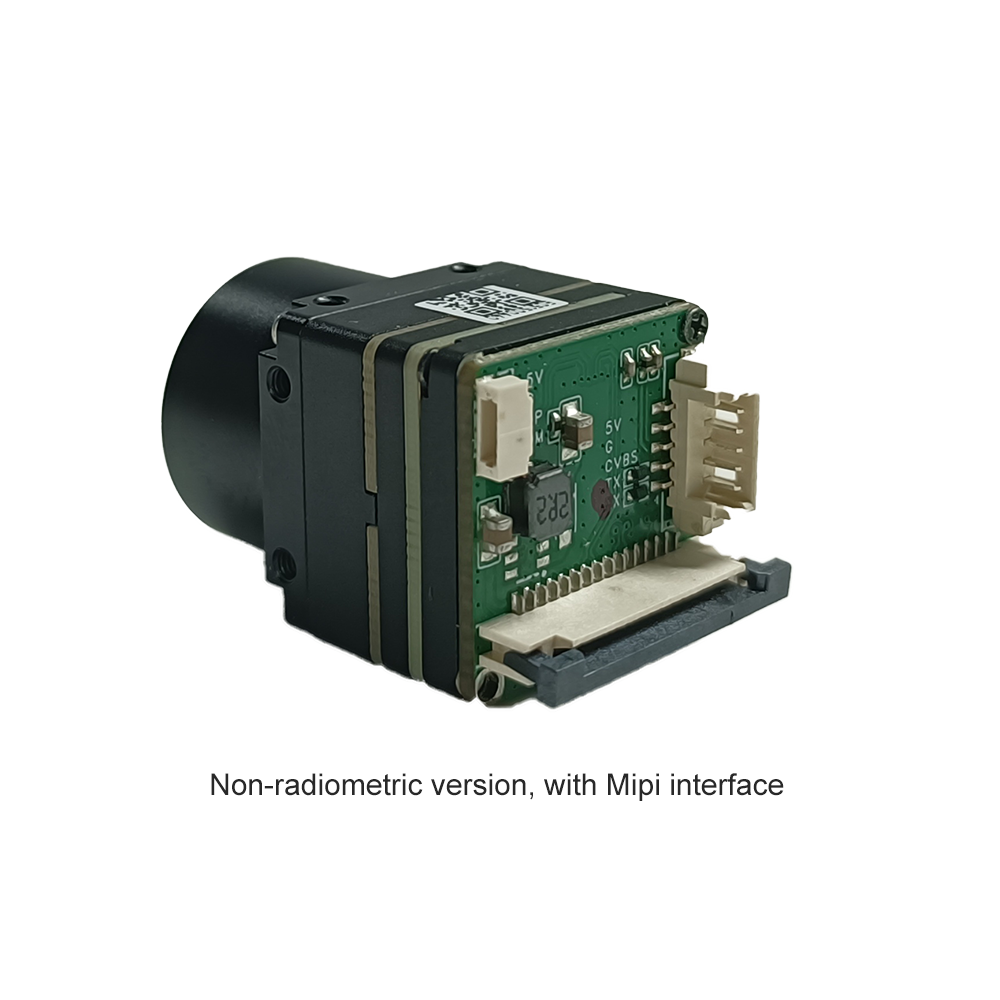
The thermal module enumerates on the host platform as a standard driverless webcam. In industrial and scientific core configurations, the module can output standard uncompressed 8-bit visual representations (YUV/RGB) or 16-bit raw gray-scale arrays containing precise temperature values for every pixel (known as Radiometric Mode). This makes it highly suited for fast deployments on Single Board Computers (SBCs) such as the Nvidia Jetson series or Raspberry Pi.
To integrate raw 16-bit radiometric data via USB in real-time, engineers can utilize open-source frameworks like OpenCV and NumPy. Below is an industrial-grade python implementation for parsing raw temperatures:
# Real-Time 16-bit Thermal Frame Parsing Example (Python / OpenCV)
import cv2
import numpy as np

# Bind to the industrial UVC thermal source
cap = cv2.VideoCapture(0, cv2.CAP_V4L2)

# Configure the pipeline to request the RAW 16-bit video channel representation
cap.set(cv2.CAP_PROP_FOURCC, cv2.VideoWriter_fourcc(*'Y16 '))
cap.set(cv2.CAP_PROP_FRAME_WIDTH, 640)
cap.set(cv2.CAP_PROP_FRAME_HEIGHT, 512)

while True:
    ret, frame = cap.read()
    if not ret:
        break

    # Cast raw data space array
    raw_radiometric_data = frame.view(np.uint16)

    # Calculate real temperature at coordinates using standard linear scaling
    # Assuming: Temp (Kelvin) = Digital_Value * 0.04
    temp_kelvin = raw_radiometric_data * 0.04
    temp_celsius = temp_kelvin - 273.15

    # Extract structural metrics
    max_idx = np.unravel_index(np.argmax(temp_celsius), temp_celsius.shape)
    print(f"Peak Operational Hotspot Detected: {temp_celsius[max_idx]:.2f}°C at pixel {max_idx}")

    # Scale raw data to 8-bit dynamic depth for visual AI inference
    visualized_frame = cv2.normalize(raw_radiometric_data, None, 0, 255, cv2.NORM_MINMAX, dtype=cv2.CV_8U)
    colored_frame = cv2.applyColorMap(visualized_frame, cv2.COLORMAP_JET)

    cv2.imshow("Thermal Pipeline", colored_frame)
    if cv2.waitKey(1) & 0xFF == ord('q'):
        break

cap.release()
cv2.destroyAllWindows()
2. RJ45 IP (RTSP / UDP Streams via ASIC Encapsulation)
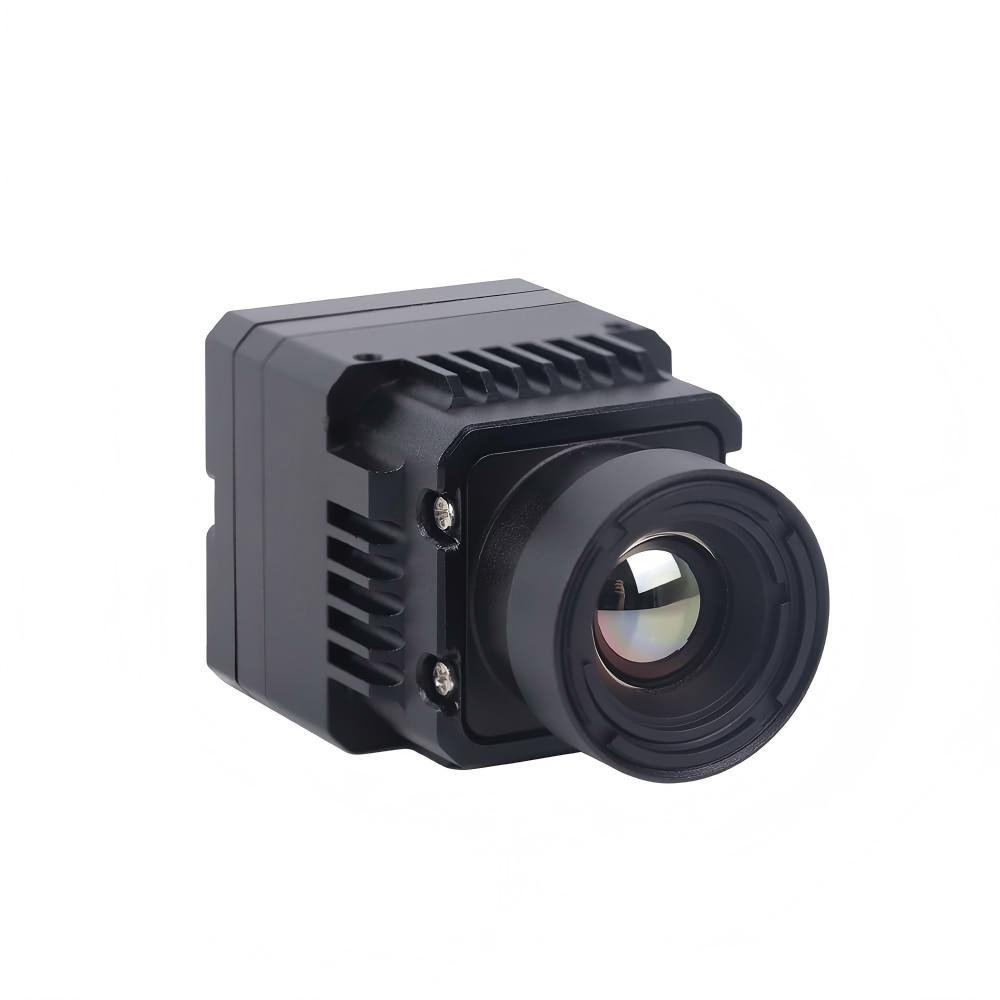
The camera module features an onboard compression chip that encodes spatial frames directly into high-efficiency H.264 / H.265 video codecs, packaging them into standard RTP/RTSP IP streams. This interface is perfect for long cable runs, drones with Ethernet backbones, and wide-area industrial monitoring. These IP modules, such as the Uncooled RJ45 CVBS RTSP IP Thermal Module, allow development teams to route high-performance streams directly into standard network architectures without relying on heavy external transcoding hardware in the field.
3. CVBS Analog Video
Outputting a standard NTSC/PAL composite signal, CVBS provides uncompressed analog video directly to active displays or legacy radio frequency (RF) transmitters. This is incredibly useful for ultra-low latency FPV drone flight and search operations where digital framing lag cannot exceed 5 milliseconds.
Designing Edge AI Thermal Inference Pipelines
Look, running deep learning models on normal visual spectrum RGB video is straightforward these days. But setting up robust neural networks on uncooled LWIR 640x512 microbolometer streams is a whole different beast. You need to adjust several structural assumptions:
- Ditch Color for Raw Contrast: Thermal arrays naturally output single-channel intensity values (representing temperature fluctuations), not typical three-channel RGB data. Applying pseudo-color palettes like "Ironbow" or "Jet" might look sleek to human operators, but it introduces synthetic color boundary gradients that will absolutely confuse your AI models. For top-tier accuracy, run your inference engine steps directly on raw, single-channel 8-bit gray-scale inputs normalized over your targeted temperature range.
- Handle Spatial Variations (Dynamic AGC Scaling): As your drone moves from looking at a cold landscape to a warm target, your camera's automatic gain control (AGC) will scale the entire image. This can wash out finer details, causing your AI model to drop its tracking lock. You need to use localized Adaptive AGC algorithms or Contrast Limited Adaptive Histogram Equalization (CLAHE). This ensures the AI model receives steady spatial edges, regardless of fluctuating absolute temperatures.
- Deploy Hardware Acceleration: If you're building a hand-held device or a compact drone payload, you need to minimize computational latency. Quantizing your models (like YOLOv8) down to INT8 precision lets engineers run them on hardware accelerators like the Google Coral Edge TPU or NVIDIA Jetson Orin Nano. This allows you to easily execute real-time inferencing on raw 640x512 video at speeds exceeding 30 FPS, while keeping overall power consumption under 10 Watts.
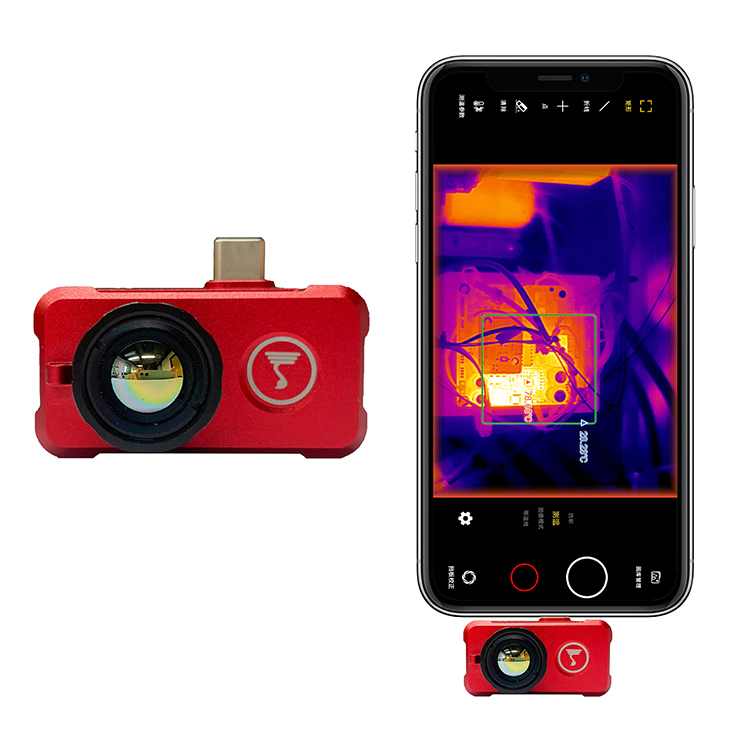
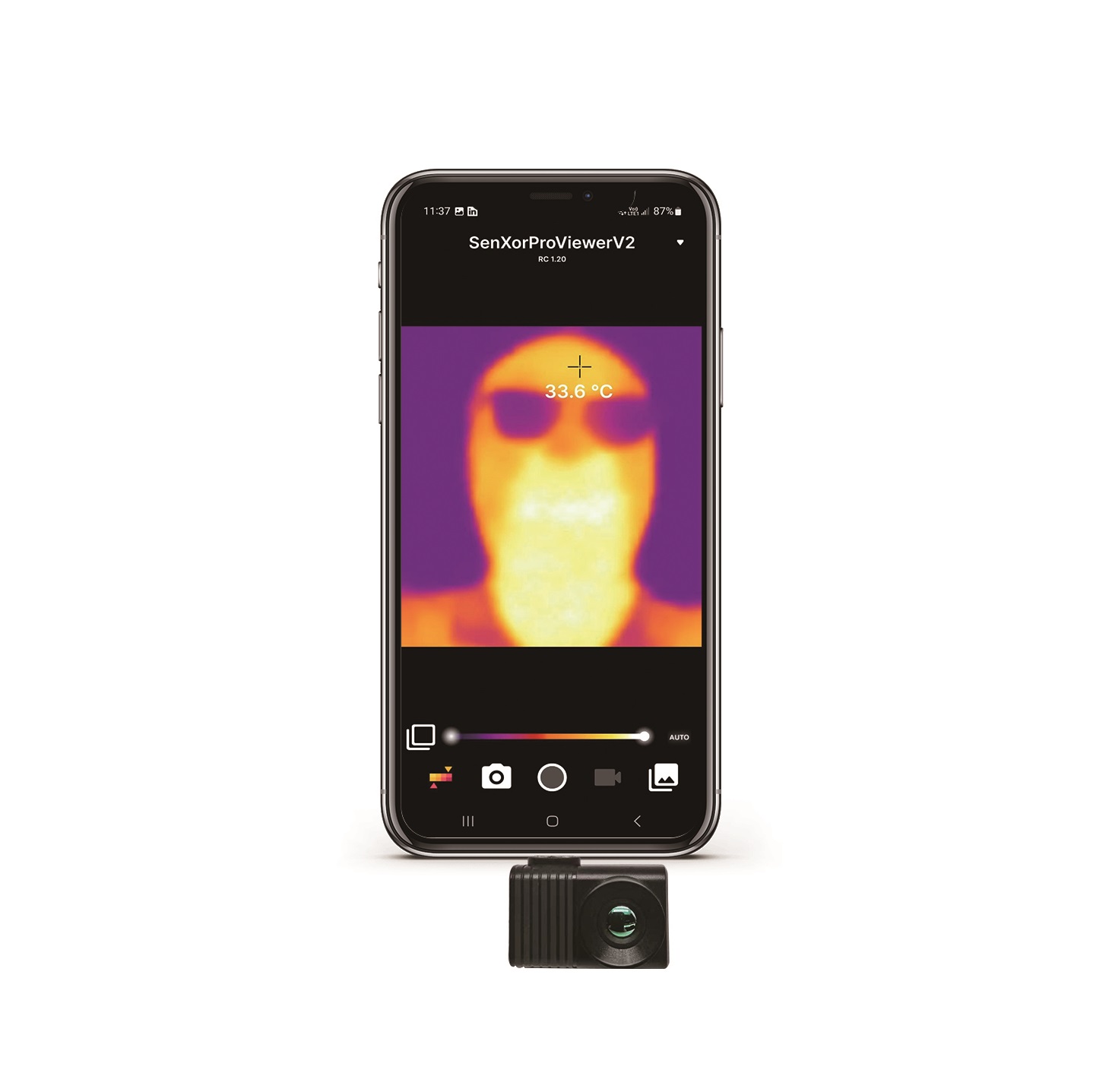
For development teams looking to build specialized hand-held monitoring tools to complement these core system boards, checking out Android Type-C thermal cameras for smartphones or dedicated radiometric handheld analysis solutions provides excellent field-testing alternatives and reference benchmarks.
5. High-Performance Hardware Solutions: Comprehensive Specifications Table
The comprehensive matrix below details the physical and technical specifications of today's leading 640x512 LWIR modular systems. Both modules listed can be customized with various Germanium lens arrays to meet the specific requirements of target missions.
| Core Parameter | Model A: Mini LWIR USB Core Module (DJI Compatible) | Model B: RJ45 / RTSP IP Thermal Sensor Module |
|---|---|---|
| Physical Product Image Reference |
 View Core Page |
 View IP Page |
| Microbolometer Type | Uncooled VOx (Vanadium Oxide) Arrays | Uncooled VOx (Vanadium Oxide) Arrays |
| Array Resolutions Supported | 640*512 / 640*480 optional selection | 640*512 Active Processing Target |
| Sensor Pixel Pitch | 12 µm ultra-fine layout pitch | 12 µm high-density system pitch |
| NETD (Thermal Sensitivity) | ≤ 40 mK (F/1.0 @ 30°C Frame Scale) | ≤ 40 mK (F/1.0 @ 30°C Frame Scale) |
| Core Dimensions | 21 mm × 21 mm (SWaP-optimized) | Miniaturized footprint with IP processor shield |
| Available Lenses (Focal Length) | 5mm / 9mm / 13mm / 18mm / 35mm / 50mm / 75mm / 100mm / 150mm | Wide optical system customization (5mm to 100mm arrays) |
| Primary Communications | USB (YUV raw/16-bit radiometric UVC streaming) | RJ45 Network Interface, CVBS analog, RTSP/IP, Onboard ASIC Processor |
| Input Operating Voltage | 5V VBUS direct USB system line | 12V DC default board distribution range |
| Power Demand (Avg Consumption) | < 1.2 Watts under active workloads | < 1.5 Watts with active IP Compression streams |
Product In-Depth Showcases & Procurement Links
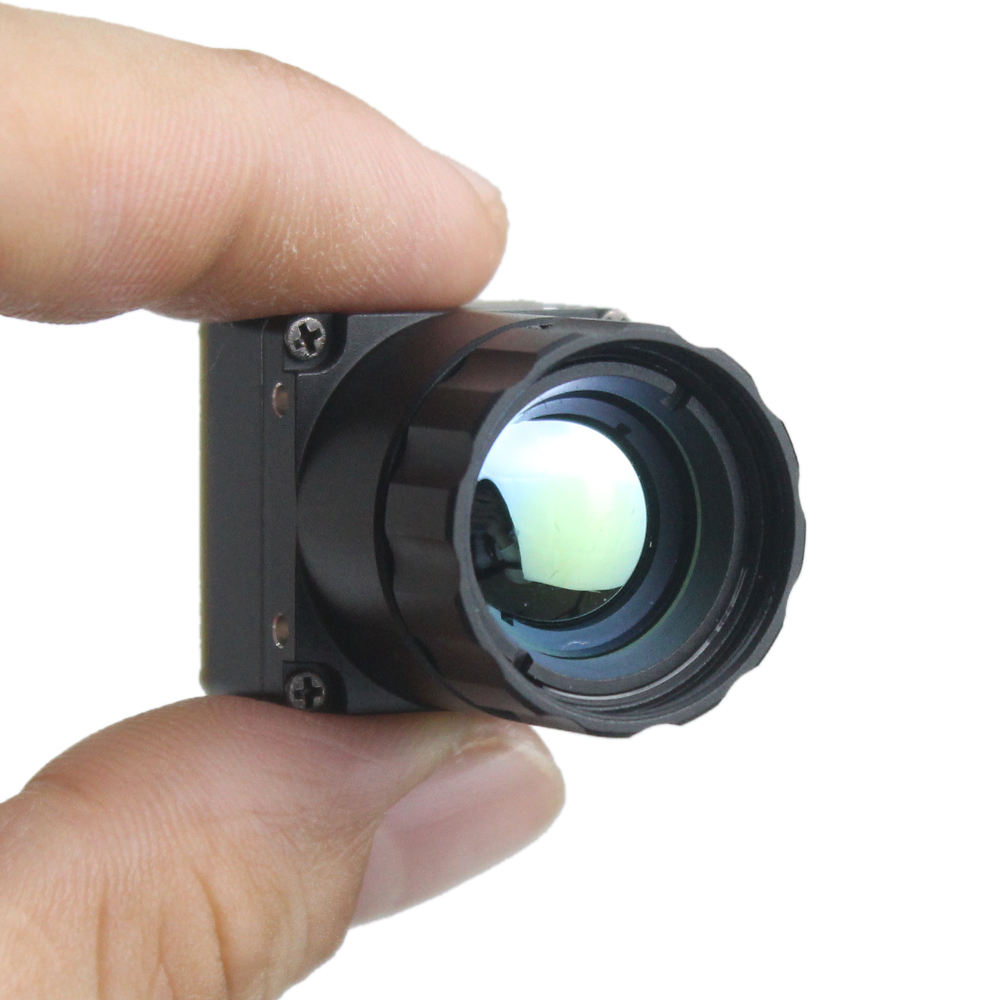
📦 Uncooled LWIR USB Mini 640*512 Thermal Imaging Camera Core Module
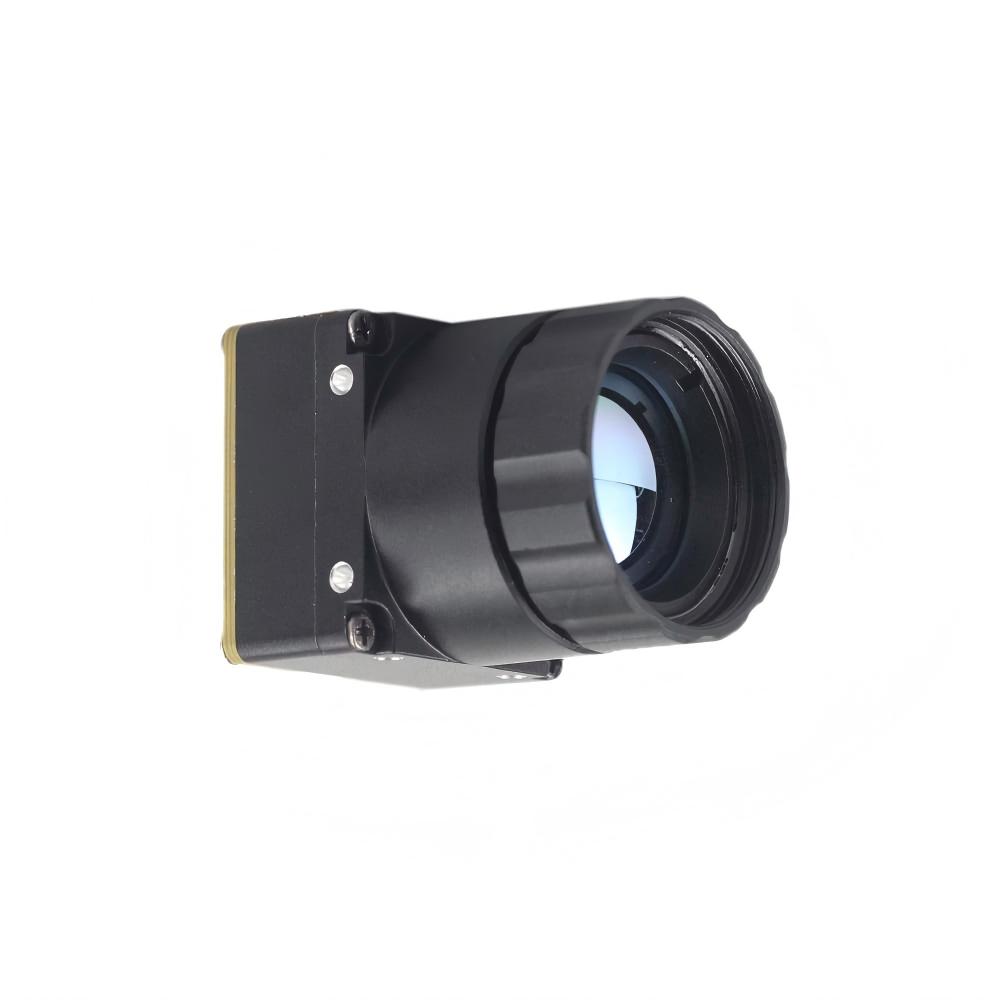
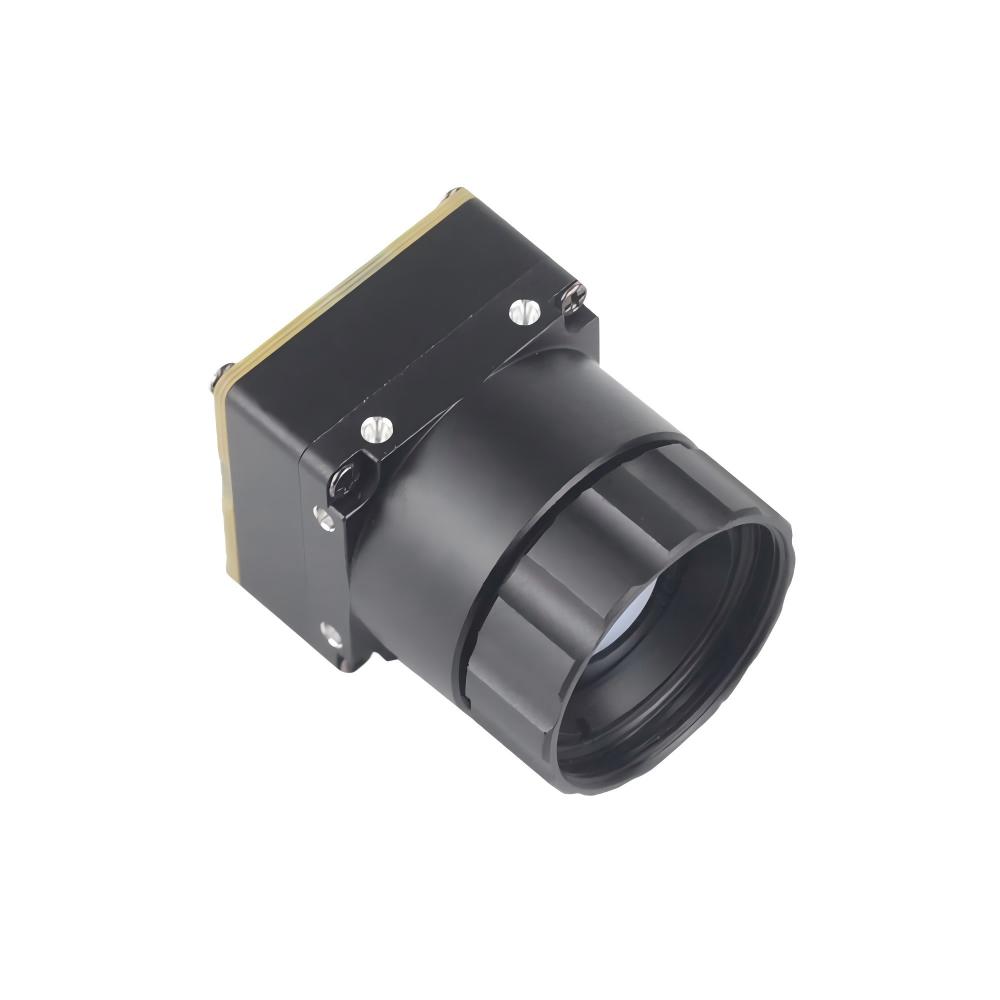
This ultra-compact uncooled LWIR core is engineered primarily for drone integrations, featuring structural compatibility with DJI-class gimbals. With its highly optimized mini-size of 21mm*21mm, it is one of the smallest and most cost-effective 640x512 microbolometer cores available on the market today. It provides stable performance, strong environmental adaptability, and supports multiple lens options (ranging from 5mm to 150mm focal lengths).
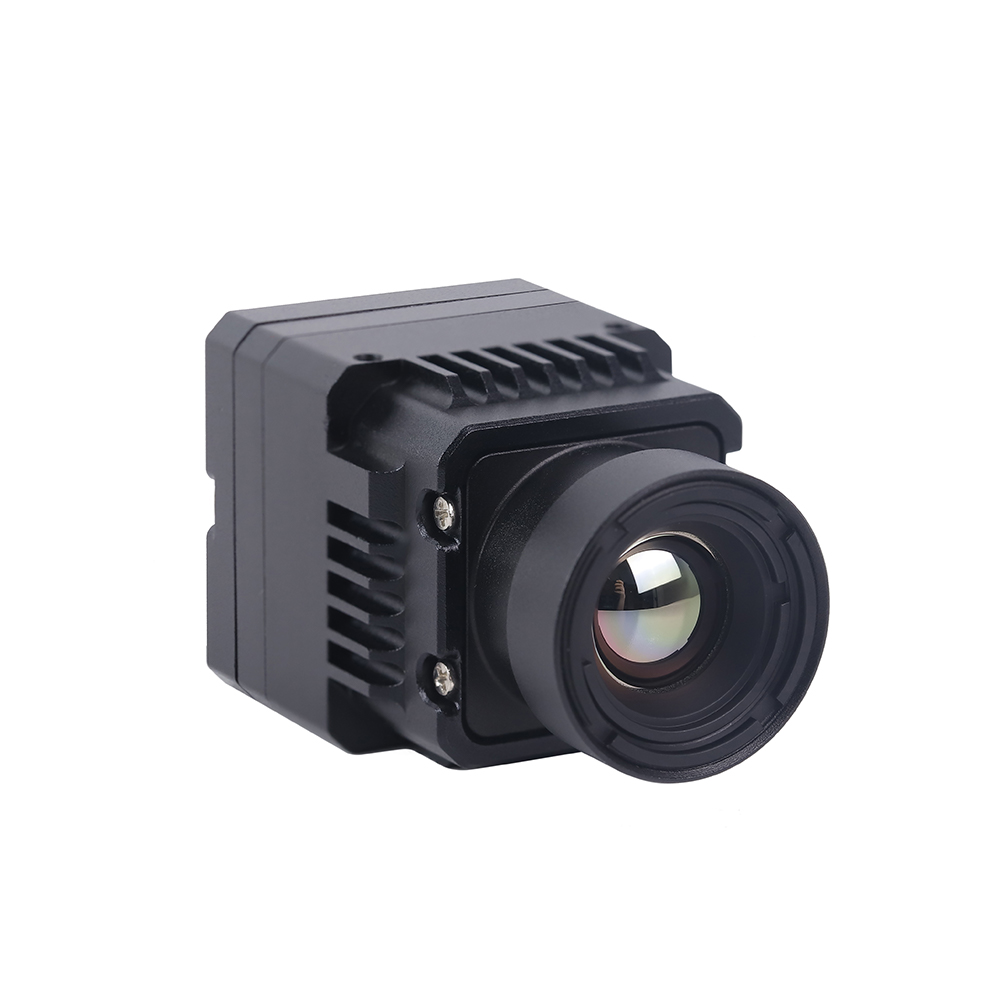
📦 Uncooled Infrared RJ45 CVBS RTSP IP 640*512 Thermal Sensor Camera Module
Designed for automated industrial inspection, long-distance remote monitoring, and direct IP networks, this 640*512 ASIC module enables real-time RTSP video streaming directly over network cables. By integrating an onboard ASIC compression processor, it eliminates the need for expensive external capture cards, making it perfect for custom security structures and aerial vehicle integration.
6. Deep-Dive Hardware Integration FAQ
Q1: Can I stream high-resolution 640x512 thermal video in real-time to a Raspberry Pi or Arduino?
Here's the deal: trying to feed a raw 640x512 thermal video stream directly into a basic microcontroller like an Arduino Uno or even a mid-range ESP32 is a fool's errand. Those platforms simply lack the RAM, processor cycles, and hardware bus bandwidth to handle this level of data throughput.
Let's do the math on the stream requirements. If you're running a 640x512 thermal sensor in 16-bit radiometric mode at a standard 30Hz frame rate, your raw data output is around 20 Megabytes per second (640 columns × 512 rows × 2 bytes/pixel × 30 FPS = 19.66 MB/s). A standard SPI bus on an Arduino saturates at around 4 to 8 Megabits per second, and its tiny KB-scale SRAM will suffer an instant stack overflow trying to ingest even a single 1.2MB frame buffer. This is why you only see low-resolution 8x8 or 32x24 thermal sensors configured over standard SPI lines.
If you're deploying a high-resolution 640x512 core, you need to interface it with a Single Board Computer (SBC) like a Raspberry Pi 4, Pi 5, or an Nvidia Jetson board via a UVC-compliant USB port or an RJ45 Ethernet link. Using a UVC-compliant USB module, Linux recognizes the camera immediately as a standard raw video device via Video4Linux2 (V4L2). This allows you to pull down the uncompressed 16-bit Kelvin arrays into a Python script using OpenCV and NumPy, bypass serial data bottlenecks, and run your real-time processing or deep learning model loops without breaking a sweat.
Q2: How do I choose between a 640x512 module and a lower-res 256x192/384x288 sensor for drone and DIY monocular builds?
Look, I get it. Lower-resolution sensors like a 256x192 or 384x288 core look tempting when you're looking at a bill of materials (BOM). But if you're building a drone tactical platform or a high-performance DIY monocular, skipping out on a 640x512 core is a massive mistake. The math behind the resolution scaling is quadratic, not linear.
If you're in the field tracking wildlife, analyzing a rescue target, or monitoring a remote perimeter fence, your maximum target detection range is everything. Consider how these sensor profiles perform in real-world scenarios:
- ⚙️ Pixel Volume Difference: A 256x192 core only gives you 49,152 tracking pixels. A 640x512 array gives you 327,680 pixels. This means you are pulling in over 660% more spatial information per frame.
- ⚙️ Real-World Range Under Johnson's Criteria: Let's take a standard human target (1.8m × 0.5m) and a 19mm lens setup. Under the Johnson Criteria, you need at least 6 vertical pixels on your sensor to "recognize" that target rather than just seeing a generic hot spot.
- With a 256x192 sensor, that target is going to turn into a single blurry box at about 80 meters.
- With a 640x512 sensor, you can maintain a high-contrast, recognizable image of that target at up to 270 meters. That is over three times the operational range!
- ⚙️ Thermal Sensitivity (NETD): The smaller sensor dies often run hotter, translating to poorer sensitivity. A high-quality 640x512 core with an NETD ≤ 40mK can easily distinguish between targets in low-contrast environments (like a cold target in a damp, muddy field). A budget 256px core will often turn that entire field into a grainy gray mess.
If you're working on a close-range indoor project (like checking printed circuit boards or home insulation beneath 5 meters), a 256x192 module will do the job just fine. But if your goal is long-range target tracking, drone surveillance, or search-and-rescue, the 640x512 core is the undisputed industry standard for a reason.
Q3: What are the size and weight constraints for integrating a 640x512 thermal core into small UAVs?
In the drone world, every single gram of weight you add directly translates to physical battery drain and reduced airtime. If you're building drone payloads, especially in the sub-250g class or specialized enterprise inspection gimbals, you are fighting a constant battle to minimize your SWaP (Size, Weight, and Power) footprint.
This is where modern uncooled 640x512 cores shine. In the shop, we work with micro-scale designs engineered in partnership with specialized electronic design firms like Shenzhen ChiYi Electronics Co., Ltd. These advanced cores completely bypass heavy, enclosed chassis structures and rely on highly integrated, single-board layouts:
- ✅ Dimensions: With a physical footprint of only 21mm × 21mm, these modules are compact enough to sit inside the smallest micro-gimbals with plenty of room to spare.
- ✅ Weight: An unhoused 12 μm core weighs under 15 grams. Adding a lightweight, high-performance athermalized 9mm Germanium lens brings your total sensor weight to just 25 grams. This makes it incredibly easy to configure dual-payload EO/IR gimbals without exceeding your aircraft's payload limits.
- ✅ Power Consumption: By using highly integrated, single-board ASIC processing structures instead of multi-layer FPGA stacks, these modules draw less than 1.2 Watts of power. This low draw means your system can easily tap into standard 5V VBUS lines or a tiny 5V UBEC without draining your main flight batteries or generating heavy heat plumes.
- ✅ Optics Integration: Thanks to the 12 μm pixel pitch, the sensor die is physically smaller than legacy 17 μm elements. This means you can use smaller-diameter Germanium lenses to achieve the same Field of View, keeping your overall optic weight and system costs to an absolute minimum.
📚 References & Further Reading
- Industry Standard & Engineering Partner: Shenzhen ChiYi Electronics Co., Ltd.
- Detailed Product Blueprint: Mini 640 LWIR Thermal Core Optimization and Use-Cases
- Additional Reading: Type-C Radiometric Thermal Cameras for On-Site Network Troubleshooting