
Top Uncooled LWIR Thermal Camera Core Supplier | 640 & 1280 OEM Modules
2026年9月10日
Thermal Camera Module Price Guide: Cost Factors, Specs & OEM Sourcing
2026年9月11日

Thermal Camera Module Bulk Order: OEM LWIR Cores for Drones & Embedded Systems
Taking an uncooled Long-Wave Infrared (LWIR) imaging build from a benchtop prototype running on a workbench development kit to thousands of deployed units out in the dirt will humble any engineering team. If you're building commercial drones, autonomous mobile robots, man-portable optronics, or smart industrial edge nodes, you already know that buying sensor cores in volume isn't like buying commodity webcams. You can't just scan a catalog, eyeball pixel resolution, check a price break, and call it a day. In the real world, your success hinges on the raw solid-state physics of the microbolometer, brutal Size, Weight, and Power (SWaP) budgets, parasitic heat migration inside sealed housings, optical Modulation Transfer Function (MTF), and hardware-level interface latencies. Make the wrong call on your core during the bench phase, and you'll pay for it ten times over with drifting radiometry, unstable gimbals, and catastrophic field failures once production ramps.
Executing an OEM thermal camera module bulk order demands complete hardware transparency, low-level firmware control, and absolute manufacturing consistency between production batches. Sourcing bare-board or enclosed OEM LWIR cores means your optomechanical, firmware, and systems engineers must evaluate raw digital pipelines, native embedded compatibility—like zero-overhead MIPI-CSI2 or driverless UVC bridges—internal non-uniformity correction (NUC) algorithms, and temperature measurement stability over hostile operating conditions. Look, we built this guide to serve as a no-nonsense, hardware-level reference for systems architects, lead optomechanical designers, and procurement managers integrating thermal vision into UAV payloads, tactical scopes, perimeter surveillance systems, and industrial edge-AI platforms.
Table of Contents
- 👉 1. Microbolometer Physics & Sensor Architecture: Evaluating VOx vs. a-Si in Bulk OEM Procurement
- 👉 2. SWaP-C Engineering for Airborne & Mobile Platforms: Weight, Power, and Form-Factor Breakdown
- 👉 3. High-Speed Embedded Interfacing: Native MIPI-CSI2, USB 3.0 UVC, and Analog Video Pipelines
- 👉 4. Industrial Radiometry: Managing NUC, Shutter Flags, and Thermal Drift Across High-Volume Deployments
- 👉 5. Purpleriver OEM LWIR Cores: Technical Specifications & Volume Matrix
- 👉 6. Bulk Order Quality Assurance, MTBF Verification, and Supply Chain Risk Mitigation
- 👉 7. Deep-Dive Technical FAQ Section
1. Microbolometer Physics & Sensor Architecture: Evaluating VOx vs. a-Si in Bulk OEM Procurement
When you're signing off on large production runs of LWIR cores, the raw thin-film semiconductor chemistry of the focal plane array (FPA) dictates your signal-to-noise ratio, sensor thermal time constant, and environmental stability. In the uncooled LWIR world, two detector materials dominate the commercial landscape: Vanadium Oxide (VOx) and Amorphous Silicon (a-Si). Understanding the physical trade-offs between these two is critical before locking in a bill of materials (BOM).
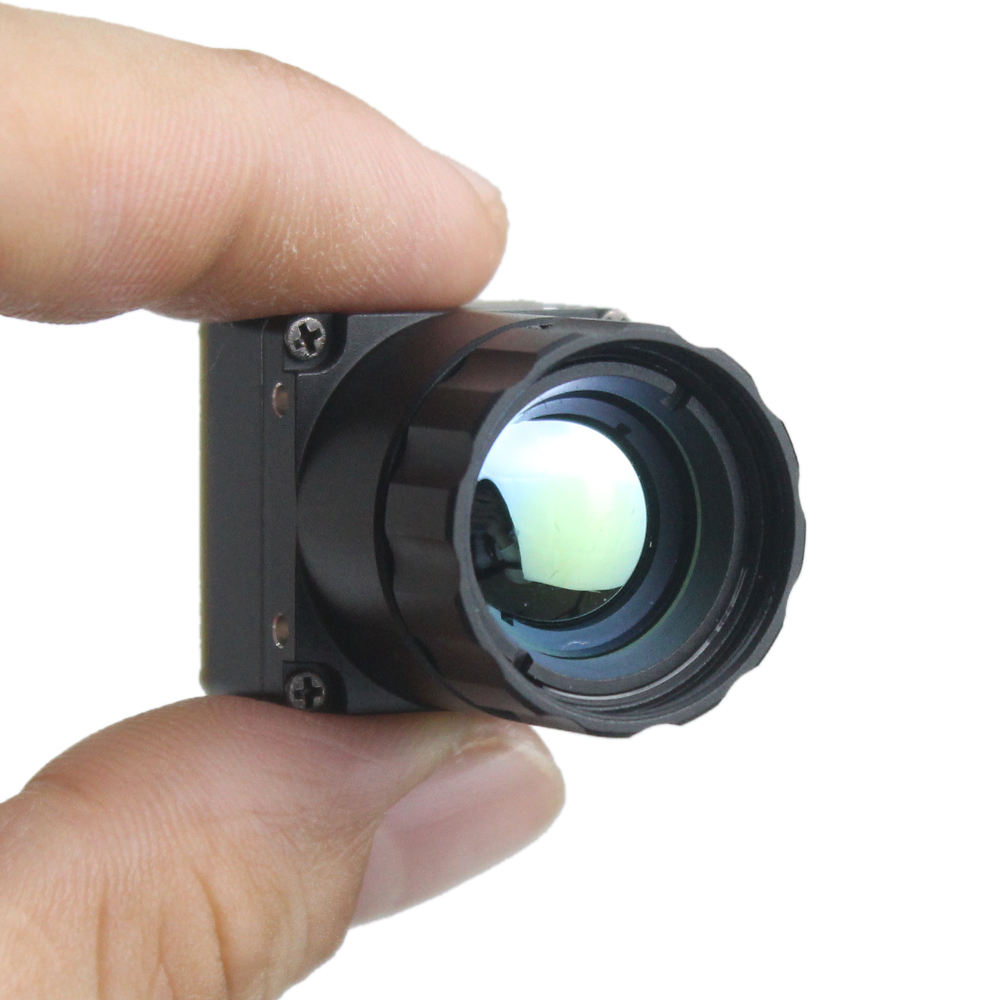
The optical journey starts when long-wave infrared energy across the 8 µm to 14 µm spectral window strikes an anti-reflective coated Germanium or Chalcogenide optical assembly and lands on the microbolometer pixel absorber membrane, which is usually built from silicon nitride (Si3N4). That absorbed photon energy heats up the underlying thermistor material, triggering a measurable shift in electrical resistance governed by the material's Temperature Coefficient of Resistance (TCR). The Readout Integrated Circuit (ROIC) samples this resistance shift through ultra-low-noise capacitive transimpedance integrators. From there, an on-board Field Programmable Gate Array (FPGA) or custom ASIC runs dead-pixel substitution, real-time two-point gain/offset correction, and radiometric calculations before pushing out raw digital video.
Vanadium Oxide (VOx) Material Advantages
Here's the deal with VOx: it delivers a noticeably higher Temperature Coefficient of Resistance, typically running between -2%/K and -3%/K at room temperatures. That higher TCR feeds straight into far better Noise Equivalent Temperature Difference (NETD). On automated volume production lines, Purpleriver VOx cores hit thermal sensitivities at or below 40 mK, and drop below 30 mK when paired with wide f/1.0 optics.
VOx also brings a significantly lower 1/f flicker noise corner frequency to the table compared to amorphous silicon. Low-frequency flicker noise in microbolometers comes down to carrier density fluctuations along microstructural grain boundaries. Precision VOx deposition yields exceptionally uniform stoichiometric thin films that maintain an impressive signal-to-noise ratio (SNR) over extended integration cycles. When you're building tactical ISR drones, border-recon payloads, or automated gas-detection systems, distinguishing fractional-Kelvin target contrasts from sensor background noise is the difference between mission success and useless telemetry.
Amorphous Silicon (a-Si) Characteristics
On the flip side, amorphous silicon arrays run on standard CMOS semiconductor lines, deposited on massive silicon wafers that historically drove down initial fabrication expenses. But a-Si brings real physical limitations: a lower TCR (generally -1.5%/K to -2%/K) paired with much higher 1/f noise floors. To pull a usable image out of that noise, a-Si cores have to rely on longer integration periods and aggressive temporal noise filtering. That drives the microbolometer thermal time constant well past 14 ms. When you throw an a-Si sensor into high-dynamic operations—like aggressive drone yaw, counter-UAS tracking, or high-speed robotic obstacle avoidance—that sluggish thermal response shows up instantly as ghosting, smeared edges, and lost spatial clarity.
Pixel Pitch Shrink: 17 µm vs. 12 µm Geometries
The shift from 17 µm to 12 µm pixel pitch has completely rewritten the playbook for bulk OEM integrations. The active diagonal of an FPA is calculated via basic geometry:
FPA Diagonal = √((Width × Pitch)² + (Height × Pitch)²)
Dropping down from a 17 µm pitch to a 12 µm architecture slashes the active physical footprint of a standard 640×512 array by nearly 50%. In the shop, this dimensional shrinkage gives your mechanical and systems teams two immediate wins:
- ✅ Optical Miniaturization: To hit the exact same field of view (FOV), a 12 µm sensor core needs an objective lens focal length roughly 29% shorter than what a 17 µm array demands. Because the volume and weight of Germanium (Ge) optics scale cubically with the clear aperture, switching to 12 µm drastically cuts optical mass and raw BOM expenses across high-volume production schedules.
- ✅ Thermal Time Constant Reduction: Smaller microbolometer bridges lower the physical thermal capacitance (Cth) of each suspended pixel membrane. That cuts thermal response time down into the 8 ms to 10 ms pocket, giving you sharp, blur-free 50 Hz/60 Hz video acquisition during high-velocity flight maneuvers.
2. SWaP-C Engineering for Airborne & Mobile Platforms: Weight, Power, and Form-Factor Breakdown
Engineering unmanned aerial systems (UAS), loitering munitions, handheld sights, and compact ground rovers (UGVs) is a brutal exercise in balancing Size, Weight, Power, and Cost (SWaP-C). On an aerial platform, every single gram of dead payload weight demands extra lift, which pulls more amps from your electronic speed controllers (ESCs), drains the flight pack faster, and shortens operational endurance.
Inside a sealed gimbal or an avionics pod, your engineering budgets are tightly coupled. Structural core mass sets the required torque and holding current for your pan-tilt brushless motors. Power consumption turns into parasitic heat that must migrate away from the microbolometer without generating uneven thermal gradients across the array. The optics must hold crisp infinity focus across wide temperature shifts without adding heavy, power-hungry mechanical focus motors.
Minimizing Mass Without Compromising Structural Rigidity
Legacy enclosed thermal cores encase everything in thick, extruded aluminum shells, pushing the payload core alone to 60 to 80 grams or more. On a 2-axis or 3-axis micro-gimbal, that extra mass demands larger brushless motors, heavier brass counterweights, and bulkier structural brackets.
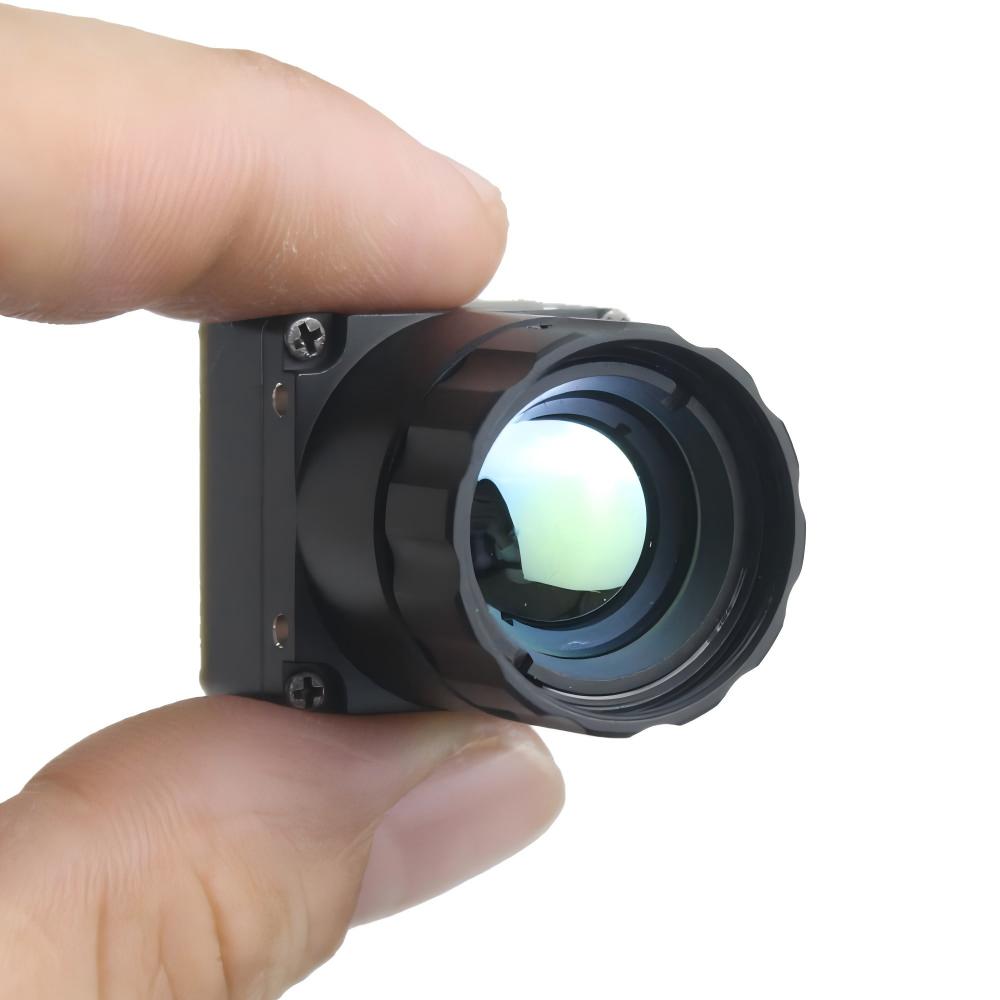
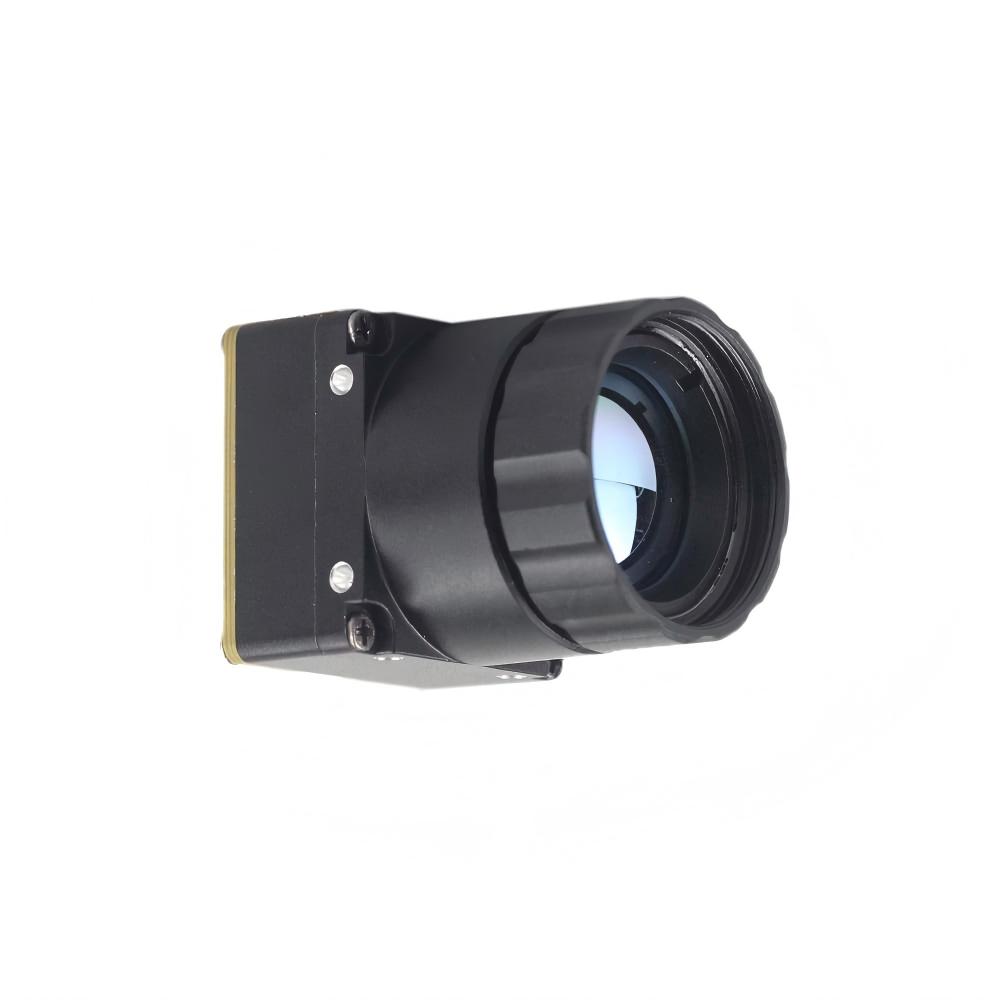
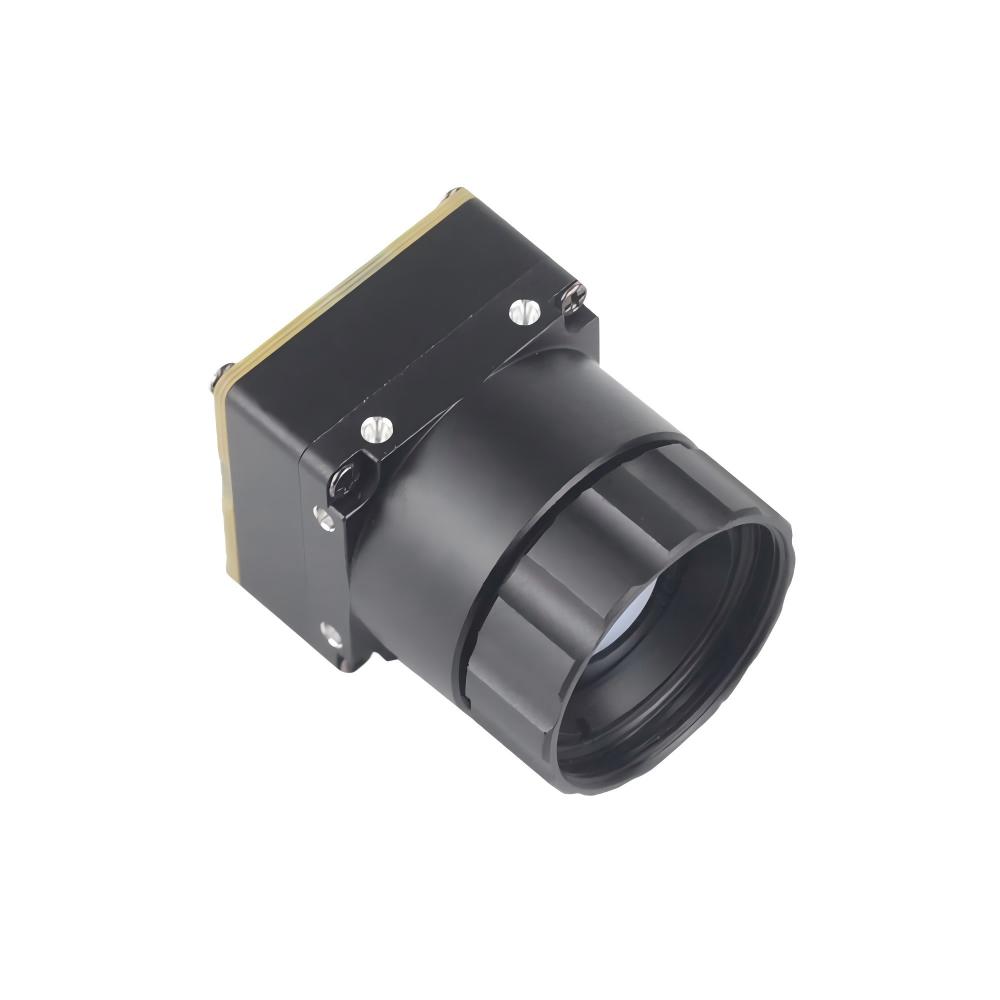
Purpleriver bare-board and micro-chassis OEM modules—such as the Mini 256 and Mini2 640—strip that structural weight down to an lean 9 to 15 grams. Utilizing precision CNC magnesium-aluminum alloys and aerospace-grade polyetherimide (PEI) structural standoffs, these assemblies provide rock-solid mechanical stiffness and optical alignment without penalizing gimbal stabilization loops.
Dynamic Power Draw & In-Pod Thermal Equilibrium
Power consumption directly drains battery endurance, but inside a sealed housing, it creates an even nastier problem: thermal feedback. An uncooled core generates its own internal heat flux. In a sealed drone pod, that heat warms up the internal air cavity and structural brackets, creating spatial temperature gradients across the microbolometer sensor face.
Our OEM cores utilize ultra-low-power ROIC silicon alongside custom low-leakage FPGAs/ASICs, keeping active power consumption locked between 0.8 W and 1.2 W. Running at 3.3V to 5.0V DC nominal, conduction heat transfer routes directly through high-thermal-conductivity interface pads to the chassis or external mounting skin. This setup avoids hot spots, limits internal air cavity temperature rise to under 15°C above ambient, and lets on-board real-time thermistor compensation algorithms run with maximum mathematical stability.
3. High-Speed Embedded Interfacing: Native MIPI-CSI2, USB 3.0 UVC, and Analog Video Pipelines
Picking your electrical and software interface is easily one of the most critical integration choices you will make. Pick the wrong topology, and you'll saddle your system with CPU-bound frame decoding, fragile custom drivers, jittery pipelines, and dropped frames right in the middle of target tracking or autonomous flight.
Embedded thermal imaging architectures generally rely on three physical bus approaches:
- ⚙️ Direct Embedded Edge AI: The microbolometer ROIC routes through on-board ISP logic and streams raw 14-bit radiometric Kelvins or pre-processed YUV video over a 2-lane MIPI-CSI2 bus straight into the Direct Memory Access (DMA) engine of an AI system-on-chip (like an NVIDIA Jetson Orin Nano, AGX, or Rockchip RK3588). Glass-to-memory hardware latency stays firmly below 10 ms.
- ⚙️ Standard Industrial Controllers & OS: The thermal module connects over an integrated USB bridge, presenting standard USB Video Class (UVC) endpoints. This approach gives you driverless plug-and-play operation under Linux Video4Linux2 (V4L2) and Windows platforms with predictable end-to-end latencies around 30 ms.
- ⚙️ Zero-Latency Tactical FPV & Targeting: The ISP feeds directly into an on-board high-speed digital-to-analog converter (DAC) to output a standard analog CVBS (NTSC/PAL) composite stream straight to a 5.8 GHz analog video transmitter (VTX). This completely bypasses operating system buffering, delivering near-zero latency under 5 ms.
Native MIPI-CSI2: Zero-Copy Processing for Edge AI
When you're building autonomous navigation, target tracking, or multi-spectral sensor fusion payloads, MIPI-CSI2 is the undisputed champion. By streaming pixel packets directly into host system memory via DMA, your host processor never touches frame packetization or protocol decoding. In demanding drone builds, this zero-copy architecture saves critical CPU cycles for running YOLO-based neural networks, optical flow tracking, and simultaneous localization and mapping (SLAM).
To preserve high-speed signal integrity across complex board-to-board routing and continuous slip-ring gimbal joints, Purpleriver modules utilize high-reliability micro-coaxial and micro-pitch board-to-board connectors from Amphenol. For specialized hardware serialization, high-speed multi-sensor bridging, and low-latency protocol conversion, Purpleriver partners with engineering specialists like JM Chip to guarantee stable clock distribution, clean bus timing, and robust electromagnetic interference (EMI) protection inside dense avionics enclosures.
Standard USB 3.0 UVC: Driverless Flexibility
For benchtop test fixtures, industrial quality inspection benches, and x86 edge industrial computers, the USB Video Class (UVC) standard delivers seamless plug-and-play capability. Modules with UVC eliminate the maintenance headaches of signed, proprietary kernel drivers. Raw 14-bit radiometric matrices can be embedded within metadata channels or streamed through synchronized dual-endpoint streams: Endpoint 0 provides 8-bit AGC pseudo-color video for operator monitoring, while Endpoint 1 provides raw 14-bit radiometric arrays for telemetry recording and alarm evaluation.
Legacy Analog CVBS: Essential for Low-Latency FPV
For low-cost loitering munitions, expendable FPV strike systems, and clip-on night sights, analog Composite Video Blanking and Sync (CVBS) remains an absolute operational must-have. Because analog generation eliminates frame queues, OS buffers, and video compression pipelines, latency from photon capture to DAC transmission is nearly instantaneous (<5 ms). Pilots piloting fast-moving aircraft through dense brush or indoor facilities rely on this instant visual responsiveness to avoid hard crashes.
4. Industrial Radiometry: Managing NUC, Shutter Flags, and Thermal Drift Across High-Volume Deployments
Deploying thermal hardware across real-world environments exposes uncooled microbolometers to massive thermal swings. Because these sensors measure tiny resistance variations created by incident radiative energy, any temperature shift inside the camera enclosure directly alters the background reading of the array itself, leading to severe spatial non-uniformity and false temperature readings.
Fixed-Pattern Noise (FPN) and Microbolometer Non-Uniformity
Because of tiny lithographic and etching variations inherent in MEMS production, every microbolometer pixel on a focal plane array has a slightly different nominal electrical resistance, thermal capacitance, and responsivity. If you point an uncorrected microbolometer at a completely uniform thermal emitter, it will output a noisy, static curtain of lines and blotches known as Fixed-Pattern Noise (FPN).
To eliminate FPN, every Purpleriver module undergoes detailed multi-point radiometric calibration during volume manufacturing. Individual pixel responsivities are mapped into gain and offset matrices stored inside the module's non-volatile EEPROM. During operation, real-time image correction is executed on the FPGA using the standard two-point correction equation:
Scorrected(x,y) = G(x,y) × [Sraw(x,y) - O(x,y)]
Where Sraw(x,y) represents the raw ADC digitizer reading, O(x,y) is the pixel-specific thermal offset map, and G(x,y) is the normalized gain calibration value. For a deeper breakdown of resolving power, optical MTF curves, and high-frequency edge performance over long standoffs, check out our comprehensive guide on mini 640 thermal camera module performance.
Mechanical Shutter Correction vs. Scene-Based NUC (SBNUC)
As the camera chassis warms or cools, the baseline offset map drifts continuously. Historically, uncooled thermal cameras handle this by firing an internal solenoid to drop an opaque mechanical shutter flag in front of the array every few minutes. The camera treats that uniform shutter blade as a zero-contrast thermal reference and recalculates the offset map O(x,y). But on real-world missions, that mechanical shutter brings two huge headaches:
- ❌ Video Freezes: The video pipeline freezes dead for 250 ms to 500 ms while the flag drops. That's an eternity when you're flying an autonomous drone at 20 m/s or running high-speed neural network target tracking loops.
- ❌ Acoustic Clatter & Wear: The mechanical solenoid makes a sharp acoustic click that can compromise tactical night operations, while introducing a physical electromechanical wear item rated for limited cycles.
To solve this, Purpleriver OEM cores support hybrid NUC strategies. Systems can utilize our silent, low-wear miniature shutter flags, or switch directly to software-based Scene-Based Non-Uniformity Correction (SBNUC). Our SBNUC engines analyze scene optical flow vectors and high-frequency spatial motion across sequential frames, mathematically isolating actual real-world thermal features from static sensor FPN patterns. The result? Unbroken, 100% shutterless video streaming without dropped frames or clicking solenoids.
Factory Radiometric Calibration Across Production Batches
For applications where you need hard surface temperature figures—such as electrical substation scanning, automated battery pack thermal inspection, or agricultural soil profiling—every digital pixel must output reliable radiometric measurements. During our high-volume factory runs, modules are loaded into automated environmental chambers facing calibrated multi-target blackbody arrays across operational temperatures from -20°C up to +150°C (standard range) or up to +550°C (high-gain industrial range). Calibration polynomial curves are flashed directly into non-volatile memory, ensuring batch-to-batch repeatability within ±2°C or ±2% across the entire operational window.
5. Purpleriver OEM LWIR Cores: Technical Specifications & Volume Matrix
To meet the structural, mechanical, and optical needs of enterprise integration teams, Purpleriver provides two primary micro-core platforms for bulk OEM and defense procurement. Both platforms are available in bare-board or enclosed form factors, offering flexible optics and industry-standard embedded buses.
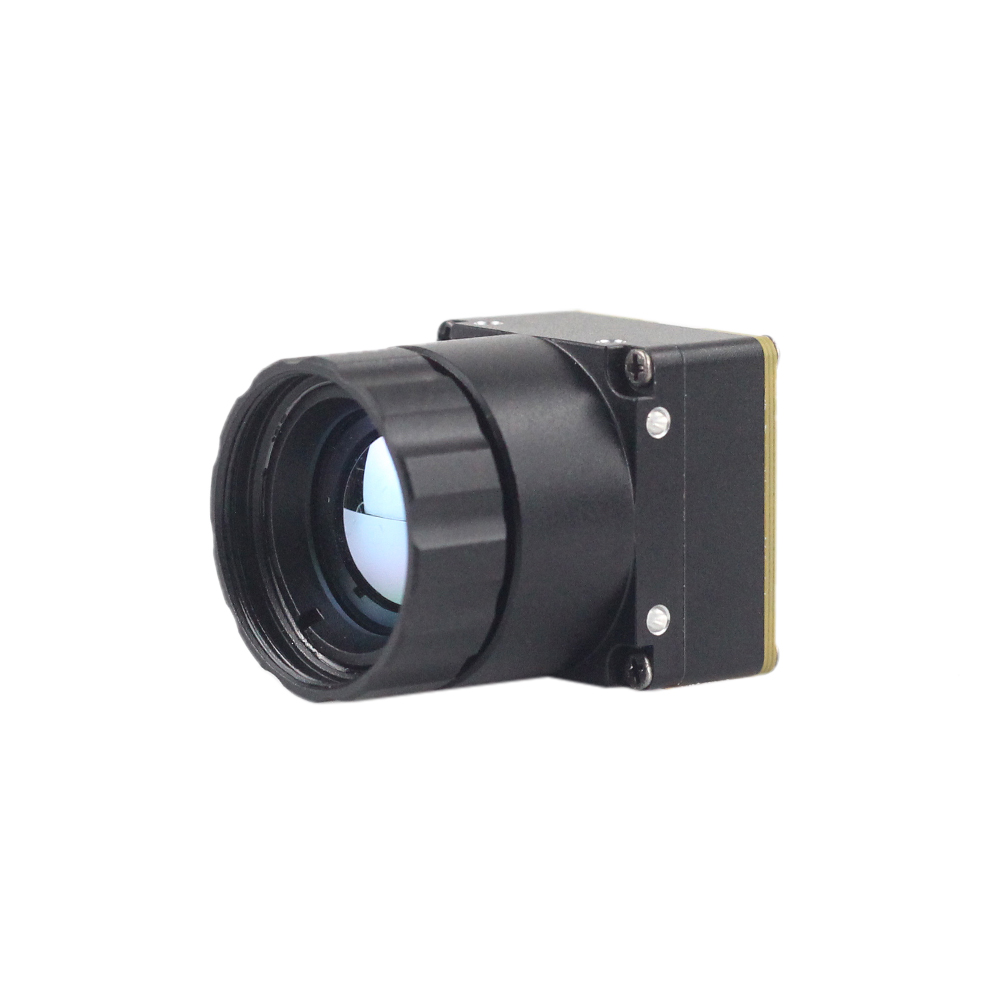
Mini 256 Uncooled LWIR Thermal Camera Module
The Uncooled LWIR Mini 256*192 Thermal Imaging Camera Module packs a high-performance imaging core into an ultra-compact footprint designed specifically for micro-UAS platforms, compact rifle sights, and tactical defense payloads such as surface mine and unexploded ordnance detection. Designed to match the form factor and field performance seen on high-end enterprise thermal drones, the Mini 256 uses advanced uncooled VOx infrared detectors for ultra-clear thermal imaging and precise temperature measurement. It captures ambient long-wave infrared radiation and outputs an exceptionally uniform thermal image complete with per-pixel radiometric temperature data.
- ✅ Resolution & Pitch: 256×192 active array, 12 µm high-sensitivity VOx microbolometer.
- ✅ Thermal Sensitivity: NETD ≤ 40 mK at f/1.0, 25°C.
- ✅ Form Factor & Mass: Ultra-miniaturized bare-board footprint weighing approximately 9 grams without optics.
- ✅ Power Consumption: Highly optimized low-power electronics consuming under 0.8 W at 3.3V–5.0V DC.
- ✅ Radiometric Support: Real-time temperature measurement across -20°C to +150°C with ±2°C accuracy.
- ✅ Primary Applications: Mine and IED detection, robotic obstacle avoidance, personal thermal scopes, and micro-FPV drones.
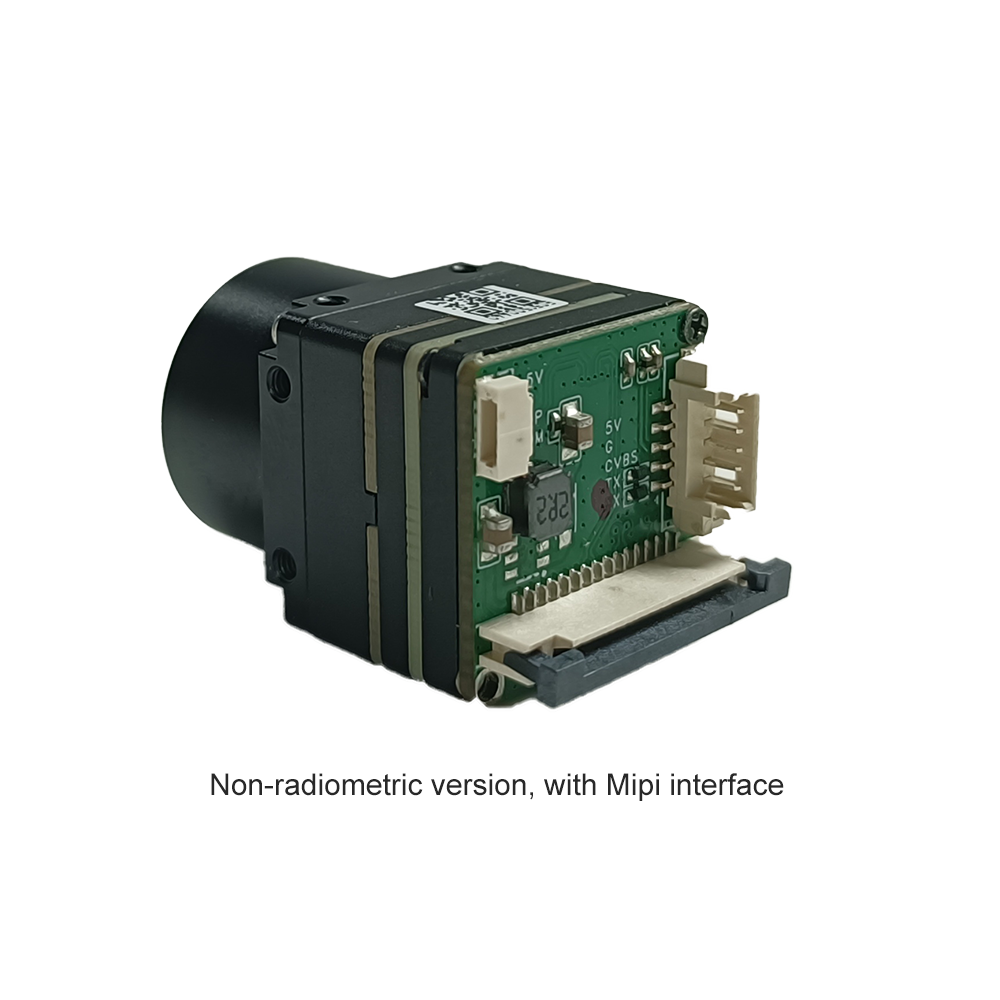
Mini2 640x512 9mm Thermal Imaging Camera Module For Drones
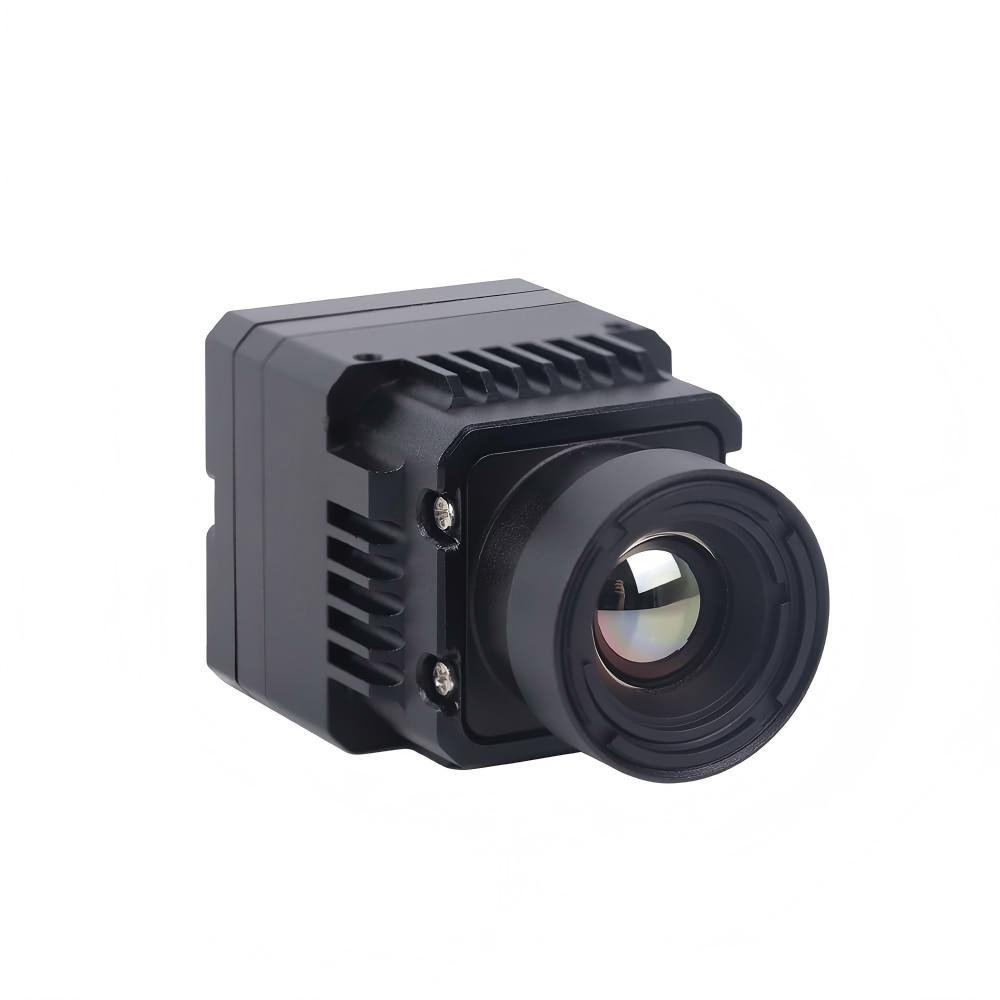
The Uncooled Infrared Mipi 640 384 256 9mm Thermal Imaging Camera Module For Drones is Purpleriver's premier aerial imaging solution. Offering flexible resolution configurations (native 640×512, with scalable binning options for 384×288 and 256×192), this core comes integrated with a factory-aligned, athermalized 9mm optical lens assembly engineered specifically for enterprise drone gimbals. The Mini2 uncooled infrared thermal imaging module features sharp and crisp image presentation, an exceptionally compact size, and low volume manufacturing cost. Native support for high-bandwidth MIPI-CSI2 interfaces alongside standard USB and analog outputs gives your engineering team immediate plug-and-play compatibility with modern edge-computing AI boards.
- ✅ Resolution & Pitch: Native 640×512 pixels with 12 µm pixel architecture.
- ✅ Optics: Integrated 9mm athermalized Germanium lens delivering an expansive wide field-of-view for search and rescue or situational reconnaissance.
- ✅ Thermal Sensitivity: NETD ≤ 35 mK to 40 mK at f/1.0.
- ✅ Interface Pipeline: Native hardware MIPI-CSI2 (D-PHY), USB 3.0 UVC driverless streaming, and zero-latency CVBS analog video.
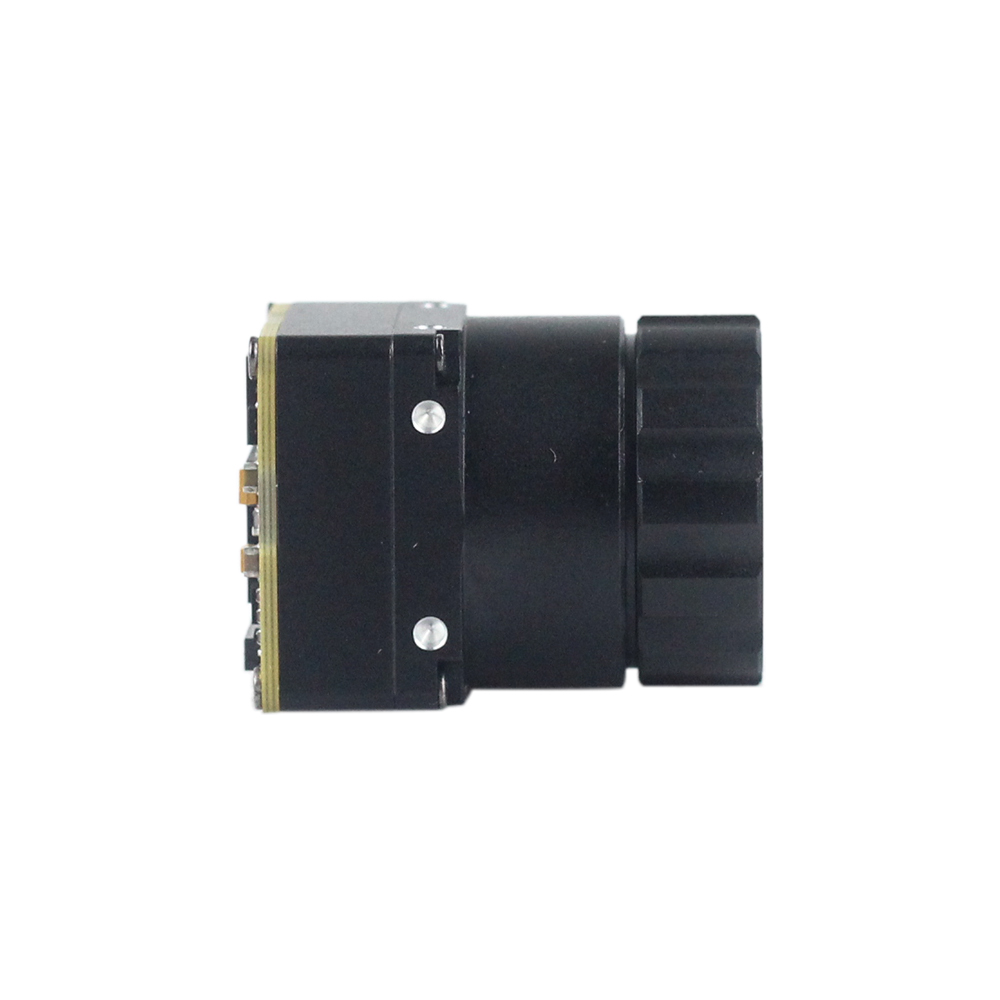
- ✅ Structural Footprint: Engineered for direct micro-gimbal mounting, weighing approximately 15 grams complete with the 9mm optical assembly.
- ✅ Primary Applications: Enterprise drone gimbal payloads, aerial utility inspection, border security, wildlife surveying, and automated SAR.
| Parameter | Mini 256 Uncooled LWIR Core | Mini2 640x512 Drone Module |
|---|---|---|
| Active Resolution | 256 × 192 pixels | 640 × 512 pixels (Scalable to 384/256) |
| Detector Architecture | Vanadium Oxide (VOx) Microbolometer | Vanadium Oxide (VOx) Microbolometer |
| Pixel Pitch | 12 µm | 12 µm |
| Spectral Range | 8 µm to 14 µm (LWIR) | 8 µm to 14 µm (LWIR) |
| NETD (Sensitivity) | ≤ 40 mK @ f/1.0, 25°C | ≤ 35 mK – 40 mK @ f/1.0 |
| Frame Rates | 25 Hz / 50 Hz | 25 Hz / 30 Hz / 50 Hz |
| Standard Optical Setup | Custom athermalized fixed-focus mounts | 9mm athermalized wide-FOV drone lens |
| Interface Ports | USB (UVC) / UART / Digital Raw | Native MIPI-CSI2 (2-lane), USB UVC, CVBS |
| Radiometric Accuracy | ±2°C or ±2% of reading | ±2°C or ±2% (Full dynamic range) |
| Operating Power | 3.3V – 5.0V DC, < 0.8 W | 3.3V – 5.0V DC, ≤ 1.0 W |
| Module Weight | Approx. 9 grams (bare-board) | Approx. 15 grams (with 9mm lens) |
6. Bulk Order Quality Assurance, MTBF Verification, and Supply Chain Risk Mitigation
Executing a thermal camera module bulk order—whether you're ordering a 100-piece pilot run or signing off on an annual delivery schedule for 10,000 cores—introduces production risks that never show up during single-board desktop testing. Semiconductor yield rates, vacuum seal integrity over years of field storage, Mean Time Between Failures (MTBF), and mechanical fatigue under continuous vibration determine whether your integration rollout thrives or crashes in the field.
Every single mass production lot follows a strict verification pipeline. Semiconductor dicing of the microbolometer wafer leads into laser vacuum-seal integrity auditing. Surface Mount Technology (SMT) lines populate the multi-layer rigid-flex boards. Assembled modules enter thermal shock environmental chambers cycling across operational limits (-40°C to +85°C), before undergoing automated multi-point blackbody calibration. Dynamic multi-axis vibration testing verifies mechanical solder joints and optical alignment, followed by final serialized logging.
Wafer-Level Packaging (WLP) vs. Hermetic Metal Can Packaging
Maintaining the internal vacuum around the microbolometer die is the absolute most critical factor governing long-term sensitivity and operating life. If the vacuum envelope fails, atmospheric gas molecules leak in and conduct heat directly to the pixel bridges, completely destroying your NETD sensitivity. When planning volume procurement, you need to match your packaging method to the operational mission:
- ✅ Wafer-Level Packaging (WLP): In WLP manufacturing, an entire semiconductor wafer carrying hundreds of microbolometer FPAs is vacuum-bonded to an infrared-transmissive silicon cap wafer inside an ultra-clean vacuum chamber. The bonded sandwich is diced into individual sensor chips. WLP yields dramatic size and weight reductions while drastically cutting fabrication costs on high-volume runs. It represents the standard for commercial UAS, consumer robotics, and compact handheld optics.
- ✅ Hermetic Metal Can Packaging: The microbolometer die is wire-bonded into a robust ceramic or metallic tub backed by an internal sintered chemical getter that traps gas molecules over decades of service, then vacuum-sealed with a Germanium window. While heavier and more expensive, metal can packaging provides the ruggedness needed for defense programs, aerospace platforms, and extreme MIL-STD multi-decade lifespans.
For European defense and security integrators evaluating extreme low-light optical performance in field operations, detailed test records can be examined in our engineering guide on kamera termowizyjna przenikliwe oczy w ciemna noc. To review our centralized component inventory and international logistics fulfillment hubs, browse our компоненты магазина тепловизионных модулей.
Environmental Stress Screening (ESS) & Reliability Auditing
To eliminate infant mortality across bulk shipments, every Purpleriver OEM manufacturing lot undergoes rigorous Environmental Stress Screening:
- ⚙️ Thermal Shock Profiling: Production cores undergo extreme thermal cycling between -40°C and +85°C with rapid transition rates. This weed out micro-fractures in SMT solder joints, adhesive outgassing near internal optics, or coefficient of thermal expansion (CTE) mismatches between lens barrels and sensor mounts.
- ⚙️ MIL-STD-810H Vibration Profiling: Uncooled cores are secured to multi-axis electrodynamic shakers and subjected to sinusoidal and wideband random vibration sweeps (20 Hz to 2,000 Hz reaching 6.06 grms). This replicates years of brutal drone motor harmonics, piston engine vibration, and tracked military transport.
- ⚙️ Automated Bad-Pixel Replacement Auditing: Microbolometers can develop blinking or drifting pixels under high thermal and mechanical shock. Automated machine vision stations test every sensor, ensuring dead pixels are mapped, isolated, and interpolated using neighboring pixel matrices in non-volatile flash, delivering 100% cosmetic and functional compliance upon receipt.
7. Deep-Dive Technical FAQ Section
How do these thermal camera modules handle real-time low-latency streaming on platforms like Raspberry Pi or Jetson?
Purpleriver OEM cores are built entirely around low-latency embedded pipelines. Connecting over native 2-lane MIPI-CSI2 to an NVIDIA Jetson (Nano, Orin NX, AGX) or Raspberry Pi CM4/CM5 pushes raw thermal packets straight into system Direct Memory Access (DMA) ring buffers. Using our production-grade Linux V4L2 drivers and lean C++ SDKs, glass-to-memory latency stays locked between 10 ms and 30 ms. The host CPU gets unbroken 14-bit radiometric Kelvin streams or pre-mapped YUV video at full 25Hz, 30Hz, or 50Hz refresh rates, giving you rock-solid deterministic timing for collision avoidance, automated target recognition, and rapid gimbal stabilization.
What ensures image consistency when scaling from single-unit testing to a bulk order?
Each module is clamped into automated robotic test stations inside climate-controlled chambers facing precision extended-area blackbody emitters traceable to national standards. The automated system stress-tests the array across wide ambient envelopes (-20°C to +60°C) and target scenes (-20°C to +150°C/550°C). Unit-specific gain matrices, two-point offset tables, bad-pixel maps, and polynomial curves are flashed directly to the core's on-board non-volatile memory. Automated optical collimation fixtures ensure that MTF, infinity focus, and optical centration match your exact mechanical tolerances. Whether you're ordering an initial run of 10 cores or scaling to a framework shipment of 5,000 units, every single camera outputs matching thermal data and spatial clarity out of the box.
Are these modules compact and lightweight enough for custom FPV builds and modular scopes?
For manual FPV piloting, our cores support native analog CVBS (NTSC/PAL) right alongside digital lines. The analog signal bypasses all frame and compression buffering to feed directly into standard 5.8 GHz analog video transmitters, delivering sub-5 ms latency for high-speed maneuvering around tight obstacles. Supported by precision athermalized optics ranging from wide-angle 9mm lenses to telephoto setups, you can drop these cores into aerodynamic drone pods or modular weapon optics without throwing off platform balance.
OEM Bulk Order Procurement Blueprint: Engineering Integration Process
To keep your program on schedule from initial design sign-off to full factory delivery, our applications engineering team runs a proven 5-stage qualification process for bulk accounts:
- ⚙️ Optical & Interface Alignment: Joint engineering review to nail down focal plane resolution (256×192 vs. 640×512), optical focal lengths (such as 9mm wide FOV), and low-level bus topologies (MIPI-CSI2, USB UVC, or CVBS).
- ⚙️ Evaluation Staging & SDK Bring-Up: Fast-track delivery of developer kits equipped with breakout testing boards, ribbon cabling, and full Linux/ROS kernel documentation.
- ⚙️ Mechanical & Thermal Path Verification: Reviewing structural CAD integration, confirming gimbal center of gravity, and designing passive conduction paths to host enclosures.
- ⚙️ Pilot Lot Validation: Pre-production run of 50 to 100 modules subjected to full environmental stress screening and calibration audits inside customer test jigs.
- ⚙️ Scheduled High-Volume Production: Full-rate production delivery backed by serialized calibration logs, rigorous QA documentation, and guaranteed long-term component availability.
Get in touch with our OEM engineering team today to review your project SWaP budget, request custom pinout documentation, and schedule sample evaluation kits for your integration bench.
📚 References & Further Reading
- Industry Standard: High-reliability interconnect systems and micro-pitch board-to-board solutions: Amphenol
- Industry Standard: Advanced embedded video conversion, serialization, and high-speed processing architectures: JM Chip
- Related Guide: Comprehensive optical resolving performance and Modulation Transfer Function analysis: Mini 640 Thermal Camera Module Performance Evaluation
- Related Guide: Operational documentation and night reconnaissance tactical capabilities: Kamera termowizyjna przenikliwe oczy w ciemna noc
- Related Guide: Industrial components catalog and global inventory distribution pathways: Компоненты магазина тепловизионных модулей