

AMG8833 Thermal Imaging Camera Array Module with USB Power: Is It Ready for Industrial Infrared Temperature Measurement?
2026年7月23日
Guide to Compact Thermal True IR Night Vision Camera Module with Built-in IR Illuminator
2026年7月27日
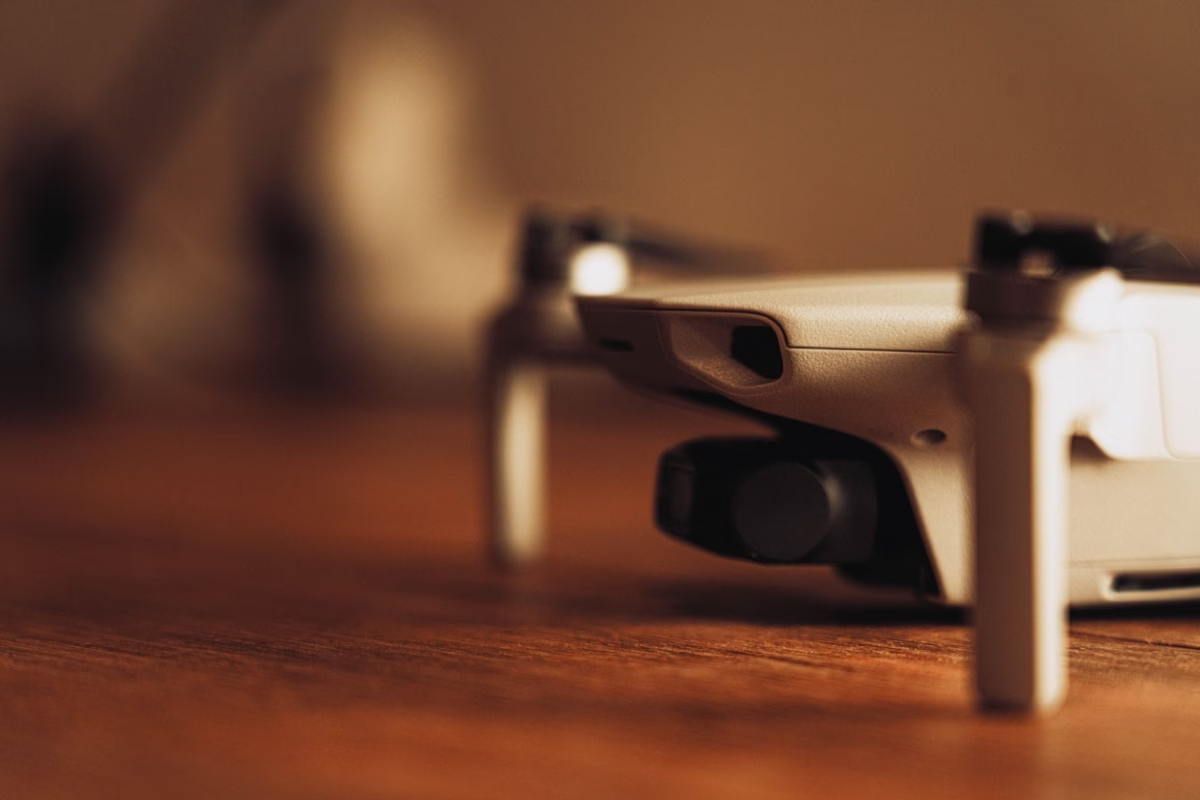
Uncooled Infrared MIPI 640 384 256 9mm Thermal Imaging Camera Module for Drones: The Ultimate Customization Guide
Look, in the unmanned aerial systems (UAS) world, Size, Weight, and Power (SWaP) isn't just a trendy design metric—it's the absolute law. If you're an OEM or payload integrator, you're constantly squeezed between two brutal demands: delivering crisp, zero-latency thermal feeds for automated flight and structural audits, while keeping the rig light enough to actually stay airborne. Here's the deal: routing raw thermal data straight through a native Mobile Industry Processor Interface (MIPI) Camera Serial Interface 2 (CSI-2) protocol right into your host edge processor changes the entire game. You eliminate the latency overhead, bypass signal conversion losses, and dump the extra hardware weight associated with clunky legacy analog or USB setups.
Consider this comprehensive guide your field-tested blueprint for integrating long-wave infrared (LWIR) microbolometer cores into next-gen drone platforms. Whether you're building lightweight 5-inch First-Person View (FPV) scouting rigs running 256x192 or 384x288 sensors, or industrial-grade inspection payloads pairing a high-res 640x512 array with a 9mm athermalized lens, we've laid out the optical, thermal, electrical, and algorithmic specs you need to streamline your build.
Table of Contents
- 👉 1. Sensor Resolution Architectures: Comparing 256, 384, and 640 Microbolometer Arrays
- 👉 2. The MIPI CSI-2 Protocol Advantage in Drone Payload Design
- 👉 3. 9mm Optical Lens Engineering for Tactical Drone Operations
- 👉 4. SWaP Optimization & Gimbal Integration for UAV Systems
- 👉 5. OEM Product Lineup & Specification Matrix
- 👉 6. Frequently Asked Questions (FAQ)
1. Sensor Resolution Architectures: Comparing 256, 384, and 640 Microbolometer Arrays
Picking the right LWIR microbolometer matrix is the first major fork in the road when configuring an uncooled thermal camera module. The spatial resolution of that microbolometer dictates your target detection range, image clarity, digital zoom headroom, processing workload, and total bill-of-materials (BOM) cost. Modern uncooled infrared cores use Vanadium Oxide (VOx) or Amorphous Silicon (a-Si) microbolometer focal plane arrays (FPAs) tuned to the 8 μm to 14 μm long-wave infrared band. In the shop, we almost always lean toward VOx for defense and heavy-duty industrial drones because of its higher Temperature Coefficient of Resistance (TCR), lower thermal noise, and long-term calibration stability.
1.1 Pixel Pitch, Spatial Resolution, and DRI Ranges
Moving from older 17 μm pixel setups down to modern 12 μm pixel pitch microbolometers drastically boosts optical efficiency while shrinking the payload's physical footprint. A tighter pixel pitch means you get a smaller focal plane array diameter for the exact same resolution class. That lets you drop lighter, smaller Germanium glass in front without cutting down your light-gathering aperture.
- ⚙️ 256x192 Array (49,152 Pixels): Tailor-made for micro-UAVs, close-quarters obstacle avoidance, and tight FPV pilot feeds. Paired with a 9mm lens, a 256x192 core gives you a ultra-compact system where wide situational awareness matters far more than fine thermal detailing.
- ⚙️ 384x288 / 384x256 Array (110,592 Pixels): The reliable workhorse for commercial mapping, ag scouting, and mid-range infrastructure audits. Packing more than double the pixels of 256-class sensors, it hits the sweet spot between spatial detail and compute requirements. For deep architectural strategies on wiring up 384-class cores, check out our engineering walkthrough on Thermal Module Camera Integration (384x288).
- ⚙️ 640x512 Array (327,680 Pixels): The premier choice for professional UAV thermal imaging, tactical ISR, search and rescue (SAR), and high-voltage grid audits. Delivering four times the spatial resolution of old 320x240 units, a 640x512 array mated to a 9mm wide-angle lens lets pilot operators map massive areas in a single flight leg while preserving enough pixel density to spot tiny thermal anomalies from safe standoff distances. For long-range surveillance requiring narrow fields of view, take a look at our technical breakdown of the 640x512 Thermal Camera Module with 35mm Optics.
When we calculate actual target acquisition in the field, we rely on Johnson’s Criteria. Your real-world detection distance hinges on target critical dimensions (d), effective optical focal length (f), sensor pixel pitch (p), and Instantaneous Field of View (IFOV):
IFOV = p / f
For p = 12 μm (0.012 mm) and f = 9 mm:
IFOV = 0.012 mm / 9 mm = 1.333 mrad (milliradians)
Theoretical Detection Distance (N = 1.5 cycles on target, d = 1.8 m human):
Range_detection = (d / (2 × N × IFOV)) = (1.8 / (2 × 1.5 × 0.001333)) ≈ 450 meters
When you run the math, a 640x512 sensor resolves target features at 2.5 times the distance of a 256x192 sensor using the exact same 9mm optical lens. That keeps your expensive drone hardware well out of harm's way when inspecting dangerous high-voltage lines or industrial stacks.
1.2 Thermal Sensitivity (NETD) and Frame Rate Optimization
Noise Equivalent Temperature Difference (NETD) is the core metric that defines your sensor's thermal resolution. Expressed in millikelvins (mK), NETD tells you the smallest temperature differential required to generate a signal-to-noise ratio (SNR) of one. Lower mK numbers translate directly to cleaner imagery and better contrast when tracking minute thermal signatures.
Our standard pro-grade drone thermal modules are rated at < 40 mK (tested at f/1.0, +30°C, 30Hz), while custom-tuned modules drop down below < 30 mK. High sensitivity is a lifesaver during low-contrast flight conditions—like overcast days, thick humidity, or late-night runs when scene temperatures equalize. A low mK rating gives onboard AI vision models crisp target edges despite heavy background clutter.
Frame rate tuning is just as critical once you get airborne. Running low frame rates (like 8.7Hz or 9Hz, often used to dodge EAR/ITAR export controls) introduces massive motion blur, shutter lag, and frame tearing during quick yaw maneuvers, gimbal pitches, or fast low-altitude passes. For smooth autonomous flight, fast target lock, and crisp FPV piloting, you want full-rate 25Hz, 30Hz, or 60Hz feeds. High frame rate, uncompressed 14-bit video lets image processing pipelines run spatio-temporal noise reduction without creating ugly ghosting artifacts. For a deeper dive into algorithmic tuning and high-sensitivity sensors, read our guide on Pro-Grade AI-Enhanced LWIR Modules.
2. The MIPI CSI-2 Protocol Advantage in Drone Payload Design
In the past, light drone builds relied heavily on old composite analog video (NTSC/PAL) or standard USB 2.0/3.0 links. Analog runs are notoriously vulnerable to high-frequency radio frequency (RF) interference spit out by high-power brushless motor Electronic Speed Controllers (ESCs) and video transmitters (VTX). That interference shows up as nasty static lines, horizontal tearing, and washed-out contrast. On the flip side, standard USB 2.0 links introduce messy frame buffering delays (40 ms to 120 ms) and hog host CPU overhead just to run OS driver stacks.
2.1 MIPI CSI-2 vs. USB 2.0/3.0 & Analog Video: Latency and Bandwidth
Moving to native MIPI CSI-2 (Camera Serial Interface 2) is a massive step forward for drone flight computer builds. Built specifically for high-speed mobile and embedded vision systems, MIPI CSI-2 operates as a point-to-point differential bus. It pushes data straight from the sensor's read-out integrated circuit (ROIC) directly into the application processor's direct memory access (DMA) engine.
Architectural Interface Comparison Matrix
| Metric / Parameter | Native MIPI CSI-2 | USB 2.0 / USB 3.0 UVC | Analog (NTSC / PAL) |
|---|---|---|---|
| Glass-to-Glass Latency | < 5 ms to 10 ms | 40 ms – 100 ms | 60 ms – 120 ms |
| Data Bandwidth Overhead | Zero Protocol Overhead (RAW14) | High USB Packet Encapsulation | Bandwidth Limited (< 0.4 MP) |
| Host CPU Utilization | < 1% (Direct Memory Access) | 15% – 35% (Driver Stack) | 10% – 20% (Frame Grabber) |
| Radiometric Precision | Full 14-Bit Uncompressed Digital Counts | Often Compressed to 8-Bit YUV | 8-Bit Analog Quantized Loss |
| EMI Immunity | Extremely High (Differential Pairs) | Moderate (Shielded Cable) | Very Poor (RF Ground Noise) |
The real winning factor with MIPI CSI-2 is how natively it handles raw 14-bit radiometric thermal feeds. In radiometric setups, every pixel value corresponds to an actual analog-to-digital converter (ADC) count linked directly to the infrared energy striking the sensor detector. By piping uncompressed 14-bit frames straight to your host processor over MIPI, you bypass image compression artifacts and dynamic range loss. That lets your onboard CPU execute real-time radiometric temperature measurements, auto gain control (AGC), dynamic histogram equalization, and custom palette mapping without bottlenecking.
When running flexible printed circuits (FPC) from the thermal core to your main processor board, make sure your layout team specifies low-profile, high-integrity board-to-board connectors—like those built by Hirose Electric—to keep your differential signals clean under vibration.
2.2 Direct Interface to Edge AI Processors (NVIDIA Jetson, Raspberry Pi)
Modern UAV builds increasingly rely on Edge AI to run local target classification, track thermal anomalies, and adjust flight paths autonomously without needing a ground link. MIPI CSI-2 modules plug right into the hardware CSI ports on standard System-on-Modules (SoMs):
- ⚙️ NVIDIA Jetson Orin Nano / Orin NX / AGX Orin: The native MIPI CSI-2 bus interfaces straight to Jetson’s hardware Image Signal Interface (NVCSI). Raw 14-bit thermal frames bypass CPU system memory entirely through CUDA Inter-Process Communication (IPC) zero-copy buffers. TensorRT-accelerated Deep Neural Networks (like YOLOv8, EfficientDet, or custom thermal segmentation models) process 640x512 thermal video inside GPU VRAM at frame rates over 60 FPS, giving you instant target identification for personnel or hot spots.
- ⚙️ Raspberry Pi Compute Module 4 (CM4) / Raspberry Pi 5: Using standard Unicam MIPI CSI-2 connections and Linux kernel drivers (V4L2 framework), developers can build low-cost, ultra-light search drones. Workflows using `libcamera` grab uncompressed raw pixel buffers to trigger local alerts, log GPS-tagged radiometric TIFFs, or trigger failsafe parachutes if on-board temps spike.
3. 9mm Optical Lens Engineering for Tactical Drone Operations
Designing optics for long-wave infrared is a completely different ballgame than dealing with visible light. Standard optical glass absorbs LWIR radiation (8 μm to 14 μm) like a brick wall. That means LWIR lenses must be ground from single-crystal Germanium (Ge), Chalcogenide glass, or Zinc Selenide (ZnSe). To handle harsh flight environments, these optical elements are treated with High-Efficiency Anti-Reflective (AR) or Diamond-Like Carbon (DLC) exterior coatings to resist atmospheric dust, wind erosion, and moisture exposure.
3.1 Field of View (FOV) Calculations Across Array Form Factors
A 9mm focal length lens sits right in the optical sweet spot for tactical drone operations. It offers a wide enough Field of View (FOV) for piloting while retaining the spatial clarity needed for target identification. You can calculate your total horizontal field of view ($\text{HFOV}$) using the active horizontal array dimension ($W$) and the effective focal length ($f = 9\text{ mm}$):
HFOV = 2 × arctan( W / (2 × f) )
Here is how a fixed 9mm LWIR lens behaves across the three common sensor resolutions using modern 12 μm pixels:
- 640x512 Array (W = 640 × 0.012 mm = 7.68 mm):
- ⚙️ $\text{HFOV} = 2 \times \arctan(7.68 / 18) \approx 46.2^\circ$
- ⚙️ $\text{VFOV} = 2 \times \arctan((512 \times 0.012) / 18) \approx 37.6^\circ$
- ✅ In the Field: Outstanding situational coverage. Flying at an altitude of 50 meters, a single frame captures a ground swath 42.6 meters wide—perfect for search-and-rescue sweeps and rapid solar panel mapping.
- 384x288 Array (W = 384 × 0.012 mm = 4.608 mm):
- ⚙️ $\text{HFOV} = 2 \times \arctan(4.608 / 18) \approx 28.6^\circ$
- ⚙️ $\text{VFOV} = 2 \times \arctan((288 \times 0.012) / 18) \approx 21.7^\circ$
- ✅ In the Field: Delivers a balanced, mid-range framing optimized for utility corridor inspections and localized facility checks.
- 256x192 Array (W = 256 × 0.012 mm = 3.072 mm):
- ⚙️ $\text{HFOV} = 2 \times \arctan(3.072 / 18) \approx 19.3^\circ$
- ⚙️ $\text{VFOV} = 2 \times \arctan((192 \times 0.012) / 18) \approx 14.6^\circ$
- ✅ In the Field: Narrower view best suited for forward-looking pilot navigation, close obstacle avoidance, or fixed tracking feeds on small airframes.
3.2 Athermalized Germanium Optics vs. Motorized Focus Mechanisms
Drones experience extreme temperature swings, often climbing from hot asphalt up into freezing air within minutes. Single-crystal Germanium has a massive refractive index temperature coefficient ($\frac{dn}{dT} = 3.96 \times 10^{-4} \text{ K}^{-1}$), meaning standard uncompensated optics go wildly out of focus as environmental temperatures drop.
To keep focus locked tight from -40°C to +80°C, hardware designers choose between two main barrel designs:
- ✅ Passively Mechanically Athermalized Lenses: These optical assemblies combine Germanium and Chalcogenide elements housed inside a dual-metal barrel pairing materials with opposing coefficients of thermal expansion (CTE)—typically high-grade Aluminum and Invar alloys. As thermal expansion occurs, the mechanical structure automatically compensates by shifting the lens elements the exact physical distance needed to hold the focal plane flat on the detector. Passive setup requires zero draw from your battery, zero driver software, introduces no lag, and has zero motors to fail in flight.
- ⚙️ Motorized Continuous Focus Assemblies: These use miniature stepper motors or voice-coil actuators to physically shift lens elements. While great for variable zoom, motorized focus units add noticeable weight, increase physical package size, pull current from the flight battery, and suffer from mechanical backlash under heavy airframe vibration. That's why fixed, passively athermalized 9mm prime lenses remain the go-to choice for low-SWaP builds.
4. SWaP Optimization & Gimbal Integration for UAV Systems
In aerospace payload engineering, every gram saved on hardware equals extra flight endurance, faster climb rates, or headroom for secondary sensors like LiDAR and rangefinders.
4.1 PCB Layout, Thermal Dissipation, and Miniature Footprints
Squeezing an uncooled LWIR core down to a tiny 21mm x 21mm PCB footprint takes tight, high-density multi-layer HDI board design. Here is how we manage it on the bench:
- ⚙️ Noise Isolation: Microbolometers measure temperature variations down to tiny fractions of a millikelvin. Parasitic heat or electrical noise from nearby switching regulators or processors can throw off sensor uniformity. We use split ground plane barriers to isolate sensitive analog bias lines from high-current switching nodes.
- ⚙️ Shutterless NUC Algorithmic Tuning: Older thermal cores relied on a noisy mechanical shutter that slammed closed periodically to recalculate pixel offsets, freezing video for half a second. Modern low-SWaP cores run shutterless algorithmic Non-Uniformity Correction (NUC). Onboard logic constantly monitors scene dynamics and internal thermal sensors to update gain matrices on the fly without interrupting your live video feed.
- ⚙️ Thermal Paths: While uncooled microbolometers consume very little power (typically < 0.8W to 1.2W), onboard FPGA/SoC processing generates localized heat. We pour heavy copper layers and place dense thermal via arrays beneath processing chips to dump heat out to the outer aluminum shell, keeping the focal plane stable.
For custom payload enclosures, rigid-flex PCB runs, and tight IPC-Class 3 surface-mount SMT assembly, we routinely collaborate with fabrication experts like Shenzhen ChiYi Electronics Co., Ltd..
4.2 Electromagnetic Shielding & Structural Integration
A drone airframe is an electrically noisy environment. Unshielded sensor boards sitting inches away from ESC switching lines, high-amperage power tracks, and multi-watt telemetry links will pick up severe RF interference, showing up as rolling horizontal bands across your thermal image.
To eliminate interference, we focus on two critical design steps:
- ⚙️ Full Metallic Enclosures: Enclosing the 21mm x 21mm core in a lightweight, CNC-machined 6061 aluminum housing acts as a Faraday cage. It isolates low-noise amplifiers and ADCs from RF noise while functioning as an integrated heatsink and rigid chassis.
- ✅ Gimbal Mass Balancing: Keeping core module mass under 25 grams cuts rotational inertia on 2-axis and 3-axis gimbals. Lighter payloads let you run smaller gimbal motors at reduced drive currents, cutting power draw and preventing gimbal motor heat from soaking back into the camera housing.
5. OEM Product Lineup & Specification Matrix
To help you pick the right hardware for your flight platform, here is a direct comparison of our primary uncooled thermal imaging camera cores built for drone payload integration.
| Specification / Model | Uncooled Infrared Mini2 640x512 9mm MIPI Module | Uncooled LWIR USB Mini 640x512 Core Module |
|---|---|---|
| Detector Type | Vanadium Oxide (VOx) Uncooled Microbolometer | Vanadium Oxide (VOx) Uncooled Microbolometer |
| Array Resolution | 640 × 512 Pixels (256 & 384 arrays available) | 640 × 512 / 640 × 480 Optional |
| Pixel Pitch | 12 μm | 12 μm |
| Spectral Response | 8 μm to 14 μm (LWIR) | 8 μm to 14 μm (LWIR) |
| Thermal Sensitivity (NETD) | < 40 mK (@ f/1.0, 30Hz, +30°C) | < 40 mK (@ f/1.0, 30Hz, +30°C) |
| Video Interface | Native MIPI CSI-2 (14-bit Uncompressed RAW Data Stream) | USB 2.0 / Type-C Direct Digital Output (UVC Compliant) |
| Optical Lens Configurations | 9mm Athermalized Germanium Optics | 5mm, 9mm, 13mm, 18mm, 35mm, 50mm, 75mm, 100mm, 150mm |
| Dimensions & Weight | 21mm × 21mm PCB Footprint (< 25 grams) | 21mm × 21mm PCB Footprint (< 30 grams) |
| Power Consumption | < 0.8W Operational | < 1.0W Operational |
| Target Applications | Embedded Edge AI, Jetson/RPi integration, tactical SAR, micro FPV platforms | Plug-and-play commercial inspection payloads, fast-turnaround UAV gimbals |
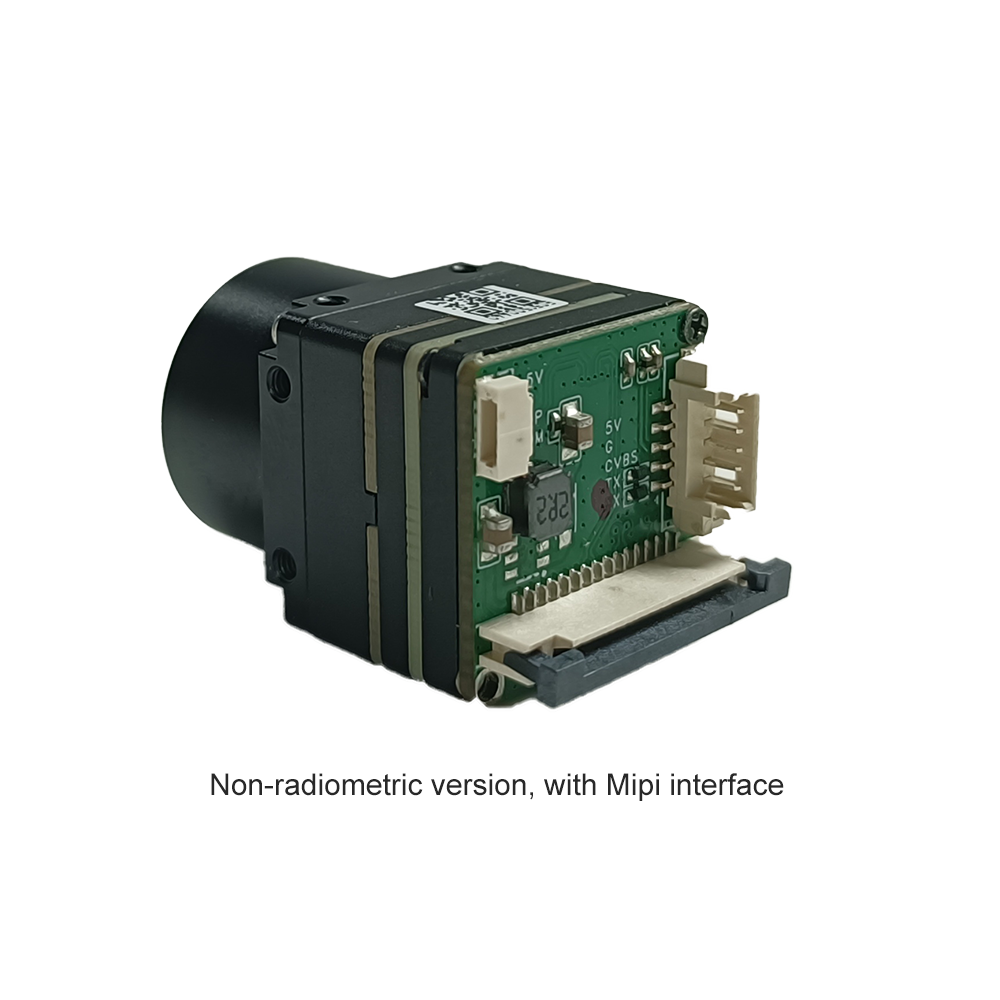
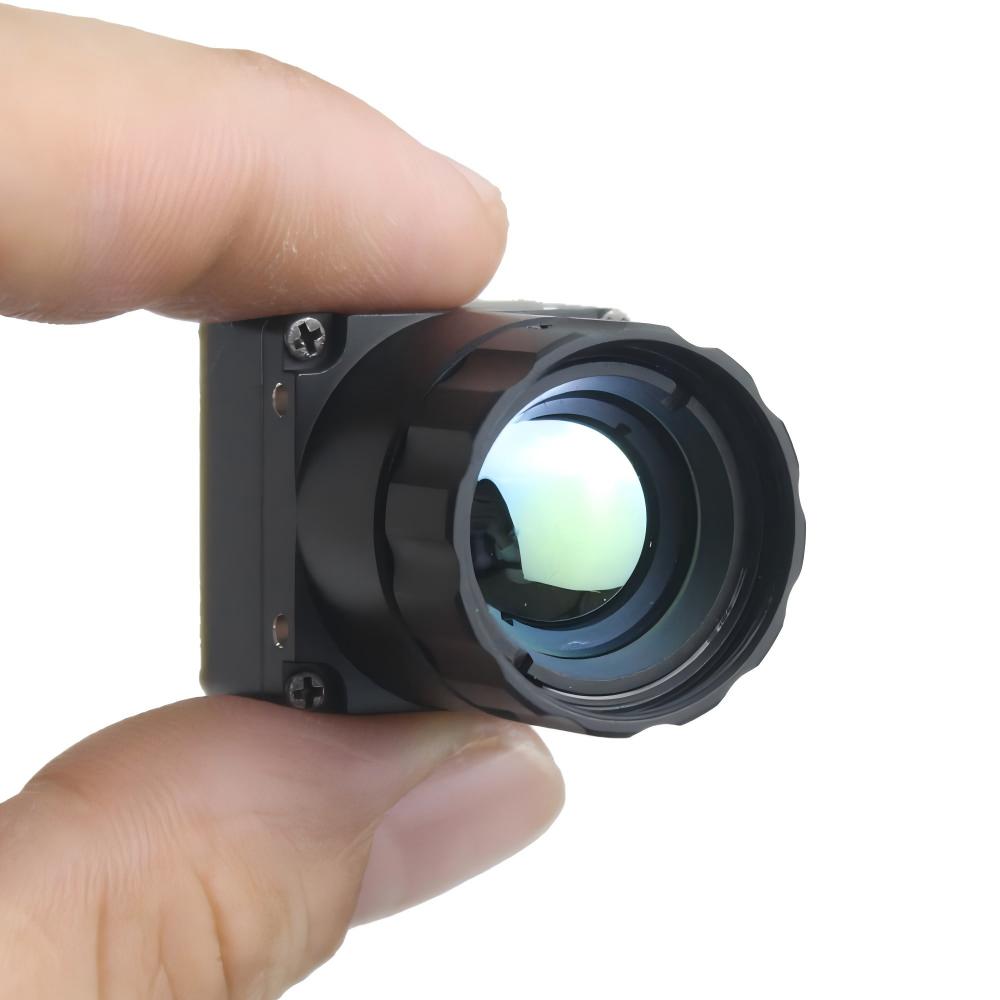
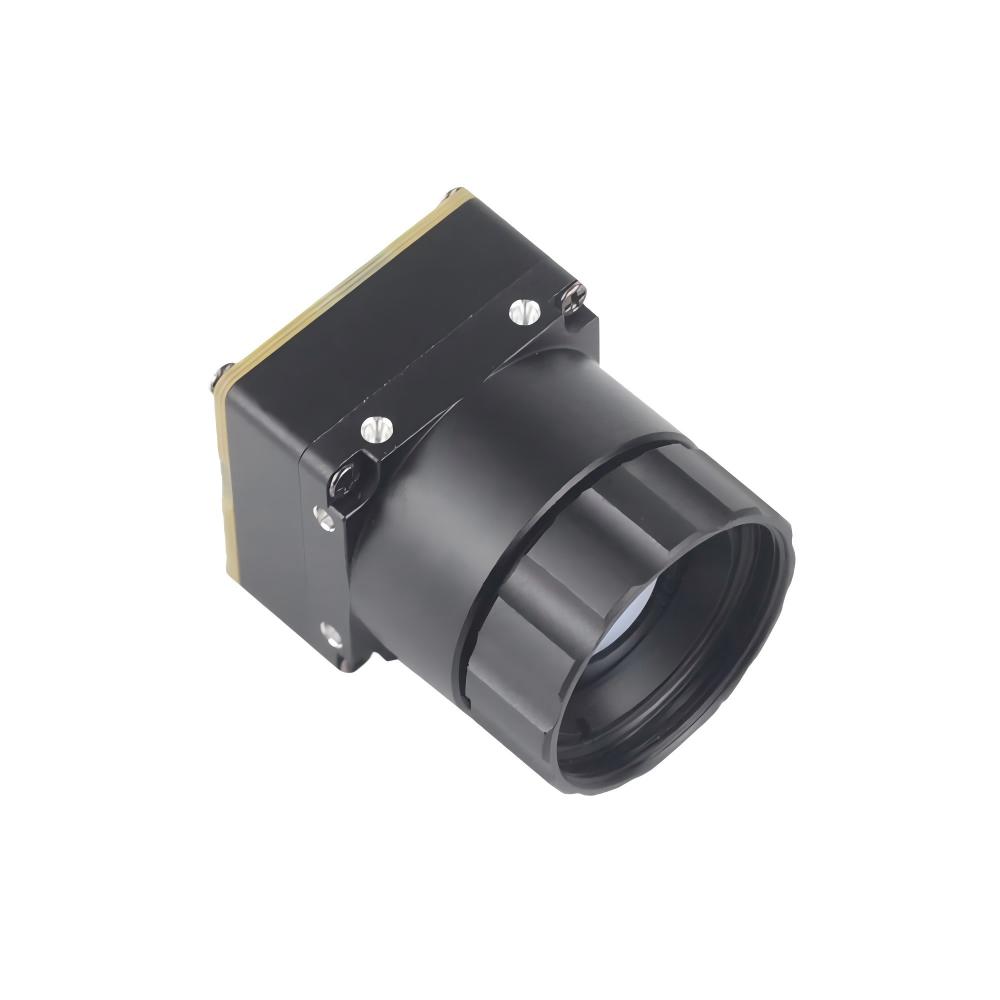
Uncooled Infrared Mini2 640x512 9mm Thermal Imaging Camera Module For Drones
The top-tier core for custom drone payload integration. Featuring a high-resolution 640x512 VOx sensor paired with a 9mm athermalized lens, this module outputs raw uncompressed 14-bit thermal video directly over native MIPI CSI-2. Designed for minimal power draw and ultra-low latency, it’s built specifically for Edge AI processing, tactical search-and-rescue, and high-altitude inspections.
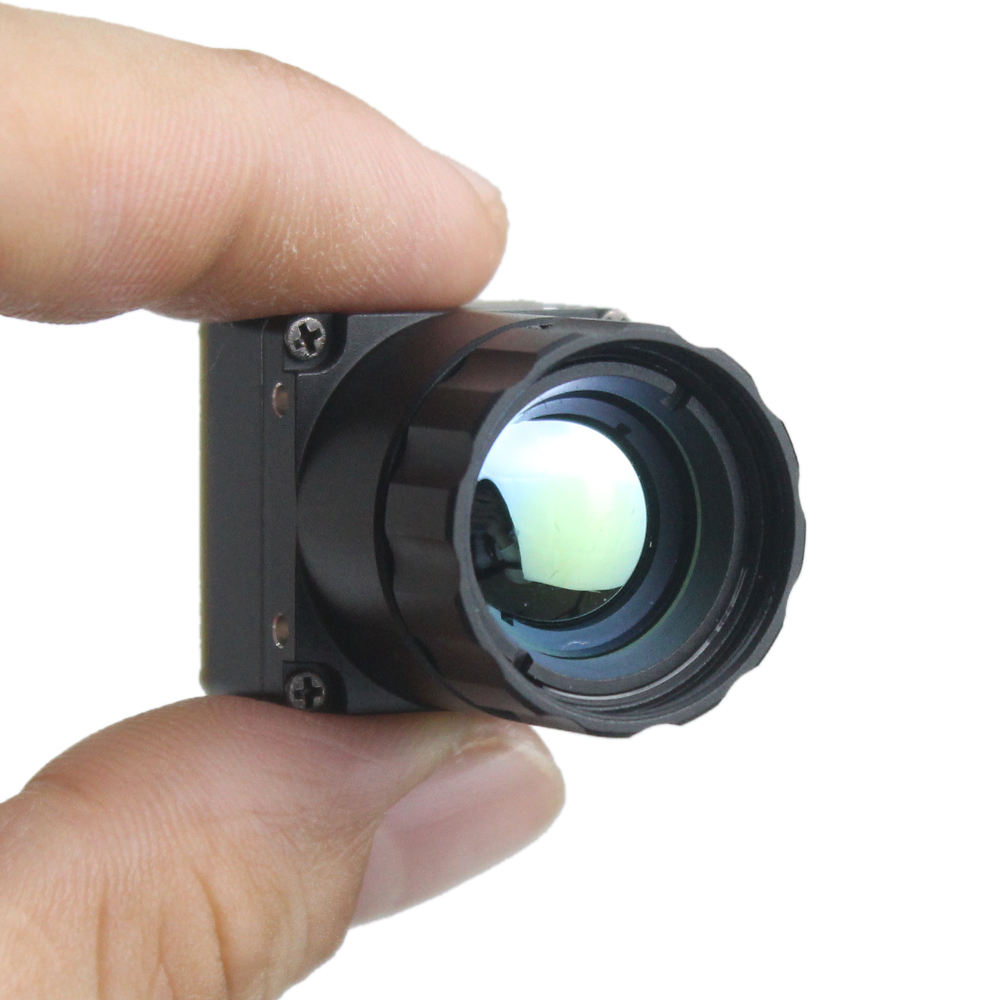
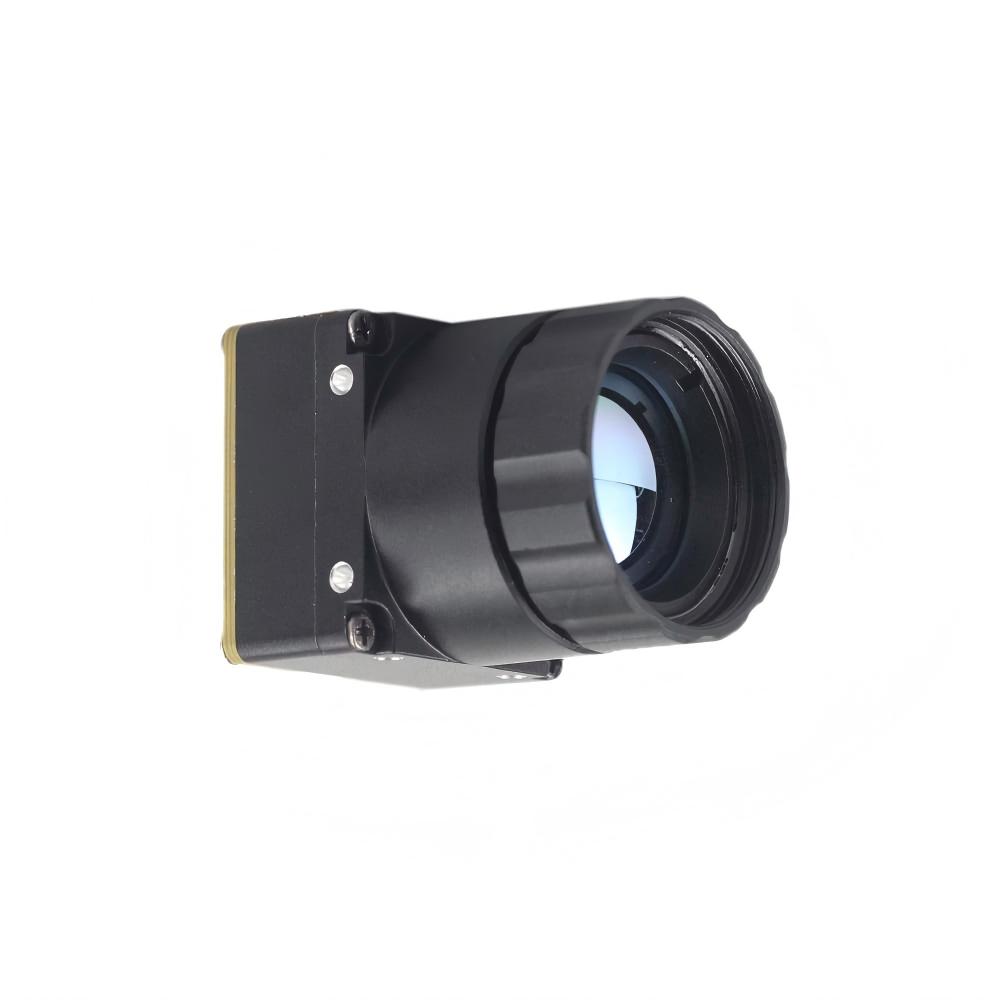
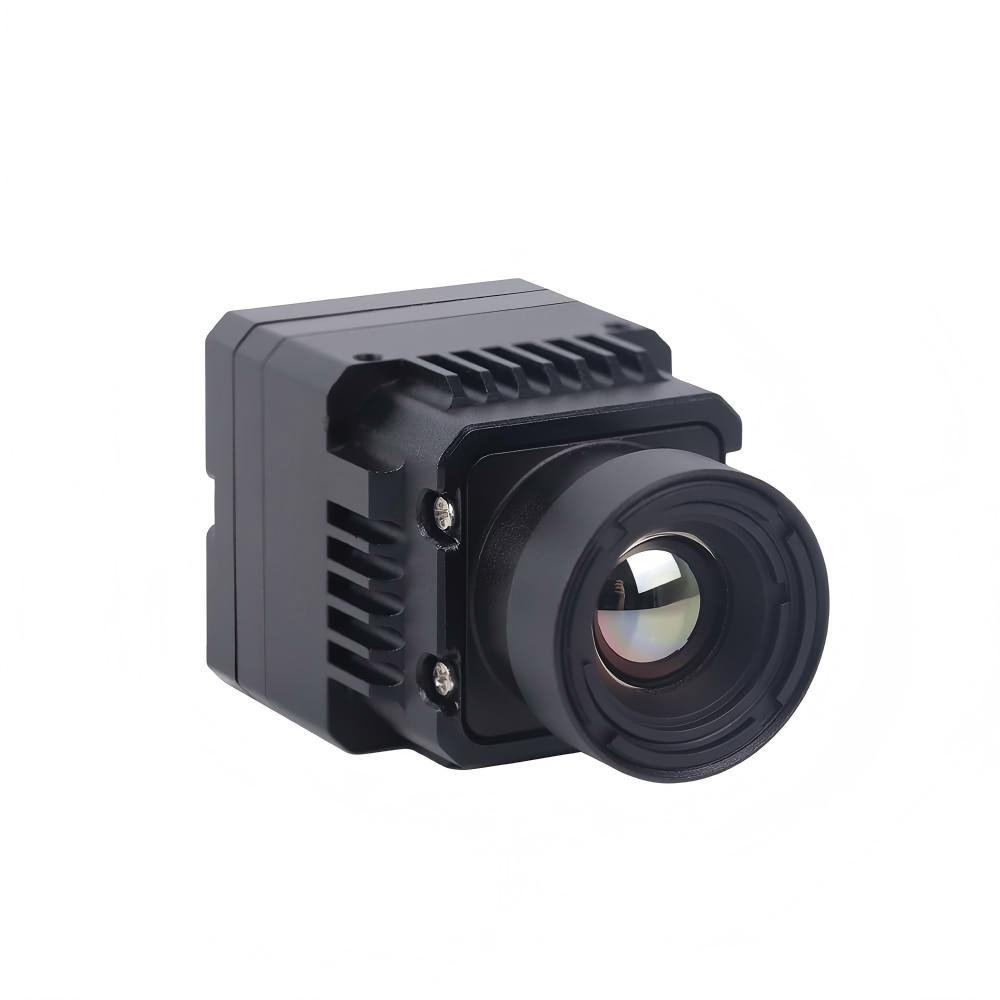
Uncooled LWIR USB Mini 640*512 Thermal Imaging Camera Core Module For Drones Similar To DJI
Engineered for fast commercial deployment and quick bench prototyping. Offers a tiny 21mm x 21mm footprint, multiple lens options from 5mm up to 150mm, and direct UVC-compliant USB output. High thermal stability and simple plug-and-play setup make it ideal for commercial gimbals and rapid engineering builds.
6. Frequently Asked Questions (FAQ)
What are the core technical trade-offs between 256x192, 384x288, and 640x512 thermal microbolometer resolutions for drone payloads?
A 384x288 sensor strikes a solid middle ground for commercial inspections and crop scouting, doubling the detail of basic cores. But for industrial missions—like powerline audits, search and rescue, or tactical scouting—640x512 is the industrial standard. Packing 327,680 individual pixels, a 640x512 array with a 9mm lens lets you fly higher and cover more ground safely while keeping enough clarity to feed real-time AI classification models.
How does the native MIPI CSI-2 interface lower latency and improve Edge AI processing compared to traditional USB thermal modules?
MIPI CSI-2 hooks straight into the hardware video input pins of processors like the NVIDIA Jetson or Raspberry Pi CM4. Frame data streams directly into RAM via zero-copy Direct Memory Access (DMA), dropping latency down under 10 milliseconds. Because MIPI preserves the raw, uncompressed 14-bit data, onboard GPUs or neural accelerators access pure radiometric numbers instantly, running target tracking and automated temperature checks at full frame rates.
Why is passive mechanical athermalization necessary for 9mm Germanium thermal drone lenses operating in extreme climates?
Motorized focus mechanisms can fix this, but they add weight, pull power from your flight battery, introduce mechanical failure points, and need custom software drivers. Passively athermalized barrels solve the issue mechanically. By combining optical elements with metal housings engineered from complementary expansion alloys (like Aluminum and Invar), the barrel physically expands or contracts to offset thermal shifts. That keeps your 9mm lens locked in focus from -40°C to +80°C without pulling a single milliwatt of power.
Is a 21mm x 21mm thermal camera core compact and lightweight enough for 5-inch FPV drone platforms and mini gimbals?
By using 12 μm VOx sensors and dense multi-layer board layouts, this core fits directly inside narrow airframe noses, 5-inch FPV scout builds, or mini 2-axis/3-axis gimbals. The minimal weight keeps payload inertia low, meaning your gimbal motors run cooler and pull less power, ultimately preserving flight time.
📚 References & Further Reading
- Precision Interconnect Standard: High-density, high-reliability board-to-board FPC connectors for embedded vision provided by Hirose Electric.
- Manufacturing & SMT Assembly: High-precision HDI PCB fabrication and surface-mount technology services by Shenzhen ChiYi Electronics Co., Ltd..
- Related Payload Integration Guide: Learn how to optimize 384x288 microbolometer integration strategies in our Ultimate Guide to Thermal Module Camera Integration (384x288).
- Long-Range Thermal Optics: Technical analysis on narrow FOV long-range thermal camera cores in our guide on Thermal Camera Module 640x512 with 35mm Optics.
- AI Sensor Enhancements: Exploring high-sensitivity, AI-assisted LWIR cores in our deep-dive on Pro-Grade AI-Enhanced LWIR Modules.